Safa Marwah
A significant security flaw identified in a prominent WordPress plugin designed for website migration and backup operations could enable unauthenticated adversaries to achieve remote code execution and subsequently seize full control of an extensive number of compromised web properties. The vulnerability, residing within a plugin boasting over five million active installations, represents a considerable threat to the integrity and security of a substantial portion of the internet’s most popular content management system. This critical defect underscores the persistent security challenges inherent in complex web ecosystems reliant on third-party extensions.
The identified vulnerability, cataloged as CVE-2026-19949, has been assigned a high-severity rating, reflecting its potential for severe impact. Its discovery is attributed to security researcher Jack Taylor, who responsibly disclosed the flaw to Defiant’s cybersecurity division, Wordfence, in mid-August. Wordfence’s subsequent analysis, released recently, confirmed that CVE-2026-19949 is a second-order SQL injection vulnerability affecting versions of the "All-in-One WP Migration and Backup" plugin up to and including 7.109. This particular class of SQL injection is insidious as it does not immediately manifest but rather leverages a delayed execution mechanism, often triggered by a subsequent, seemingly innocuous action.
At its core, the exploit hinges on the plugin’s flawed handling of escaped backslashes and quotation marks during the critical process of rewriting database content when a backup archive is restored. This parsing deficiency creates an avenue for malicious data to be surreptitiously introduced into the database. Specifically, an unauthenticated attacker can embed specially crafted data through standard WordPress trackbacks. This seemingly benign data payload remains dormant within the site’s database until an administrator performs a site export and subsequent import—operations that are central to the plugin’s intended functionality and are routinely undertaken by website managers.
The sophisticated nature of this attack chain involves several stages. Once the crafted data is injected via trackbacks, it lies in wait. When an administrator initiates the restoration of a backup archive, the plugin begins to process the stored database content. During this process, the previously injected SQL payload, which exploits the incorrect parsing of string boundaries, is executed. This execution allows the attacker to exfiltrate sensitive information, specifically the plugin’s secret import key (designated ai1wm_secret_key), which can be exposed through a publicly accessible comment section or other visible database output. With this key in hand, the attacker gains the ability to import a specially prepared .wpress archive. Such an archive can be meticulously constructed to contain arbitrary executable code, which, upon import by the legitimate administrator, grants the attacker complete control over the target website. The ability to execute arbitrary code at this privilege level is the penultimate step to a full site takeover, enabling a wide array of malicious activities.

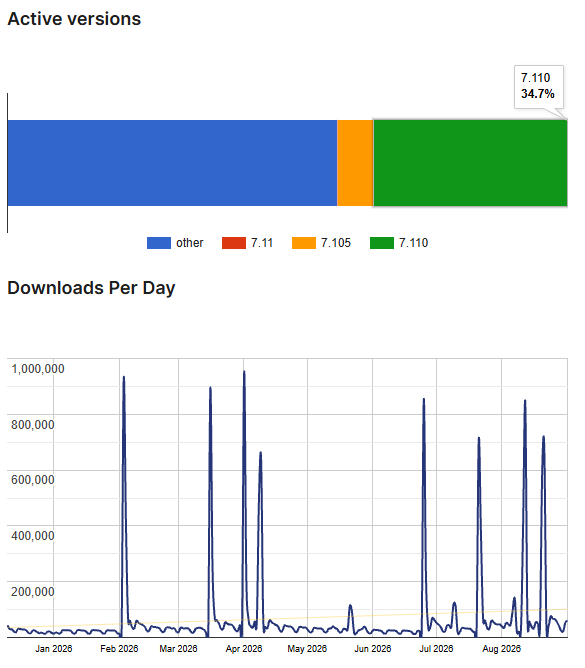
The scale of potential impact is staggering. According to official statistics from WordPress.org, the "All-in-One WP Migration and Backup" plugin currently boasts more than five million active installations globally. This widespread adoption means that a vulnerability of this magnitude could expose millions of websites, ranging from personal blogs to large corporate portals and e-commerce platforms, to severe compromise. While the vendor promptly addressed the issue with the release of version 7.110, the update statistics paint a concerning picture. As of recent reports, only approximately 35% of the plugin’s user base has migrated to the patched version. This leaves an alarming 3.25 million-plus websites still operating vulnerable iterations of the "All-in-One WP Migration and Backup" plugin, representing a massive attack surface for threat actors.
The fact that the exploit requires an administrator action to trigger its final payload does not significantly diminish its severity, though it does introduce a temporal delay. Wordfence researchers emphasize that, given the core purpose of the plugin—backup and restoration—these administrative actions are not exceptional but rather routine and expected. Website administrators frequently perform exports, imports, and migrations as part of regular maintenance, staging environment updates, or disaster recovery procedures. Therefore, while not an immediate, drive-by compromise, the likelihood of an administrator eventually performing the necessary action to trigger the exploit remains extremely high. The researchers further caution that even a deactivated vulnerable version of the plugin poses a latent risk, as it can still be exploited if temporarily reactivated, perhaps during a troubleshooting or migration process.
The disclosure timeline reflects a responsible approach to vulnerability management. Jack Taylor’s initial finding was reported in mid-August, with Wordfence validating the discovery and subsequently disclosing the issue to ServMask, the developers behind the "All-in-One WP Migration and Backup" plugin, on August 15. ServMask acted swiftly, releasing version 7.110, which contained the fix for CVE-2026-19949, on August 20. This rapid response from the vendor is commendable, highlighting the importance of a well-defined vulnerability disclosure and patching process. However, the subsequent slow rate of user adoption of the patch remains a critical concern, creating a significant window of opportunity for attackers.
The implications of such a widespread vulnerability are far-reaching. A successful takeover of a WordPress site can lead to numerous detrimental outcomes. Attackers could inject malware into the website, infecting visitors or redirecting them to malicious domains. They might deface the site, damaging brand reputation and user trust. E-commerce sites could be exploited for payment card skimming, leading to financial fraud and regulatory penalties. Personal data stored in the database could be exfiltrated, resulting in data breaches and compliance violations. Furthermore, compromised sites can be leveraged as part of larger botnets for distributed denial-of-service (DDoS) attacks or for distributing spam and phishing campaigns, turning legitimate websites into tools for further cybercrime. The economic fallout for affected businesses could include loss of revenue, remediation costs, legal fees, and irreparable reputational damage.
This incident serves as a stark reminder of the inherent security risks associated with the extensive use of third-party plugins and extensions in popular content management systems like WordPress. While plugins provide immense functionality and flexibility, each one represents a potential entry point for attackers if not developed and maintained with stringent security practices. The WordPress ecosystem, with its vast array of developers and varying levels of security expertise, is particularly susceptible to such vulnerabilities.
For website administrators, the immediate and most critical action is to update the "All-in-One WP Migration and Backup" plugin to version 7.110 or higher without delay. This proactive measure is paramount to safeguarding their digital assets. Beyond immediate patching, this event underscores the necessity for a robust and continuous cybersecurity posture. This includes:
- Regular Software Updates: Implementing a disciplined schedule for updating all WordPress core files, themes, and plugins. Automated updates, where feasible and safe, can help reduce the window of vulnerability.
- Comprehensive Backup Strategies: While ironic given the nature of the vulnerable plugin, maintaining multiple, redundant backups stored securely off-site remains crucial for disaster recovery.
- Web Application Firewalls (WAFs): Deploying a WAF can provide an additional layer of defense by filtering malicious traffic and potentially blocking exploit attempts even against unpatched vulnerabilities.
- Security Audits and Monitoring: Regularly auditing website security settings, user accounts, and monitoring for suspicious activity can help detect compromises early.
- Principle of Least Privilege: Ensuring that all users and plugins operate with the minimum necessary permissions to perform their functions.
- Vulnerability Scanning: Employing tools to regularly scan for known vulnerabilities in plugins and themes.
Looking ahead, the ongoing challenge of securing the WordPress ecosystem will necessitate continued collaboration between security researchers, plugin developers, and website administrators. Developers must adopt more rigorous secure coding practices, implement thorough security testing, and respond promptly to reported vulnerabilities. Website owners must prioritize security as an integral part of their operational strategy, understanding that a single vulnerable component can jeopardize their entire online presence. The persistent gap between patch availability and widespread adoption highlights a significant hurdle in the collective effort to enhance global cyber resilience, emphasizing the need for better awareness campaigns and more streamlined update mechanisms across the web. This incident, therefore, is not merely a technical report but a critical case study in the evolving landscape of web application security and the shared responsibility required to defend against pervasive digital threats.




 Lisa Mariana
 Aura Kasih
 Ayu Aulia