
 Ayu Aulia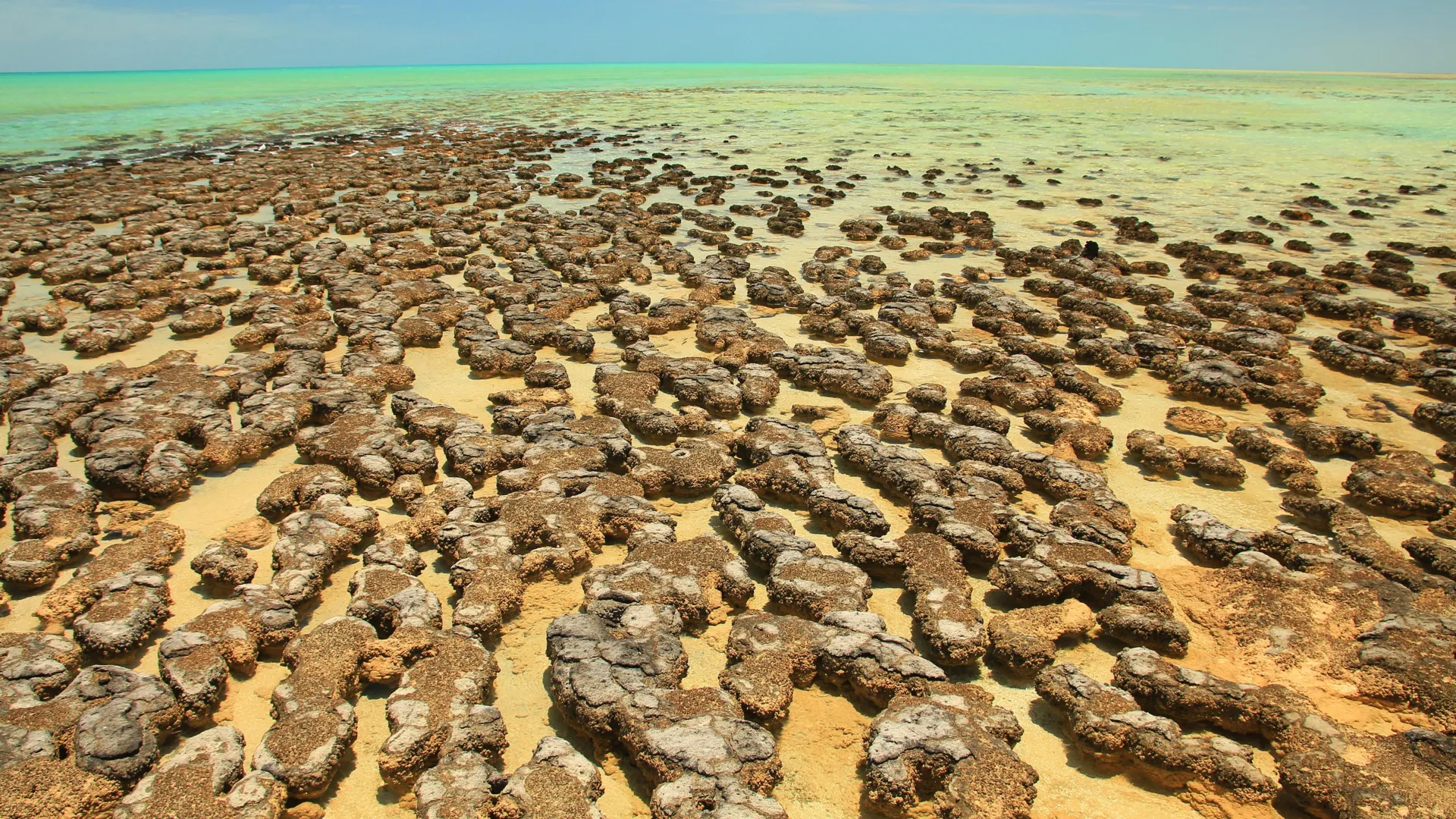
Within the seemingly inert layers of ancient stromatolites and their microbial mat counterparts lies a profound biological narrative, a densely packed chronicle of microscopic communities that once profoundly reshaped Earth’s early atmosphere. A recent investigation now posits that these "living fossils" may also harbor critical evidence elucidating one of biology’s most enduring mysteries: the seminal emergence of complex life forms from simpler cellular progenitors. This groundbreaking research, published in Current Biology, provides unprecedented insights into the potential mechanisms that underpinned the most significant evolutionary transition in Earth’s history.
For billions of years, preceding the diversification of macroscopic flora and fauna, stromatolites played an instrumental role in terraforming our planet. These laminated, lithified structures, meticulously constructed by successive layers of microorganisms, were prodigious producers of oxygen, gradually enriching the early atmosphere and paving the way for aerobic respiration and the subsequent evolution of more complex organisms. Their continued existence in rare, specialized environments today offers a unique, living window into the primeval conditions of early Earth, making them invaluable subjects for scientific inquiry.
A collaborative research endeavor, co-led by Associate Professor Brendan Burns, an evolutionary microbiologist at UNSW Sydney, alongside colleagues from the University of Technology Sydney and The University of Melbourne, has uncovered a previously undocumented microbial species coexisting in intimate association within these ancient formations. This discovery is not merely an addition to the taxonomic record; it represents a tangible model for understanding how rudimentary cells might have initiated cooperative relationships, ultimately culminating in the highly integrated and structurally elaborate cells that constitute all multicellular life, including humanity. Associate Professor Burns emphasizes the profound implications, stating that stromatolites might transcend their recognized role as mere cradles of early microbial life, potentially revealing the very genesis of complexity itself.
A Microscopic Partnership with Deep Evolutionary Roots
Stromatolites and microbial mats, though originating billions of years ago, are not relics confined to the fossil record. They persist in select locations globally, with one of the most prominent examples being Shark Bay, a UNESCO World Heritage site situated in Western Australia. This unique environment, characterized by hypersaline waters and extreme conditions, provides a modern analogue for the early Earth, allowing scientists to study these ancient ecosystems in a contemporary context.
Samples meticulously collected from Shark Bay provided the foundation for the research team’s isolation of a particular lineage of archaea, identified as a member of the enigmatic Asgard archaea superphylum. This group holds immense significance in evolutionary biology due to its hypothesized close phylogenetic relationship to the last eukaryotic common ancestor (LECA). Eukaryotes, characterized by their complex internal membrane-bound organelles, including a nucleus and mitochondria, encompass all plants, animals, fungi, and protists.
A prevailing hypothesis in evolutionary biology, known as the endosymbiotic theory or eukaryogenesis, posits that the inaugural eukaryotic cell arose from an ancient, symbiotic partnership between an archaeon and a bacterium. According to this model, one organism eventually engulfed the other, with the ingested bacterium evolving into the mitochondria—the crucial energy-generating organelles within eukaryotic cells. While compelling genetic and biochemical evidence supports this theory, direct empirical observation of what such an incipient partnership might have resembled has remained elusive. The present study addresses this lacuna by providing the first visual evidence of an Asgard archaeon engaging in direct physical interaction with a bacterium via remarkably fine, tubular structures termed nanotubes. This visual confirmation offers a compelling "little model," as Associate Professor Burns describes it, for the initial stages of these pivotal evolutionary partnerships.
Years of Pursuit: Cultivating the Elusive Microbe
Despite the detection of the organisms’ DNA through genetic sequencing of the environmental samples, the task of cultivating these microbes in a controlled laboratory setting for direct study proved to be a formidable challenge. Associate Professor Burns recounts a multi-year effort, spanning "four or five years," involving extensive optimization and the pursuit of numerous experimental dead ends.
Asgard archaea are notoriously difficult to culture ex situ, a characteristic that often reflects their highly specialized ecological niches and intricate interdependencies. Crucially, the researchers were unable to grow the identified Asgard archaeon in isolation. This inherent difficulty, as Associate Professor Burns suggests, likely provides a significant biological clue: "The fact that we could never get these organisms into pure culture is probably because they always depend on other organisms to survive." This obligate interdependence underscores the very essence of the symbiotic relationships being investigated.
Overcoming these cultivation hurdles necessitated the deployment of advanced imaging technologies. The research team eventually achieved significant breakthroughs utilizing electron cryotomography, a sophisticated three-dimensional imaging technique capable of resolving cellular structures at an astonishing resolution, down to a millionth of a millimeter. This method involves rapidly freezing biological samples to preserve their native state, followed by electron microscopy to generate detailed 3D reconstructions.
The high-resolution images obtained through electron cryotomography unequivocally depicted the archaeon and bacterium engaged in direct physical contact, mediated by bacterial nanotubes. Further observations revealed the archaeon producing chains of budded vesicles and intricate tube-like structures, suggesting active material exchange. Biochemical analyses further indicated a clear chemical complementarity between the two microbes; each partner appeared to produce vital compounds, including vitamins, essential nutrients, and hydrogen, that the other could readily utilize. This reciprocal metabolic exchange provides a concrete example of the mutualistic benefits that could have driven such ancient partnerships. Coauthor Associate Professor Debnath Ghosal from The University of Melbourne emphasized the profound significance of directly visualizing this interaction, stating that "This discovery brings us a few steps closer towards understanding how complex cells evolved from relatively simpler microbial life forms."
Ancient Cellular Machinery Comes into View
The analytical rigor of the study was further augmented by the integration of deep learning, a sophisticated form of machine learning. According to coauthor Associate Professor Kate Mitchie from UNSW, this computational approach was employed to predict the three-dimensional structures of proteins within these microbes. This innovative application allowed the researchers to infer the functional roles and architectural blueprints of critical cellular machinery, effectively providing a glimpse into "ancient versions of the cellular machinery that later became central to complex life." This predictive capacity is particularly powerful in cases where direct structural determination is challenging, offering a window into the molecular origins of eukaryotic complexity.
Associate Professor Burns characterizes archaea as essential "companions" within these microbial ecosystems. Life within microbial mats can be extraordinarily challenging, characterized by fluctuating environmental conditions, nutrient gradients, and competitive pressures. In such harsh regimes, close cooperative relationships between organisms, even at the microscopic scale, can confer a decisive survival advantage, highlighting the evolutionary imperative of interdependence.
A Living Window into Early Earth
Associate Professor Iain Duggin from the University of Technology Sydney eloquently encapsulates the profound implications of these findings, remarking on the extraordinary thought that microbes might have sustained such intricate partnerships in these environments for millions of years, ultimately contributing to the genesis of complex life, including humans. He muses, "It’s as if we have slowly arisen from the bottom of the sea," emphasizing the deep evolutionary lineage connecting present-day life to these primordial microbial communities.
The newly identified archaeon has been formally designated Nerearchaeum marumarumayae. This name elegantly intertwines scientific nomenclature with cultural heritage: "Nerearchaeum" references Nereus, the ancient Greek sea god, while "marumarumayae" is a Malgana word meaning ‘ancient home’. Malgana is one of the traditional languages spoken by the Indigenous people of central Shark Bay, whose enduring connection to country is recognized through Native Title. Malgana elders, rangers, and community members continue to be active custodians of Shark Bay, diligently safeguarding its wildlife and restoring its fragile ecosystems. The region itself possesses a rich Indigenous history, with evidence of human habitation dating back approximately 30,000 years.
Honoring Shark Bay’s Malgana Heritage
The process of formally naming the new microbe involved extensive consultation with Kymberly Oakley, a leading expert in the Malgana language. Researchers also collaborated closely with Malgana elders to ensure that the chosen language for the organism’s scientific name was used respectfully and appropriately. The elders graciously granted permission for the inclusion of the Malgana language, thereby allowing their rich cultural heritage to be recognized and celebrated on a global scientific platform.
For the scientific community, the microbial communities of Shark Bay represent an unparalleled opportunity to study environmental conditions that closely mirror those prevalent on early Earth. For the Traditional Owners, these same environments constitute a living cultural heritage, meticulously protected and cared for through generations. This convergence of scientific discovery and Indigenous stewardship underscores the multifaceted value of such unique ecological sites.
Looking ahead, Associate Professor Burns expresses aspirations to identify additional microbial partnerships within these complex ecosystems, aiming to expand what he metaphorically terms a "little primordial Asgard soup." This ongoing endeavor promises to yield further pieces of the intricate puzzle surrounding the earliest stages in the evolution of complex life. He further emphasizes that the significance of this work extends beyond the organisms themselves, highlighting the "huge collaborative effort across disciplines with many graduate students being instrumental in building this story."
He concludes by underscoring the dual nature of this research: "Part of what makes this exciting is that it’s not just discovery, but connection. Not just across many years, but at a time when these fragile ecosystems face mounting threats from climate change and human activity." The findings serve as a powerful reminder of how deeply survival can depend on cooperation between organisms, a principle that remains profoundly relevant in the face of contemporary environmental challenges. "These microbes remind us that even the smallest partners can leave the deepest mark on our history," Associate Professor Burns reflects, encapsulating the profound lesson gleaned from these ancient, living archives.




 Lisa Mariana
 Aura Kasih


 Safa Marwah