Safa Marwah
The Cronos blockchain, an Ethereum-compatible network linked to Crypto.com, has successfully reinstated its transactional capabilities after a significant exploit targeted the Tectonic decentralized finance (DeFi) lending platform, leading to an estimated $74 million in manipulated borrowings. The incident, characterized by a rapid price manipulation scheme, underscored critical vulnerabilities within certain DeFi protocols, prompting an immediate and decisive network halt by Cronos validators to mitigate further damage and protect user assets. The swift response and subsequent restoration of the network highlight the complex challenges and emergent resilience mechanisms within the rapidly evolving decentralized financial ecosystem.
The sophisticated attack unfolded with alarming speed, executing its primary phases within a mere 20-minute window. The perpetrator systematically manipulated the market value of Tectonic’s native TONIC token, artificially inflating its price by a staggering one hundredfold. This drastic and sudden increase in value allowed the attacker to use the overvalued TONIC tokens as collateral against which they could borrow substantial amounts of more liquid, "real" assets, predominantly Ethereum. Such price manipulation typically exploits low liquidity pools or vulnerabilities in oracle mechanisms that feed price data to smart contracts, enabling an attacker to influence perceived asset values significantly.
Despite the notional $74 million in manipulated borrowings, the attacker ultimately managed to extract approximately $6 million worth of Ethereum. The discrepancy between the borrowed amount and the successfully exfiltrated funds suggests that a significant portion of the manipulated assets became "stuck" within the Cronos ecosystem, likely due to a combination of factors such as immediate freezing actions by the network, illiquidity of the borrowed assets once the exploit was detected, or the inability to complete withdrawal transactions before the network intervention. Blockchain security and data analytics firm PeckShield was instrumental in identifying and detailing these transactional flows, providing crucial insights into the exploit’s mechanics and financial impact.
Cronos Network is an Ethereum Virtual Machine (EVM)-compatible blockchain, developed by Crypto.com, designed to facilitate the rapid deployment of decentralized applications (dApps) with lower transaction fees and faster finality compared to the Ethereum mainnet. Its compatibility with Ethereum’s tooling and smart contracts makes it an attractive environment for developers and users transitioning from or operating across multiple blockchain ecosystems. Tectonic, a prominent DeFi lending application built on the Cronos chain, functioned as a critical component of its burgeoning ecosystem. Before the incident, Tectonic was the largest lending protocol on Cronos, boasting a Total Value Locked (TVL) of approximately $122 million. DeFi lending protocols like Tectonic enable users to deposit their cryptocurrency holdings to earn interest or to borrow digital assets by providing other cryptocurrencies as collateral. This mechanism forms the backbone of many decentralized financial services, offering users opportunities for yield generation and liquidity provision.

The attack on Tectonic leveraged a fundamental vulnerability often observed in nascent or less liquid DeFi protocols: the susceptibility of token prices to manipulation. By artificially boosting the TONIC token’s price, the attacker could exploit the protocol’s collateralization logic, which relies on accurate price feeds to determine borrowing limits. In a typical lending scenario, users deposit collateral (e.g., Ethereum) to borrow another asset (e.g., stablecoins), with the collateral value exceeding the borrowed amount to cover potential market fluctuations. The attacker subverted this by using vastly overvalued TONIC to borrow legitimate, high-value assets. This form of exploit underscores the critical importance of robust and decentralized oracle solutions that are resistant to single-source price manipulation and possess sufficient depth to reflect true market liquidity.
The immediate aftermath of the exploit saw a catastrophic decline in Tectonic’s standing. According to data from DeFiLlama, the protocol’s Total Value Locked plummeted from $122 million to just under $3 million. This precipitous drop reflects a massive loss of user confidence and significant withdrawals as investors scrambled to protect their assets or simply exited a now-compromised platform. Such a dramatic reduction in TVL can severely cripple a DeFi protocol’s operational capacity and long-term viability, making it challenging to attract new users or regain its former market position.
Tectonic’s team acted promptly upon detecting the anomaly, issuing public advisories urging users to refrain from interacting with the protocol until a full investigation could be completed and safety confirmed. This communication was a crucial step in preventing further losses and managing community expectations during a crisis. Simultaneously, the Cronos Network initiated an emergency response, culminating in the unprecedented decision to halt the entire blockchain’s operations. This measure, executed through a validator-consensus emergency action, effectively froze all in-progress transactions, preventing the attacker from further exploiting the vulnerability or withdrawing additional funds. Halting a blockchain is an extreme measure, often viewed as a last resort due to its implications for decentralization and the principle of immutability, but it can be indispensable in containing catastrophic exploits.
Following an intensive period of assessment and remediation, the Cronos Network successfully restarted its operations. The network announced its return to full functionality, confirming that blocks were being produced once again. Crucially, the chain state was restored to a point prior to the Tectonic exploit, specifically to block 90,896,189, as of 2026-08-30 23:49:01 UTC. This "rollback" or state restoration effectively erased the malicious transactions and the consequences of the exploit from the blockchain’s history, a move that, while controversial in principle for a decentralized ledger, was deemed necessary to protect the broader ecosystem and its users from irreversible damage. Such an action requires significant coordination and agreement among network validators, demonstrating a centralized element of control often present in even decentralized systems during emergencies.
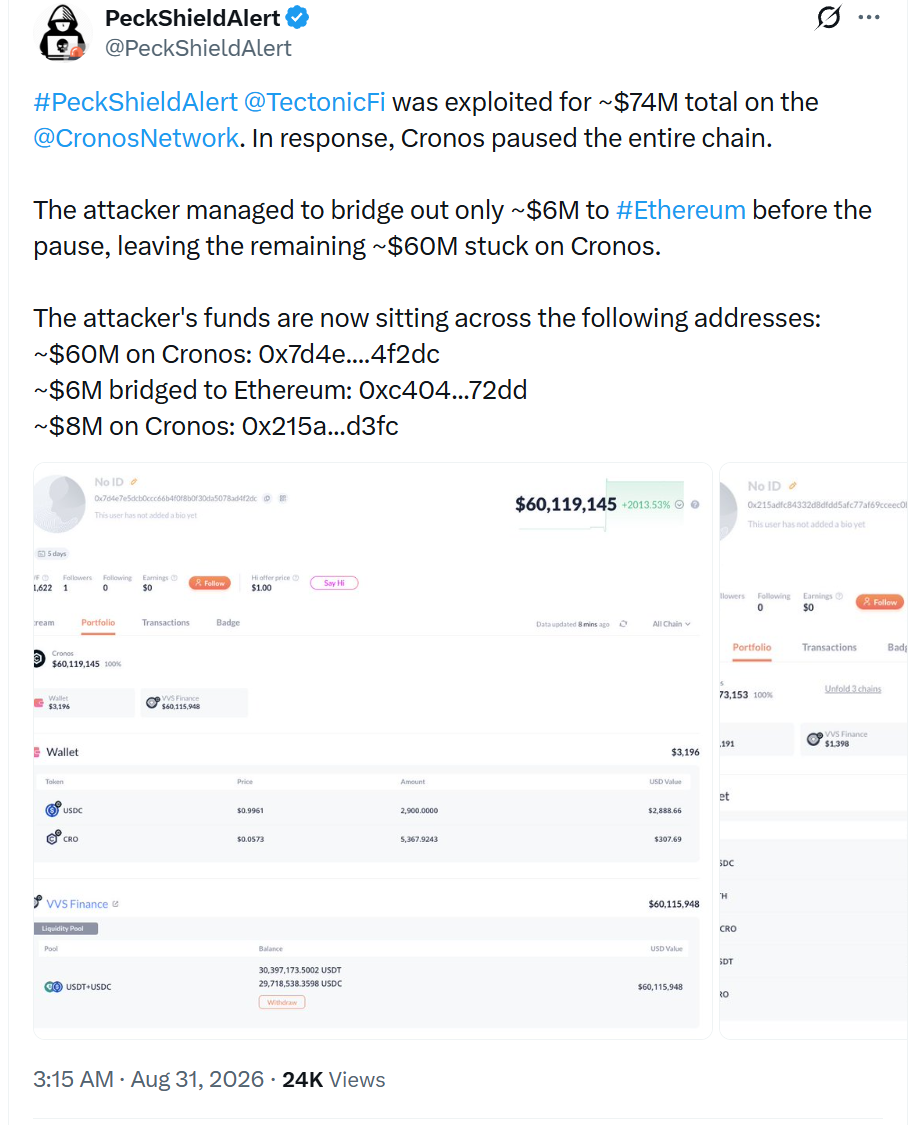
In the wake of the restart, the Cronos blockchain is undergoing rigorous monitoring to ensure stability, protocol compatibility, and to detect any lingering issues. This continuous oversight is critical for rebuilding trust and confirming the integrity of the network. Furthermore, the Cronos team has committed to publishing a comprehensive post-mortem report. This report is expected to provide granular details of the exploit, a root cause analysis, the steps taken for mitigation and recovery, and, most importantly, the preventative measures being implemented to bolster the security posture of the network and its integrated protocols. Such transparency is vital for fostering community trust and contributing to the collective knowledge base of blockchain security.
The Tectonic exploit on Cronos serves as a stark reminder of the inherent risks and complexities within the DeFi landscape. While offering unparalleled innovation and financial accessibility, decentralized protocols remain vulnerable to sophisticated attacks that exploit smart contract logic, oracle dependencies, or tokenomics design flaws. The incident underscores the imperative for continuous security audits, robust decentralized oracle networks, vigilant real-time monitoring, and clearly defined emergency response protocols. As the DeFi sector matures, the focus will increasingly shift towards developing more resilient architectures, implementing proactive threat intelligence, and establishing industry-wide best practices to safeguard user assets and maintain the integrity of decentralized financial systems. The ability of the Cronos network to respond decisively and recover highlights both the fragility and the emergent resilience of these cutting-edge technological frameworks.



 Lisa Mariana
 Aura Kasih
 Ayu Aulia