Safa Marwah
A sophisticated campaign utilizing general-purpose infostealer malware is actively targeting users of Anthropic’s Claude AI platform, facilitating unauthorized access to user accounts, depletion of usage quotas, and potential exposure of conversational data. This emerging threat underscores a critical vulnerability in the ecosystem of advanced AI services, where the compromise of local user machines can directly translate into direct control over high-value online sessions, bypassing traditional authentication mechanisms.
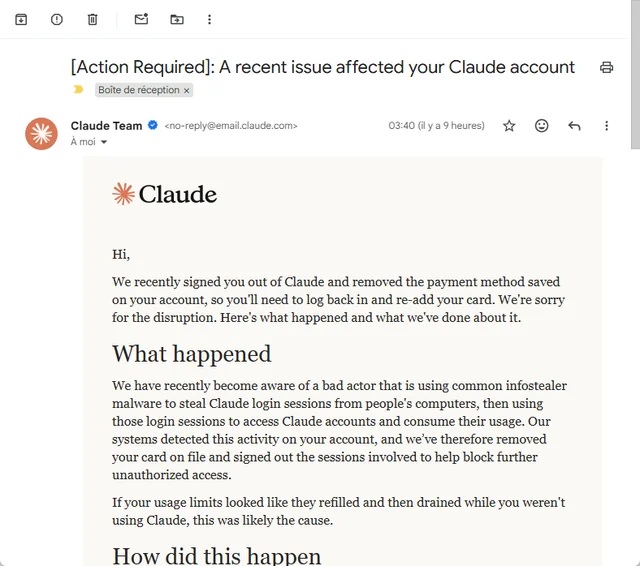
Anthropic, the developer behind the Claude AI model, has initiated notifications to affected users, acknowledging the illicit activity. The company’s internal investigations confirm that malicious actors are exploiting active browser login sessions stolen from user computers previously infected with a range of infostealer malware. Once compromised, these stolen sessions grant adversaries unfettered access to Claude accounts, enabling them to engage with the AI model, consume allocated usage credits, and potentially extract or manipulate content generated within the chat interface. In response, Anthropic is proactively invalidating compromised sessions, removing stored payment information, and issuing refunds for any unauthorized charges identified. The core issue lies not with the Claude platform’s security architecture itself, but rather with the widespread prevalence and efficacy of endpoint-level malware designed to harvest sensitive data from infected personal computers.

The operational methodology of these attacks hinges on the ability of infostealer malware to extract active session tokens or cookies from web browsers. Unlike traditional credential theft, which requires an attacker to re-authenticate using stolen usernames and passwords—potentially triggering multi-factor authentication (MFA)—session hijacking leverages tokens that signify an already authenticated user. This means that once a token is acquired, the attacker can effectively "step into" the legitimate user’s ongoing session without needing to re-enter credentials or navigate MFA prompts. This capability makes infostealers particularly potent, as they offer a direct pathway to operational control over online services without the common friction points of security protocols. The observed pattern of "usage limits refilling and then draining" without user interaction is a direct indicator of such session compromises, as the attackers utilize the legitimate session to interact with the AI.
Anthropic’s analysis points to a diverse array of common infostealer malware families implicated in these incidents. On Windows operating systems, the identified threats include Vidar, LummaC2, StealC, RedLine, and Acreed. For macOS users, a smaller but significant number of compromises have been attributed to Atomic Stealer (AMOS). These malware strains are not designed to specifically target AI platforms; rather, they are general-purpose tools widely available on underground forums, engineered to indiscriminately collect a broad spectrum of sensitive data from infected machines. This data typically encompasses saved browser passwords, autofill data, credit card information, cryptocurrency wallet details, and, critically for this scenario, active session cookies for various online services. The infection vectors for such malware are varied but often include deceptive downloads, pirated software, malicious advertisements, phishing campaigns, and trojanized applications. Acknowledging one reported instance of compromise stemming from a pirated game download highlights the critical role of user vigilance and secure computing practices in preventing such infections.
The implications of these attacks extend beyond mere financial loss from drained usage. The unauthorized access to AI chat sessions raises significant concerns regarding data privacy, intellectual property, and the potential for misuse. Users often interact with AI models like Claude for a wide range of tasks, from drafting sensitive business documents and analyzing proprietary data to personal brainstorming and creative writing. If these sessions are compromised, any information shared with or generated by the AI within that session becomes vulnerable to exfiltration by the attackers. This could lead to corporate espionage, competitive intelligence theft, exposure of personal identifying information, or even the use of the user’s identity to generate malicious or deceptive content. The ability of threat actors to leverage a legitimate user’s established AI session also presents opportunities for further sophisticated social engineering attacks, using the AI to craft convincing phishing messages or to generate content that could aid in other criminal activities, all under the guise of the legitimate user.
The proliferation of infostealer malware represents a persistent and evolving challenge in the cybersecurity landscape. These tools are continuously refined to evade detection, target new data types, and exploit new vulnerabilities in operating systems and applications. Their accessibility on dark web marketplaces further lowers the barrier to entry for aspiring cybercriminals, contributing to their widespread deployment. The incident with Claude users underscores that even sophisticated cloud-based services, protected by robust backend security, remain vulnerable to attacks that originate at the user’s endpoint. This highlights a fundamental principle of cybersecurity: the weakest link often resides at the point of human interaction with technology.
Mitigating the risks posed by infostealer malware requires a multi-faceted approach, emphasizing both user responsibility and platform-level safeguards. For individual users, adopting stringent security hygiene is paramount. This includes:
- Endpoint Security: Deploying and maintaining reputable antivirus or endpoint detection and response (EDR) solutions that are regularly updated to detect emerging malware threats.
- Software Acquisition: Sourcing all software, including games and utilities, exclusively from official and trusted vendors to avoid inadvertently downloading trojanized applications.
- Patch Management: Ensuring that operating systems, web browsers, and all installed applications are kept up-to-date with the latest security patches to close known vulnerabilities.
- Credential Management: Employing strong, unique passwords for all online accounts, ideally managed through a secure password manager. While MFA is often bypassed by session hijacking, it remains a critical layer for initial login protection and should be enabled wherever possible.
- Session Monitoring: Being vigilant for unusual activity within online accounts, such as unexpected usage spikes or changes to account settings.
- Malware Remediation: Critically, if a compromise is suspected or confirmed, users must take immediate action to thoroughly scan their systems with reputable security software and remove any detected malware. As Anthropic emphasized, simply revoking a session does not eliminate the underlying infection, leaving subsequent sessions vulnerable to re-compromise.
For AI platform providers like Anthropic, continuous investment in advanced security measures is essential. This includes developing and deploying sophisticated anomaly detection systems capable of identifying suspicious patterns of activity within user sessions that might indicate compromise. Implementing stricter session management policies, such as shorter session timeouts for high-privilege activities or requiring re-authentication for sensitive actions, could also reduce the window of opportunity for attackers. Furthermore, robust user education initiatives that inform users about the risks of infostealers and best practices for endpoint security are crucial. The ongoing dialogue between AI developers and the broader cybersecurity community will be vital in anticipating and countering future threats that leverage the intersection of AI capabilities and endpoint vulnerabilities.
Looking ahead, the threat landscape targeting AI platforms is expected to evolve in sophistication. As AI becomes more integrated into critical workflows and handles increasingly sensitive data, the motivation for cybercriminals to target these services will only intensify. This incident serves as a stark reminder that the security of advanced AI models is not solely dependent on the robustness of the AI’s internal architecture or the cloud infrastructure it resides upon, but equally on the integrity and security of the user’s local computing environment. The collective effort of platform providers, cybersecurity researchers, and individual users will be indispensable in building a resilient defense against these pervasive and impactful threats. The continuous adaptation of security strategies, informed by real-world incidents such as the Claude session hijacks, will be paramount in safeguarding the integrity and trustworthiness of the burgeoning AI ecosystem.




 Lisa Mariana
 Aura Kasih
 Ayu Aulia