Ayu Aulia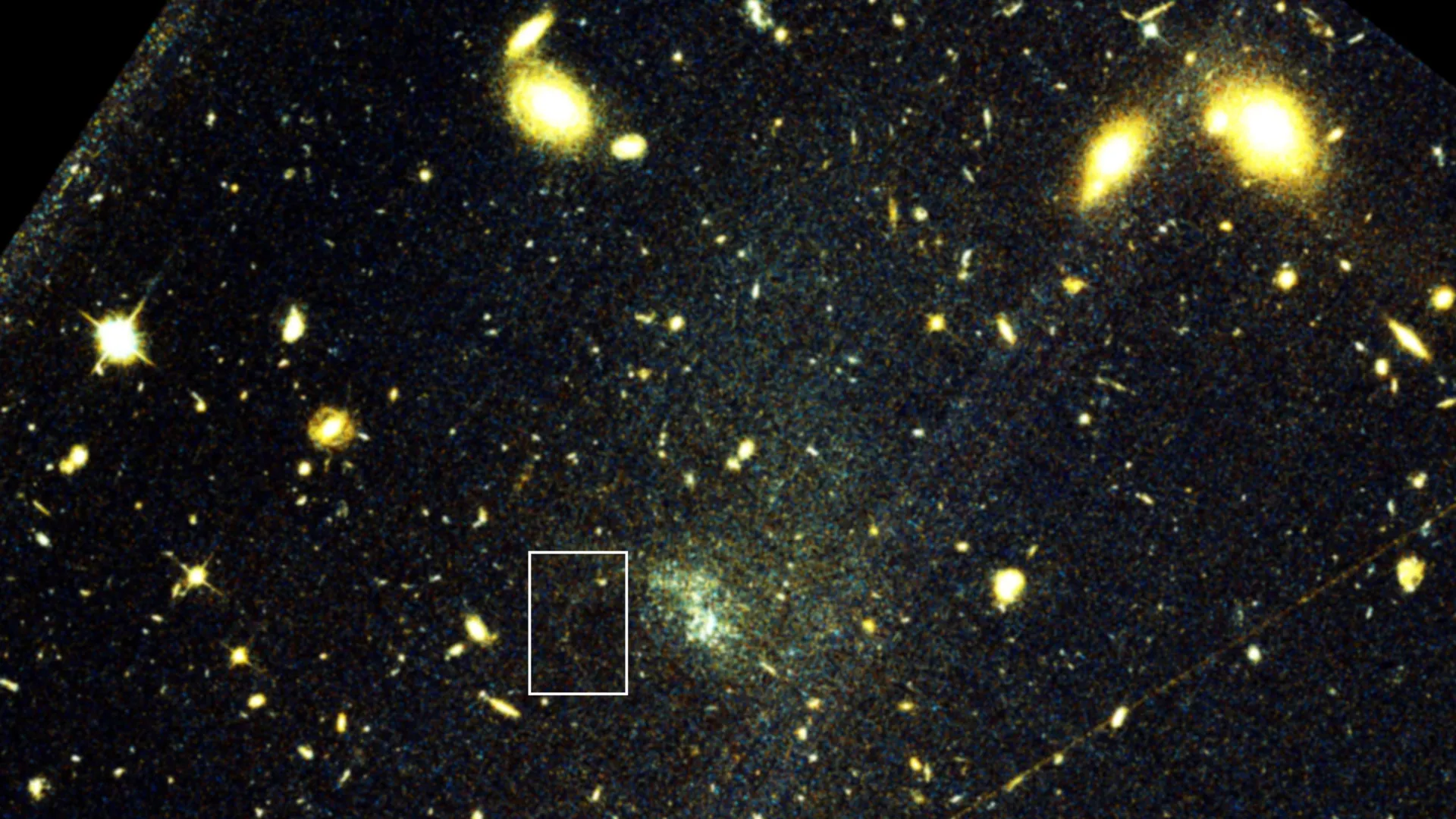
An ancient stellar system, gradually dispersing over eons, has yielded a delicate filament of stars stretching across the cosmos, providing astronomers with an unprecedented instrument for probing one of the universe’s most profound enigmas: dark matter.
For countless millennia, a venerable star cluster has been undergoing a slow dissolution, its constituent stars scattering to form an ethereal, attenuated band traversing interstellar space. This fragile cosmic structure now presents astrophysicists with an innovative methodology to explore one of the most significant mysteries in the universe. An international consortium of researchers, which included a distinguished astrophysicist from Northwestern University, has successfully identified the inaugural extragalactic stellar stream of this specific morphology. While theoretical models have long predicted the existence of such celestial formations encircling other galaxies, their intrinsic dimness has historically rendered their detection exceedingly challenging.
This recently unveiled stellar filament offers scientists an exceptional mechanism for investigating dark matter, a constituent of the cosmos that continues to represent a fundamental unanswered question within the discipline of astrophysics. By meticulously analyzing the morphology of this stellar current, investigators were able to reconstruct the gravitational field pervasive within its host galaxy. This critical data then enabled them to deduce the precise influence exerted by unseen dark matter upon the trajectories of the stars comprising the stream. These pioneering findings hold the potential to significantly advance scientific understanding of how dark matter is distributed across a diverse range of galactic systems and, indeed, throughout the entire cosmic expanse. The seminal research detailing these observations was formally published on August 12 in the prestigious scientific journal, Nature.
"The stars within a stellar stream trace nearly identical orbital paths, and these orbits are fundamentally shaped by the gravitational forces of the encompassing galaxy," explained Dr. Tjitske Starkenburg, a coauthor of the study and a research assistant professor at Northwestern’s Center for Interdisciplinary Exploration and Research in Astrophysics. "Through the sophisticated modeling of these gravitational dynamics, we can derive an estimation of the galaxy’s total mass. Given our existing approximations of the mass contributed by luminous matter, such as stars, the residual mass must, by inference, be attributable to dark matter." Dr. Starkenburg, a recognized authority in extragalactic astronomy, collaborated on the study, which was jointly spearheaded by Julie Kiel Holm of the University of Copenhagen and Sarah Pearson of the Technical University of Denmark.
Unveiling Extragalactic Stellar Filaments
Globular clusters represent highly concentrated aggregations of stars, gravitationally bound into a compact configuration. As such a cluster navigates its orbit within a host galaxy, the pervasive gravitational influence of the larger galactic system can progressively dislodge individual stars from the cluster’s periphery. Crucially, these liberated stars do not simply disperse haphazardly in all directions. Instead, they tend to maintain trajectories that closely mirror their original orbital paths, thereby generating elongated, slender stellar streams. These streams serve as invaluable cosmic archives, preserving detailed information regarding the gravitational forces they have encountered throughout their journey.
Within the confines of the Milky Way galaxy, astronomers have cataloged dozens of these stellar streams, originating from various globular clusters. However, prior to this groundbreaking investigation, no analogous stream had been definitively identified in any other galaxy. The extreme faintness of such structures typically causes them to be completely obscured by the pervasive light emitted by their parent galaxies, making their discernment exceptionally difficult.
The pivotal discovery emerged from a comprehensive review of archival observations acquired by NASA’s venerable Hubble Space Telescope, data which were presented by study coauthors David Sand and Catherine Fielder, both distinguished astronomers at the University of Arizona. It was during the meticulous examination of images of the ultra-diffuse galaxy UGC 9050-Dw1 by study coauthor David Hendel, specifically for an unrelated publication, that a subtle, curvilinear arc became discernible. This delicate feature exhibited all the characteristics consistent with a stellar stream.
UGC 9050-Dw1 is situated approximately 115 million light-years from Earth. Its classification as an ultra-diffuse galaxy, characterized by a comparatively sparse stellar population, provided an unusually dark and quiescent background. This fortuitous circumstance significantly enhanced the contrast, allowing the exceptionally dim stellar stream to be distinguished with unprecedented clarity against the otherwise overwhelming galactic luminosity.
Pioneering a New Metric for Dark Matter Quantification
The significance of this discovery extends far beyond the mere identification of an extragalactic stellar stream. Researchers have now conclusively demonstrated, for the first time, that a stellar stream originating from a globular cluster can serve as a potent diagnostic tool for investigating the distribution and properties of dark matter within a galaxy situated beyond the Milky Way.
Dark matter constitutes an estimated 85% of the total mass of the universe. Its enigmatic nature stems from its fundamental inability to emit, absorb, or reflect electromagnetic radiation, rendering it invisible to conventional astronomical instruments. Consequently, astronomers are compelled to infer its presence and properties indirectly, primarily through the gravitational influence it exerts upon visible baryonic matter, such as stars, gas, and entire galaxies.
Following the initial identification of the stream, the research team embarked on an extensive computational campaign, executing thousands of sophisticated computer simulations. These simulations systematically explored a vast parameter space, testing myriad combinations of potential globular cluster characteristics and various hypothetical distributions of dark matter. The objective was to ascertain which theoretical scenarios could accurately replicate the observed appearance and kinematics of the stellar stream.
The simulation models that most closely aligned with the empirical observations furnished novel estimations of UGC 9050-Dw1’s total mass and, critically, elucidated how that mass is spatially distributed throughout the galaxy. The results unequivocally indicated that UGC 9050-Dw1 contains a substantial proportion of dark matter, a finding that is entirely consistent with prevailing astrophysical expectations for ultra-diffuse galaxies. "Our empirical results corroborate prior investigations and their insights into the dark matter content of this specific ultra-diffuse galaxy," stated Kiel Holm. "Crucially, we have achieved this measurement using an entirely novel methodological approach for this class of galaxies, thereby validating the efficacy of this technique beyond the confines of our own galaxy."
Stellar Streams: Unlocking the Dark Matter Architecture
While the current analytical focus is concentrated on a singular galactic system, this seminal discovery portends a future where systematic searches for analogous stellar streams could be conducted across a wide spectrum of diverse galactic types. The acquisition of a larger, more representative sample would enable astronomers to accrue significantly greater insights into the behavioral characteristics of dark matter and its spatial arrangement within the cosmic web.
Thin stellar streams are particularly promising as probes because they possess an inherent sensitivity to gravitational perturbations. Even minor concentrations of dark matter, acting as gravitational lenses or perturbers, have the potential to induce observable disturbances within these delicate structures, manifesting as discernible gaps or localized clumps of stars.
"Slender stellar streams can develop discrete gaps or localized overdensities when small concentrations of dark matter traverse their paths," Dr. Starkenburg elaborated. "For an extended period, astronomers have debated whether such phenomena have been observed within stellar streams located in the Milky Way. Should we be able to definitively confirm that these features are indeed caused by dark matter interactions, it would furnish us with an entirely unprecedented methodology to rigorously test hypotheses regarding dark matter distribution – and, ultimately, to deepen our understanding of its fundamental nature." This potential breakthrough offers a direct observational pathway to probe the granularity of dark matter halos, a critical component for differentiating between competing dark matter models.
Next-Generation Observatories: A New Era of Discovery
The advent of forthcoming astronomical observatories is poised to revolutionize the detection of these elusive cosmic structures, rendering them considerably more accessible to scientific inquiry. The European Space Agency’s Euclid mission and NASA’s Nancy Grace Roman Space Telescope are meticulously engineered to conduct extensive wide-field surveys, encompassing significantly larger swathes of the celestial sphere than their predecessor, the Hubble Space Telescope. This enhanced survey capability dramatically increases the probability that astronomers will successfully detect stellar streams encircling a multitude of additional galaxies.
"It is truly exciting that we managed to identify a thin stellar stream around a galaxy other than our own utilizing pre-existing data from the Hubble Space Telescope, and subsequently validate this discovery with complementary ground-based telescopic observations," Dr. Starkenburg remarked. "This bodes exceptionally well for the capabilities of newly deployed telescopes, including the Roman Space Telescope, which possesses an observational field of view 100 times greater than that of Hubble. This exponential increase in survey efficiency promises an explosion of new discoveries, potentially transforming our understanding of galactic dynamics and dark matter."
The study, formally titled "Evidence for the First Globular Cluster Stellar Stream beyond the Milky Way," received substantial financial backing from VILLUM FONDEN (grant number VIL53081) and the European Union (BeyondSTREAMS award number 101115754). Dr. Starkenburg also gratefully acknowledges crucial support provided by the National Science Foundation (grant number AST-2510183) and NASA (grant numbers 22-ROMAN22-0055 and 22-ROMAN22-0013), which were instrumental in facilitating this groundbreaking research.




 Lisa Mariana
 Aura Kasih
 Safa Marwah