Aura Kasih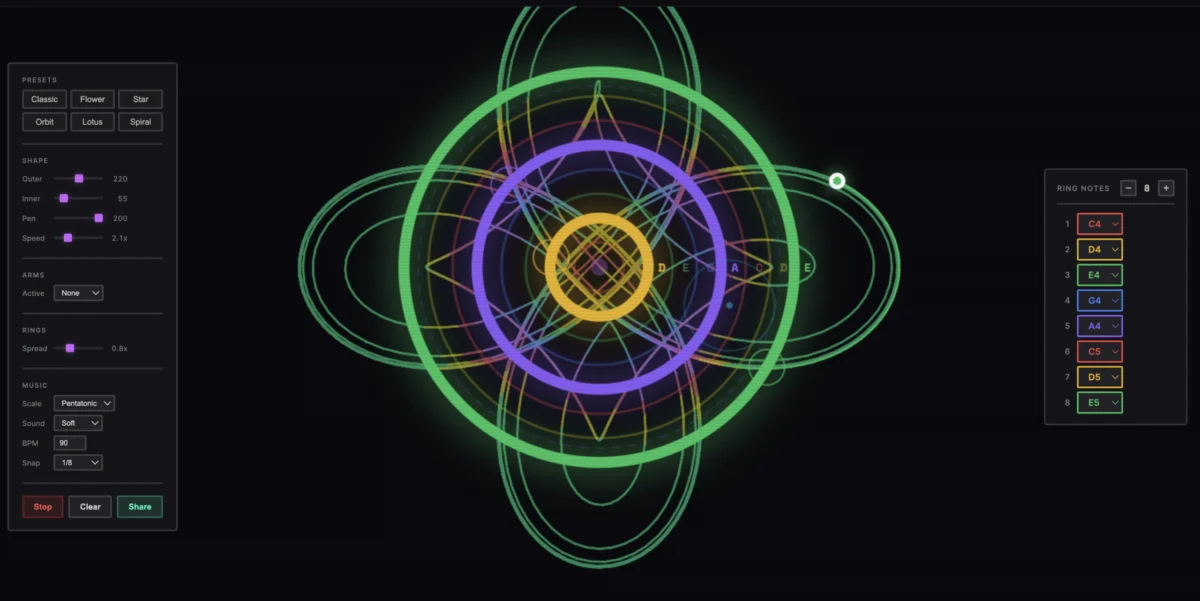
A novel web application is merging the captivating visual allure of geometric drawing with the intricate world of musical composition, offering users an accessible and engaging platform for creative expression directly within their web browsers. This innovative tool, dubbed "Musical Spirograph," invites individuals to orchestrate a symphony of visual patterns and auditory landscapes, transforming mathematical principles into a mesmerizing artistic experience.
The genesis of Musical Spirograph lies in the potent synergy between two distinct yet complementary forms of artistic and scientific inquiry: the timeless fascination with Spirograph’s predictable yet endlessly varied geometric outputs and the burgeoning field of algorithmic music generation. Historically, the Spirograph toy, a staple of childhood creativity for decades, allowed users to create intricate, mesmerizing patterns by rotating a gear within a larger ring. These patterns, known as hypotrochoids and epitrochoids, are not merely aesthetically pleasing; they are the direct result of precise mathematical relationships governing the movement of points along a rolling circle. The toy’s enduring appeal stems from its ability to produce complex, beautiful designs with a simple, intuitive mechanism, tapping into a fundamental human appreciation for order and emergent complexity.
Parallel to the visual arts, the realm of music has increasingly embraced algorithmic approaches. Generative music, a field that gained significant traction in the late 20th century and continues to evolve with advancements in artificial intelligence and computational power, focuses on systems that can autonomously create musical compositions. Pioneers like Laurie Spiegel, whose influential "Music Mouse" software celebrated its 40th anniversary in recent years, demonstrated the potential for computers to act as creative partners, generating music based on user-defined parameters and mathematical structures. The core idea behind generative music is to move beyond traditional compositional methods by leveraging algorithms to explore vast musical possibilities, often resulting in unique and evolving soundscapes.
Musical Spirograph ingeniously bridges these two domains by integrating the visual generation of Spirograph-like patterns with the creation of musical notes. The application functions by simulating the movement of a series of points governed by mathematical equations, mirroring the mechanical process of a Spirograph. As these points traverse the digital canvas, they interact with a series of concentric rings. Each ring is programmed to trigger a specific musical note when a point passes through it. This elegantly simple yet profound interaction creates a direct, tangible link between the visual trajectory of the generated pattern and the resulting sonic output. The result is a dynamic interplay where the visual rhythm and form directly dictate the melodic and harmonic content of the generated music, offering a unique synesthetic experience.
The core functionality of Musical Spirograph is deceptively straightforward, yet its potential for customization and creative exploration is extensive. Users are presented with a selection of six distinct virtual rotors, each with its own unique mathematical properties that influence the shape and complexity of the generated patterns. Furthermore, the application allows for the simultaneous use of up to three drawing arms, enabling the creation of layered and more intricate visual designs. Beyond these primary controls, a suite of additional parameters allows users to fine-tune the visual output, adjusting variables that affect the scale, density, and overall aesthetic of the geometric formations.

The musical dimension of Musical Spirograph is equally robust, offering a rich palette for sonic experimentation. The application provides six different pre-defined musical scales, allowing users to easily explore various harmonic frameworks. For those seeking more granular control, the platform also permits complete customization of the notes, enabling users to construct their own unique scales or chord progressions. Complementing the melodic possibilities, six distinct synthesizer presets are available, each offering a different timbral quality to shape the sound of the generated notes. This allows for a wide range of sonic textures, from delicate, bell-like tones to more robust, organ-like sounds.
The interplay between visual and auditory elements is further enhanced by features that allow for the manipulation of musical timing and structure. Users can adjust the quantization of the notes, determining how precisely they align with a rhythmic grid, and can set the beats per minute (BPM) to control the overall tempo of the composition. In an expansion of the core concept, the number of rings can be extended to span two octaves, significantly broadening the melodic range and harmonic complexity of the generated music. This layered approach to customization ensures that while the basic premise is accessible to beginners, advanced users can delve deep into the technicalities to craft highly personalized and sophisticated artistic outputs.
While the primary appeal of Musical Spirograph lies in its ability to foster accessible creativity, it’s important to acknowledge the technical aspects of its sound engine. As with many browser-based audio applications, the sound engine may exhibit certain limitations, potentially leading to clipping or artifacts when complex or intense sonic events occur. These are common challenges in real-time audio processing within a web environment, where computational resources and browser-specific audio APIs can impose constraints. The desire for direct MIDI output, enabling users to route the generated musical data to external synthesizers or digital audio workstations, represents a logical next step for power users seeking to integrate Musical Spirograph into more professional music production workflows. Such integration would unlock the potential for these algorithmically generated patterns to drive a far wider array of sonic instruments and effects.
The implications of tools like Musical Spirograph extend beyond mere entertainment. They represent a significant democratization of creative technologies, bringing sophisticated concepts in mathematics, art, and music into the hands of a broad audience. By abstracting away complex coding and technical jargon, such platforms lower the barrier to entry for individuals who might otherwise be intimidated by these fields. This accessibility can foster a deeper appreciation for the underlying principles of mathematics and computational thinking, revealing the inherent beauty and order that can emerge from logical systems. Furthermore, these tools serve as powerful educational resources, offering an engaging and intuitive way to explore concepts related to geometry, trigonometry, and algorithmic processes.
The future outlook for browser-based generative art and music tools is exceptionally promising. As web technologies continue to advance, particularly in areas like Web Audio API and WebGL, the capabilities of these applications will undoubtedly expand. We can anticipate more sophisticated sound engines, richer visual rendering capabilities, and more intuitive interfaces for controlling complex algorithmic processes. The integration of machine learning and AI could further enhance these platforms, enabling them to learn from user preferences, generate more nuanced musical compositions, and even suggest visual patterns based on desired aesthetic outcomes.
Moreover, the trend towards interconnected creative platforms suggests a future where tools like Musical Spirograph are not isolated experiences but can seamlessly integrate with other creative software and hardware. The ability to export not just audio but also vector graphics or even code snippets could open up new avenues for artists and designers to incorporate algorithmic elements into their larger projects. The ongoing evolution of these tools points towards a future where the lines between art, science, and technology continue to blur, empowering individuals to explore and express their creativity in increasingly innovative and profound ways, all from the convenience of their web browser. Musical Spirograph stands as a compelling testament to this exciting trajectory, offering a glimpse into a future where art is not just created but is algorithmically orchestrated.




 Lisa Mariana
 Safa Marwah
 Ayu Aulia