Ayu Aulia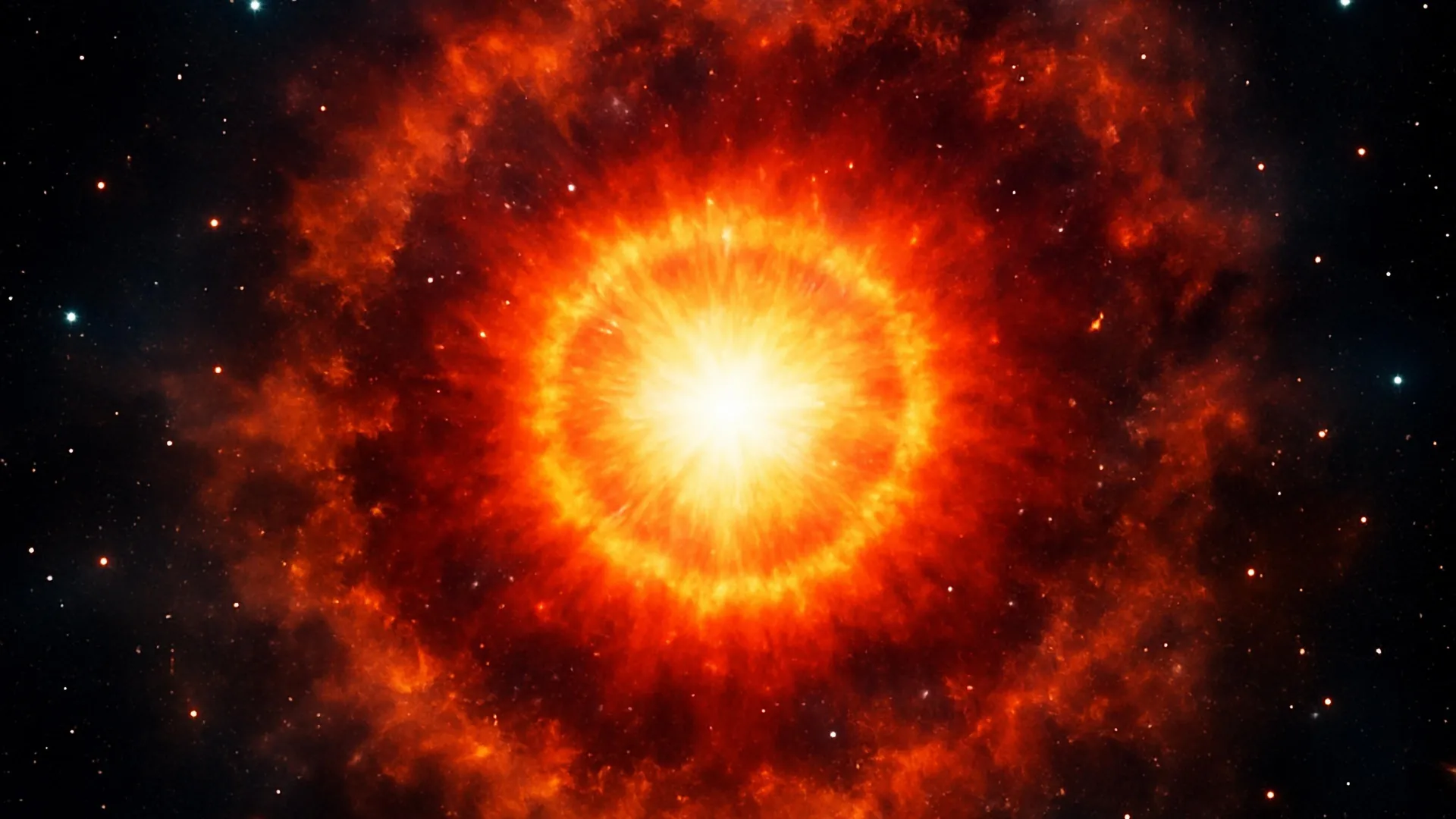
A groundbreaking study suggests that enigmatic primordial black holes, relics from the universe’s infancy, could be stealthily instigating the violent thermonuclear demise of white dwarf stars, leading to Type Ia supernovae across our galaxy. This novel hypothesis not only offers a fresh perspective on the mechanisms behind these crucial cosmic explosions but also provides a compelling explanation for peculiar elemental distributions observed within the stellar populations of the Milky Way, thereby potentially offering an indirect pathway to detect these elusive dark matter candidates.
The concept of primordial black holes, or PBHs, posits their existence as theoretical vestiges from the universe’s earliest epochs. Unlike the stellar-mass black holes that form from the collapse of massive stars or the supermassive black holes anchoring galactic centers, PBHs are hypothesized to have emerged from the extreme conditions prevalent during cosmic inflation. This brief, exponential expansion phase of the nascent universe is thought to have amplified microscopic quantum fluctuations in the distribution of matter and energy. Regions with sufficiently higher density could have collapsed under their own gravity to form black holes, ranging from subatomic to asteroid-sized, within fractions of a second after the Big Bang.
These ancient gravitational anomalies hold significant cosmological interest, particularly as potential constituents of dark matter. Dark matter, an invisible substance that interacts primarily through gravity, is estimated to comprise approximately 27% of the universe’s total mass-energy content, vastly outweighing the ordinary baryonic matter that makes up stars, planets, and galaxies. Despite its pervasive gravitational influence, which is detectable in galactic rotation curves, gravitational lensing, and the large-scale structure of the cosmos, dark matter remains unobserved directly. PBHs offer an intriguing, albeit unconfirmed, solution to this long-standing astrophysical enigma, providing a non-WIMP (Weakly Interacting Massive Particle) candidate for the universe’s missing mass.
The potential for PBHs to traverse stellar interiors has been a subject of theoretical inquiry for some time. Previous investigations have explored scenarios where a PBH, propelled by its orbital motion within a galaxy, might pass through a dense celestial body like a white dwarf. Such an encounter would not be a mere transit; the immense gravitational pull of the black hole, even a tiny one, could exert powerful tidal forces on the white dwarf’s stellar material. These forces could induce significant internal heating, compression, and mechanical stress within the white dwarf, potentially destabilizing its delicate hydrostatic equilibrium and initiating a runaway thermonuclear reaction. This proposed interaction pathway presents an entirely new mechanism for triggering Type Ia supernovae, distinct from the conventionally accepted models.
A white dwarf represents the final evolutionary stage for most low-to-intermediate mass stars, including our Sun. After exhausting their nuclear fuel, these stars shed their outer layers, leaving behind a compact core primarily composed of carbon and oxygen, supported against gravitational collapse by electron degeneracy pressure. Type Ia supernovae are exceptionally luminous stellar explosions, characterized by the complete thermonuclear disruption of a white dwarf. The prevailing understanding is that these events occur in binary star systems where a white dwarf accretes matter from a companion star, gradually increasing its mass until it approaches or exceeds the Chandrasekhar limit (approximately 1.4 solar masses). Beyond this critical mass, electron degeneracy pressure can no longer withstand gravity, leading to a catastrophic ignition of carbon and oxygen fusion throughout the star, resulting in an explosion of unparalleled brilliance. These "standard candles" are vital for measuring cosmic distances and understanding the universe’s expansion history.
Investigating an Alternative Supernova Pathway
An international research collaboration, spearheaded by Shing-Chi Leung, an assistant professor at SUNY Polytechnic Institute and a visiting associate scientist at The University of Tokyo Kavli Institute for the Physics and Mathematics of the Universe (Kavli IPMU), embarked on a comprehensive investigation into this novel PBH-triggered explosion channel. The team also benefited from the expertise of Kavli IPMU Visiting Senior Scientist Ken’ichi Nomoto and Kavli IPMU Senior Fellow Alexander Kusenko, renowned figures in astrophysics and cosmology.
The research focused on meticulously modeling the complex physical processes involved in PBH-induced white dwarf explosions. This included simulating the dynamics of the PBH’s passage, the resulting gravitational perturbations, the initiation of thermonuclear burning, and the subsequent nucleosynthesis – the creation of new atomic nuclei – within the exploding star. The scientists then analyzed the predicted observable characteristics of these hypothetical supernovae, such as their luminosity evolution (light curves), spectral features, and the elemental composition of the ejecta. Intriguingly, earlier work by the same team, detailed in a paper published in 2025, had already demonstrated that the properties of supernovae generated through PBH-triggered explosions bore a striking resemblance to those predicted by standard Type Ia supernova models. This initial finding suggested that PBH-induced events might be indistinguishable from conventional Type Ia supernovae through typical observational means, making them "secret" in a cosmic sense.
Benchmarking Models Against Cosmic Observations
For their latest endeavor, the research team advanced their analysis by rigorously comparing their sophisticated PBH-triggered supernova models with a diverse array of real astronomical observations. This comparative study encompassed well-known supernova remnants, which are the expanding shells of gas and dust left behind after a star explodes, providing a fossil record of the event. Specific remnants examined included Tycho (SN 1572), Kepler (SN 1604), and 3C 397, each offering unique insights into different Type Ia explosion scenarios. The team also analyzed data from more recent, nearby supernovae, such as SN 2011fe and SN 2012cg, which have been observed with high fidelity across multiple wavelengths, allowing for detailed study of their light curves and spectra.
Crucially, the researchers extended their comparison to the broader chemical landscape of the Milky Way, analyzing the abundance patterns of various elements observed in stars across our home galaxy. The results of this extensive comparison were compelling: the PBH-triggered Type Ia supernova models demonstrated a remarkable capacity to reproduce several key characteristics observed in these diverse supernovae and their remnants, lending considerable credence to the hypothesis.
A central component of their investigation involved the examination of specific radioactive isotopes and stable elements produced during the explosion. The team focused on species such as Nickel-56 (Ni-56), Nickel-57 (Ni-57), Manganese (Mn), and stable Nickel (Ni). Ni-56, in particular, is a crucial diagnostic element for Type Ia supernovae, as its radioactive decay powers the characteristic light curve, causing the supernova to brighten and then fade over weeks to months. By analyzing the ratios and absolute abundances of these elements, astronomers can infer critical parameters about the progenitor star, including its initial mass, its metallicity, and the specific thermonuclear pathways that occurred during the explosion.
Metallicity, in astronomical terms, refers to the abundance of elements heavier than hydrogen and helium within a star. It serves as a vital chronological indicator, probing the cosmic epoch when a star formed. Stars born early in the universe’s history, from gas clouds primarily composed of hydrogen and helium, exhibit low metallicities. Subsequent generations of stars incorporate elements forged in the interiors of previous stars and dispersed by supernovae, thus displaying higher metallicities. By linking the chemical signatures from PBH-triggered SNe Ia to the metallicity of the stars that hosted them, the researchers gained insights into when and where these unusual explosions might have occurred within the Milky Way’s history.
Primordial Black Holes: Architects of Galactic Chemistry?
Beyond merely explaining individual supernovae, the research team utilized their supernova models to explore the broader implications of this explosion mechanism for galactic chemical enrichment. Supernovae are the primary cosmic factories responsible for dispersing newly synthesized heavy elements into the interstellar medium. These enriched materials then become the building blocks for subsequent generations of stars, planets, and potentially life itself. Understanding the full spectrum of supernova types and their relative contributions is therefore essential for comprehending the chemical evolution of galaxies.
The team’s analysis yielded a profound conclusion: to adequately account for the intricate chemical abundance trends observed in stars throughout the Milky Way, a non-zero fraction of PBH-triggered Type Ia supernovae might be necessary. This finding implies that primordial black holes, despite their elusive nature, may have played an active and significant role in shaping the chemical composition of our galaxy over cosmic timescales, influencing the availability of elements critical for stellar and planetary formation through the stellar explosions they instigated.
As Shing-Chi Leung articulated, "Our work suggests that some supernovae we observe in the sky could be a result of the PBHs. Therefore, even though we cannot directly observe these evasive entities, they leave many interesting clues in nature for us to probe their properties." This perspective elevates PBH-triggered supernovae from a theoretical curiosity to a potentially observable phenomenon, offering an indirect but powerful probe for the existence and characteristics of primordial black holes, and by extension, dark matter itself.
The profound implications of this study extend to multiple frontiers of astrophysics and cosmology. If confirmed, the PBH-triggered supernova channel would necessitate a re-evaluation of the overall Type Ia supernova rate and its composition. It could explain observed variations in Type Ia properties that are difficult to reconcile with standard models. Furthermore, it opens a novel observational window into the early universe, allowing scientists to infer properties of PBHs that formed billions of years ago by studying stellar explosions occurring today.
Looking ahead, the research team intends to broaden the scope of their investigation. This will include a comprehensive study of how PBH-triggered explosions might influence the overall population dynamics of conventional supernovae and their combined rates across the cosmos. Further computational refinements, exploring different PBH mass ranges and initial conditions, will be crucial. The ultimate goal remains the direct or irrefutable indirect detection of primordial black holes, which would revolutionize our understanding of dark matter, the early universe, and the intricate processes that forge the elements that make up everything around us. This groundbreaking research underscores the ongoing quest to unravel the universe’s deepest secrets, demonstrating how even the most subtle cosmic interactions can leave indelible marks on the vast tapestry of galactic evolution.


 Aura Kasih
 Safa Marwah