Ayu Aulia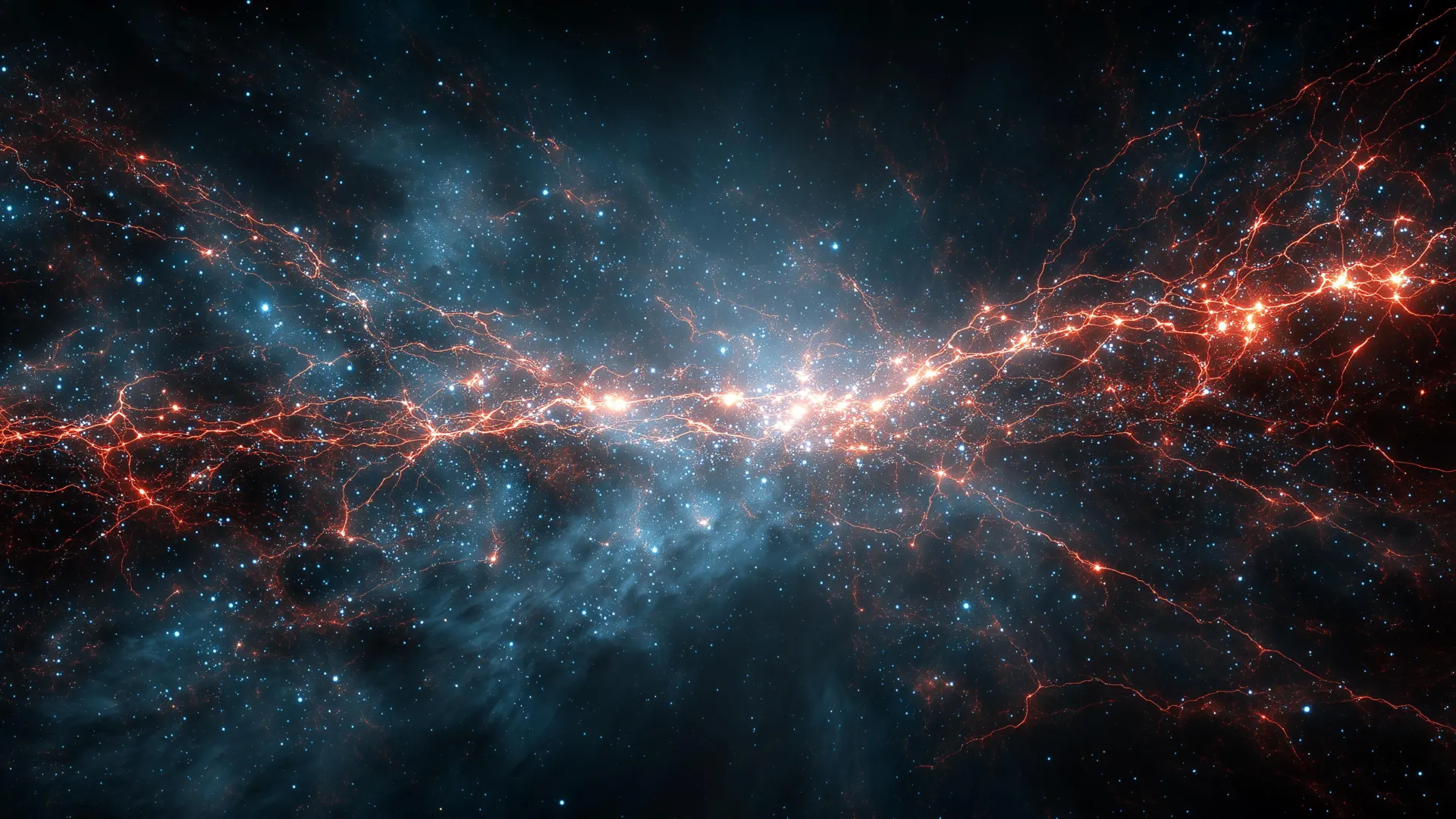
A groundbreaking theoretical investigation into the nature of dark matter has unveiled a counterintuitive dynamic: while an intrinsic attractive force among dark matter particles might intuitively suggest accelerated cosmic structure formation, the analysis reveals that such an interaction could paradoxically inhibit this very growth. For decades, dark matter has been understood primarily through its gravitational influence, acting as an unseen scaffolding for the cosmos, but this new research explores the profound implications of a "dark force" operating exclusively within the dark sector, presenting a complex interplay of effects that could reshape our understanding of the Universe’s evolution.
The prevailing cosmological paradigm, known as the Lambda-CDM model, posits that the Universe is comprised of ordinary matter, dark energy, and cold dark matter. This invisible dark matter, which accounts for approximately 27% of the Universe’s mass-energy content, is believed to interact solely through gravity. Its gravitational pull is essential for explaining the rotation curves of galaxies, the dynamics of galaxy clusters, and the large-scale structure of the cosmos. Without dark matter, visible matter alone would not possess sufficient gravitational force to bind galaxies and clusters together, nor would the observed patterns of cosmic microwave background anisotropies be explainable. The search for direct detection of dark matter particles, such as WIMPs (Weakly Interacting Massive Particles), has been ongoing for decades, yielding no definitive results, which has prompted scientists to explore alternative theoretical frameworks.
One such framework involves the intriguing possibility of a "dark sector," a realm of particles and forces that are hidden from our ordinary matter interactions, yet communicate among themselves. Within this theoretical construct, dark matter particles would not only respond to gravity but also exert an additional force on one another—a so-called dark force. This concept has gained traction as highly precise astronomical observations have begun to reveal subtle inconsistencies and "tensions" within the standard cosmological model. These discrepancies, though individually small, collectively suggest that our current understanding of cosmic evolution might be incomplete, hinting at missing ingredients or overlooked interactions.
The recently published study, featured in the Journal of Cosmology and Astroparticle Physics (JCAP), rigorously examined a class of theoretical models where dark matter particles experience an additional attractive, long-range force. The initial hypothesis, grounded in common intuition, would suggest that such an attractive force would enhance the clustering of dark matter. If dark matter particles are drawn more strongly to each other, they should coalesce into denser clumps more rapidly, thereby accelerating the formation of galaxies, galaxy clusters, and the larger cosmic web. This enhanced clustering might also offer an explanation for certain observational anomalies, such as suggestions that matter distribution on the largest cosmic scales appears more tightly clustered than the standard model predicts.
However, the findings presented a profound departure from this intuitive expectation. While the dark force indeed promotes more efficient clustering of dark matter, the researchers uncovered a simultaneous, countervailing effect that fundamentally alters the overall cosmic growth trajectory. The same interaction that causes dark matter to cluster more effectively also leads to an effective reduction in the mass of dark matter particles over cosmic time. This subtle but significant mechanism weakens their individual gravitational influence, thereby offsetting the stronger attraction generated by the hidden force. Consequently, the net outcome is not an acceleration, but rather a suppression of the growth of cosmic structure in most scenarios. This intricate interplay highlights the often non-obvious consequences of introducing new physics into the complex tapestry of cosmic evolution.
The motivation for considering such complex dark sector interactions stems from persistent cosmological puzzles. For instance, measurements of the Universe’s expansion rate, particularly the "Hubble tension," show a persistent disagreement between early-Universe estimates derived from the cosmic microwave background and late-Universe measurements from local supernovae. Similarly, the "Sigma-8 tension" refers to disparities in the observed clustering of matter on large scales, with some analyses suggesting a less clustered universe than predicted by the standard model. These observational discrepancies, while still under intense scrutiny and potentially attributable to systematics, have spurred theoretical physicists to explore extensions to the Lambda-CDM model, including scenarios involving interacting dark matter.
The concept of a "dark force" offers a compelling avenue to address these tensions. If dark matter particles possess their own internal dynamics, independent of ordinary matter, it could subtly alter the cosmic landscape in ways that align better with the latest observational data. Zachary Weiner, a researcher at the Perimeter Institute for Theoretical Physics and a corresponding author for the study, emphasizes that "what we really know about dark matter has so far been learned only through its gravitational effects. That leaves open the possibility that dark matter might have additional interactions that are hidden from ordinary matter." This perspective underscores the vast unknown that still surrounds dark matter, pushing the boundaries of theoretical exploration beyond mere gravitational influence.
The research team employed sophisticated theoretical calculations, integrating them with existing cosmological data, to model how a long-range dark force would impact the Universe’s expansion history and the subsequent growth of large-scale structures. Their methodology involved simulating the cosmic evolution under various parameters for this hypothetical dark force, meticulously tracking its influence on dark matter density fluctuations and the resulting gravitational potentials. It was through this rigorous computational and analytical process that the counterintuitive "mass loss" effect was identified. This effective reduction in mass is not a literal loss of particles, but rather a modification of their gravitational coupling strength, which dynamically diminishes as the Universe expands and the dark force interaction plays out.
The ramifications of this discovery extend beyond the immediate context of dark matter interactions. The findings could be particularly pertinent for models attempting to interpret recent measurements from the Dark Energy Spectroscopic Instrument (DESI). DESI, a cutting-edge survey mapping the 3D positions of millions of galaxies and quasars, aims to precisely measure the expansion history of the Universe and the growth of cosmic structure over billions of years. Any models proposed to reconcile DESI’s findings with existing cosmological frameworks, especially those involving novel interactions within the dark sector, must now account for this newly identified mechanism. Specifically, if these models incorporate an attractive hidden force, they must consider the possibility that dark matter effectively becomes lighter as the Universe evolves, potentially altering the interpretation of DESI’s precise cosmological parameters.
This revelation underscores a fundamental principle in theoretical physics: the Universe often harbors complexities that defy initial human intuition. What appears to be a straightforward cause-and-effect relationship—an attractive force leading to enhanced clustering—can be intricately modified by secondary effects that emerge from the underlying physics. As Weiner aptly states, "The Universe is often more subtle than our intuition. That’s exactly why we have to keep testing these ideas." This highlights the iterative and often surprising nature of scientific discovery, where theoretical models are constantly refined and challenged by both new observations and deeper theoretical insights.
The path forward involves a synergistic approach combining advanced theoretical modeling with increasingly precise observational data. Upcoming observatories and cosmic surveys, such as the Euclid mission, the Nancy Grace Roman Space Telescope, the Vera C. Rubin Observatory’s Legacy Survey of Space and Time (LSST), and future cosmic microwave background experiments like CMB-S4, are poised to deliver unprecedented cosmological datasets. These instruments will provide sharper images of the distant Universe, more accurate measurements of cosmic expansion, and highly detailed maps of matter distribution. Such data will be instrumental in discriminating between various dark matter models, helping scientists to either confirm the existence of a dark force or to place stringent constraints on its properties, potentially ruling out certain theoretical possibilities.
Ultimately, the quest to unravel the true nature of dark matter remains one of the most compelling frontiers in modern physics and cosmology. While the standard model has been remarkably successful, these persistent anomalies and new theoretical insights compel a continuous re-evaluation of its foundational assumptions. The possibility of a dark force, with its unexpected implications for cosmic structure growth, represents a significant step in this ongoing intellectual journey, pushing scientists to consider a more intricate and dynamic dark sector that could hold the key to a more complete understanding of our Universe’s origins and evolution.




 Aura Kasih
 Safa Marwah