Ayu Aulia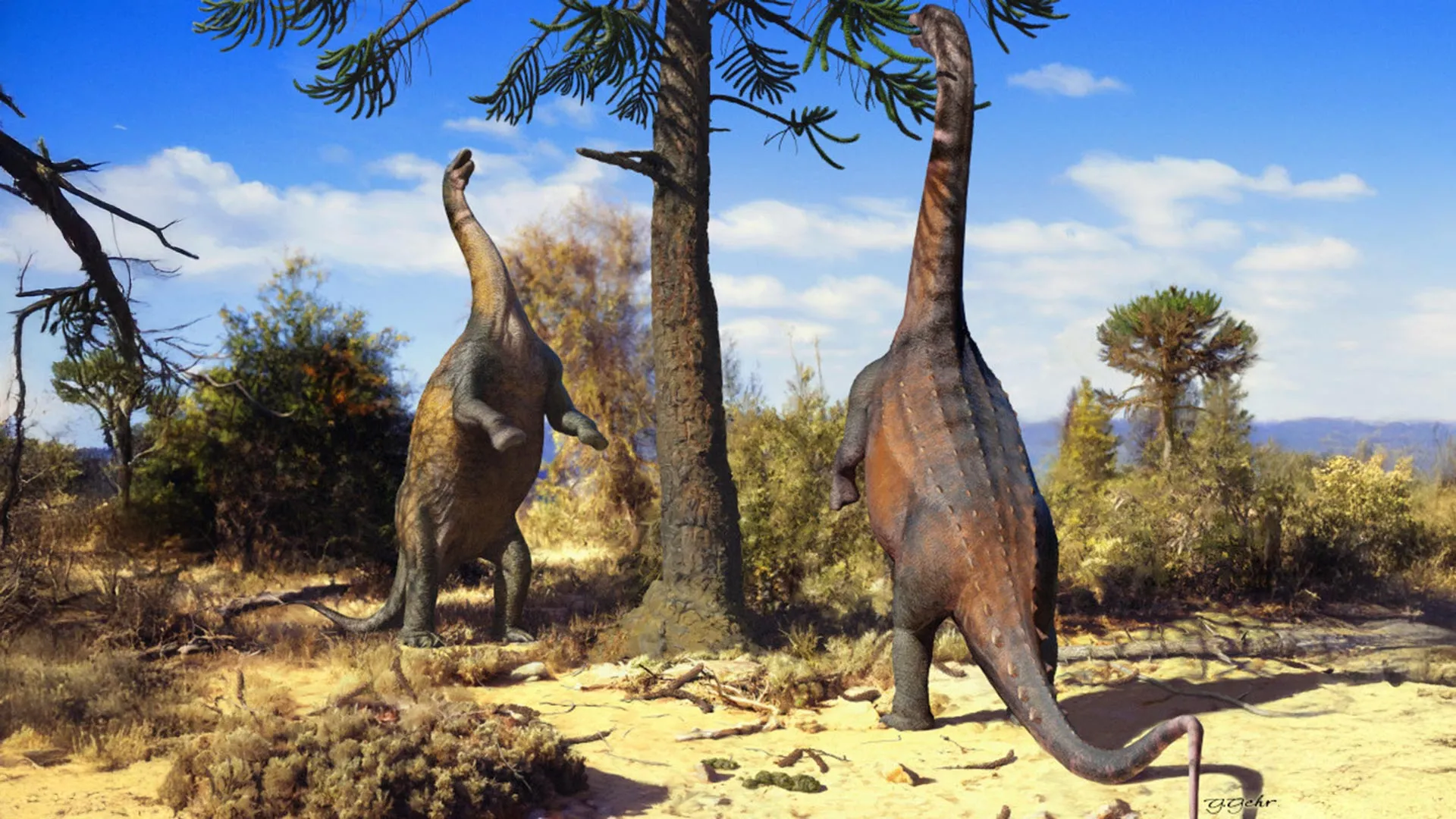
Recent biomechanical investigations into the locomotion of colossal long-necked dinosaurs, known as sauropods, suggest that certain species possessed a surprising capacity for bipedal posture, a capability particularly pronounced in their younger, less massive stages. This remarkable postural flexibility, observed in specific Late Cretaceous sauropods from South America, appears to have diminished significantly as the animals matured and attained their full adult mass, indicating a critical biomechanical threshold linked to the evolutionary trajectory of gigantism.
Sauropods, an iconic group of herbivorous dinosaurs, dominated terrestrial ecosystems during the Mesozoic Era, particularly from the Late Triassic through the Late Cretaceous periods. Renowned for their immense size, characterized by extraordinarily long necks and tails, massive bodies, and columnar limbs, these animals are widely understood to have been obligate quadrupeds. Their sheer scale, with some species exceeding 70 tons and reaching lengths over 30 meters, presents profound challenges for any deviation from a four-legged stance. The conventional paleontological view has largely discounted the sustained bipedal capabilities of these titans, deeming it implausible due to the extreme gravitational stresses involved. However, evolving analytical techniques and interdisciplinary research are progressively challenging these long-held assumptions, revealing a more nuanced picture of sauropod locomotor adaptability.
This paradigm shift is particularly evident in new research focusing on two distinct Late Cretaceous sauropod species from South America: Uberabatitan ribeiroi from Brazil and Neuquensaurus australis from Argentina. These titanosaurian sauropods, while certainly large by modern mammalian standards – comparable in mass to contemporary elephants – were considered "modest" in comparison to their truly colossal relatives like Argentinosaurus or Patagotitan. Adult Uberabatitan, for instance, could reach lengths of approximately 26 meters, making it one of the largest dinosaurs yet discovered in Brazil. Neuquensaurus, though slightly smaller, shared similar anatomical traits that are now being re-evaluated through the lens of biomechanics. Both species thrived approximately 66 million years ago, just prior to the end-Cretaceous extinction event, inhabiting diverse South American environments. The study’s focus on these relatively "smaller" giants provides crucial insights into the biomechanical limits and possibilities within the sauropod clade, particularly concerning the relationship between body size and postural versatility.
The central question underpinning this investigation revolved around understanding the precise biomechanical forces acting upon a sauropod’s skeletal structure, specifically the femur (thigh bone), during a bipedal stance. Given the extraordinary mass of these creatures, even a temporary upright posture would impose immense stress on their hind limbs. To quantitatively assess this, an international team of researchers employed a sophisticated computational method known as Finite Element Analysis (FEA). FEA is a powerful engineering tool routinely utilized to predict how complex structures, such as bridges, aircraft components, or medical implants, respond to various physical forces like pressure, weight, and heat. Its application in paleontology allows scientists to virtually "test" the structural integrity of fossilized bones under simulated loads that would have been experienced by living animals.
The methodology commenced with the creation of highly detailed three-dimensional digital reconstructions of the femurs from seven distinct sauropod species. These specimens were carefully selected to represent a broad spectrum of evolutionary branches, body sizes, and anatomical variations within the sauropod lineage. The digital models were meticulously generated from high-resolution scans of actual fossilized bones housed in natural history museums globally, ensuring anatomical fidelity. Julian Silva Júnior, the study’s lead author and a postdoctoral researcher at the School of Engineering of São Paulo State University (FEIS-UNESP), spearheaded this intricate process, conducting much of the research during an international internship.
Within the FEA framework, the researchers executed two primary simulation scenarios. The first, termed the "extrinsic scenario," modeled the external forces acting upon the femur. This primarily involved simulating the effects of gravity and the animal’s substantial body weight as it shifted onto its hind limbs in a bipedal position. The objective was to quantify the compressive and tensile stresses generated within the bone structure under this specific load. The second scenario, the "intrinsic scenario," focused on the internal forces, specifically modeling the forces that the surrounding musculature would exert on the femur. Reconstructing the precise muscle attachments and strengths in extinct animals is inherently challenging, necessitating careful anatomical inference and comparative analyses with extant large vertebrates. By integrating the data from both the extrinsic (gravitational/body weight) and intrinsic (muscular) simulations, the team was able to derive a comprehensive estimate of the total stress experienced by the femur of each species during a theoretical upright stance. This holistic approach provided a robust measure of biomechanical strain.
The results of the FEA simulations revealed a compelling pattern. The lowest levels of biomechanical stress on the femur during a simulated bipedal stance were consistently observed in the juvenile Uberabatitan ribeiroi and the adult Neuquensaurus australis. Both species, hailing from the Late Cretaceous of South America, exhibited femurs with exceptional robustness. This robustness was characterized by a notably thicker and denser bone structure, which proved highly effective at dissipating the immense forces generated when the animals adopted an upright posture. This anatomical advantage allowed for a more even distribution of stress across the bone, reducing localized strain and the risk of structural failure.
Conversely, the simulations indicated a significant increase in femoral stress for larger sauropod species, as well as for adult Uberabatitan individuals. While these colossal animals possessed proportionally massive femurs and powerful musculature, their sheer increase in body mass outpaced the relative strengthening of their bone structure. As Julian Silva Júnior explained, "The bigger ones had very large muscles and even giant femurs, but not enough to support their weight." This suggests a critical biomechanical tipping point where the benefits of bone robusticity are overwhelmed by the exponential increase in gravitational load. Consequently, while larger sauropods might have still been capable of momentarily rearing onto their hind legs, the simulations strongly imply that such a posture would have been considerably more strenuous, uncomfortable, and likely of very short duration. The study therefore posits that the ability to comfortably sustain an upright stance was inversely correlated with the animal’s overall size and age, favoring smaller, younger individuals within the sauropod lineage.
The capacity for even a temporary bipedal stance would have conferred several significant ecological and behavioral advantages upon these sauropods. Primarily, as obligate herbivores, rising onto their hind legs would have substantially expanded their foraging envelope. This would have enabled them to access leaves, fruits, and tender shoots situated higher in trees, beyond the reach of quadrupedal conspecifics or other, shorter herbivorous dinosaurs. Such access could have provided a crucial competitive edge, particularly during periods of resource scarcity or in environments where preferred vegetation was vertically stratified.
Beyond foraging, an upright posture likely played a vital role in intraspecific interactions, particularly concerning reproduction. Males might have utilized bipedal displays to visually signal their fitness and dominance to potential mates, a common strategy observed in various extant animal species. Furthermore, the mechanics of mounting for copulation in such large quadrupeds are complex; an upright stance could have facilitated the process, allowing males to achieve a more stable and effective position relative to females.
Finally, adopting a bipedal stance could have served as a potent defensive strategy. By lifting the anterior portion of their massive bodies into the air, sauropods would have instantly appeared even more colossal and formidable to approaching predators. This sudden increase in apparent size, coupled with the potential for powerful forelimb or tail strikes, could have deterred even the largest theropods. When supported not only by the hind legs but also by the robust, muscular tail – forming what is known as a tripodal stance – the animal would have achieved considerable stability, transforming into an imposing, multi-ton tower of intimidation.
While the FEA methodology provides unprecedented quantitative insights, the researchers acknowledge certain inherent limitations within their models. Crucially, the simulations did not account for the presence or biomechanical contribution of cartilage. Cartilage, a flexible connective tissue, plays a vital role in cushioning joints, absorbing shock, and distributing stress across bone surfaces in living animals. Its absence in the models means that the calculated stress levels might be somewhat overestimated, as cartilage would likely have helped to mitigate some of the strain. However, because cartilage was not modeled for any of the seven specimens, the study maintains its comparative validity, assuming a relatively similar role for this tissue across the species analyzed. The findings therefore remain highly effective for relative comparisons between different sauropod species, even if they do not provide absolute, precise stress measurements for each individual animal.
Another significant simplification was the omission of the tail’s supportive role in a tripodal stance. While the discussion alludes to the tail as a third point of contact, the computational models primarily focused on the femur’s stress in a bipedal scenario. A powerful, muscular tail, acting as a prop, would undoubtedly have significantly enhanced stability and redistributed some of the load away from the hind limbs, potentially allowing for longer sustained upright periods. Future research incorporating detailed tail biomechanics could further refine these findings. The study’s strength lies in its comparative framework, allowing paleontologists to infer general behavioral patterns and biomechanical thresholds across diverse sauropod lineages, thereby painting a more accurate picture of their ancient lives and capabilities.
This research significantly contributes to the burgeoning field of paleobio-mechanics, which utilizes engineering principles to unravel the mysteries of extinct life. By demonstrating that some sauropods, particularly in their non-adult stages, possessed a greater capacity for bipedalism than previously assumed, the study reshapes our understanding of their ecological versatility and behavioral repertoire. It highlights that gigantism, while conferring advantages in defense and resource acquisition, also imposed significant biomechanical constraints that shaped the life histories and capabilities of these magnificent creatures.
The interdisciplinary nature of this study, combining paleontological expertise with advanced engineering tools, exemplifies the future direction of vertebrate paleontology. Future investigations could expand upon this foundation by attempting to model soft tissues such as ligaments, tendons, and muscles with greater fidelity, perhaps through comparative anatomical studies with exceptionally large extant animals. Analyzing other critical skeletal elements, such as the pelvis and vertebral column, under bipedal loading would also provide a more complete biomechanical picture. Furthermore, applying similar FEA techniques to an even broader array of sauropod species, spanning different evolutionary clades and geological periods, could help to delineate the precise evolutionary pressures and anatomical adaptations that either facilitated or constrained bipedal capabilities across the entire sauropod radiation. Such continued efforts will undoubtedly deepen our appreciation for the complex interplay between form, function, and environment in the age of dinosaurs.


 Aura Kasih
 Safa Marwah