
 Lisa Mariana
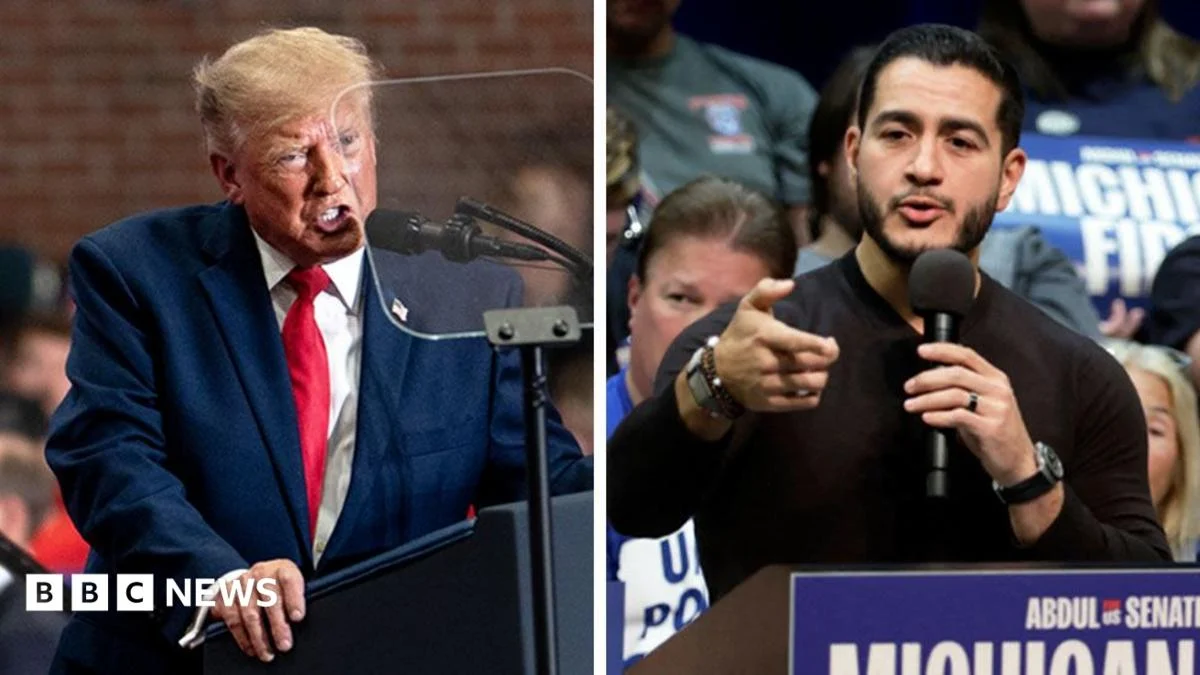
A recent political confrontation has intensified the debate surrounding the weaponization of national security narratives in American electoral contests, following incendiary remarks made by a former president targeting a prominent political figure. These comments, which evoked the tragic events of September 11, 2001, were coupled with accusations linking the individual to a contentious international organization, sparking immediate and widespread condemnation from across the political spectrum, including from former political allies. The episode underscores the persistent challenges faced by candidates from minority backgrounds and the enduring potency of certain rhetorical strategies in contemporary American politics.
The core of the controversy centers on the former president’s public statements directed at Abdulrahman Mohamed El-Sayed, a figure whose political aspirations have positioned him prominently within the American political landscape. The former president’s communication strategy deployed a potent combination of historical trauma and vague insinuation, drawing a parallel between El-Sayed and the September 11 attacks, while simultaneously asserting a connection to the Muslim Brotherhood, an organization with a complex and often debated history. This rhetorical maneuver is characteristic of a broader trend where national security concerns, particularly those related to perceived foreign influence or extremist ideologies, are leveraged to discredit political opponents.
Opponents of El-Sayed have consistently attempted to associate him with the Muslim Brotherhood, an Islamist organization established in Egypt. This narrative gained additional traction earlier this year when the former administration designated certain factions of the Muslim Brotherhood as Foreign Terrorist Organizations (FTOs), a move that complicated international relations and fueled domestic scrutiny. The accusations against El-Sayed draw heavily on historical records and personal connections, some dating back more than a decade, attempting to construct a narrative of ideological alignment.
Specific instances cited by critics include a social media post from 2012 by Eman Abdelhadi, El-Sayed’s half-sister, which reportedly stated, "my family has long been MB." While El-Sayed’s campaign has previously distanced him from other comments made by Abdelhadi, this particular post has been highlighted as indicative of a deeper, familial connection. Further scrutiny has been directed at an opinion piece El-Sayed authored for the Huffington Post in 2011. In this article, which discussed pro-democracy movements in Egypt, he acknowledged public anxieties that "supporting democracy in Egypt might allow the country to fall to the hands of the Muslim Brotherhood," a statement interpreted by critics as demonstrating a familiarity with or even an understanding of the organization’s potential influence.
Another point of contention arises from an alleged open letter from 2012, purportedly signed by a group of Egyptian Americans, including El-Sayed. This letter reportedly urged Mohamed Morsi, Egypt’s first democratically elected president and a prominent leader of the Muslim Brotherhood, to "purge the media and police" following the collapse of the authoritarian regime during the Arab Spring. This particular document, unlike the others, has not been publicly addressed or discussed by El-Sayed or his campaign, leaving it as an unrefuted, though unconfirmed, piece of the critical narrative.
In response to these persistent allegations, El-Sayed has consistently refuted any connection to the Muslim Brotherhood. He has publicly and repeatedly affirmed his unwavering loyalty to the United States. During a recent town hall event, when directly questioned about disavowing the organization, El-Sayed’s response was unequivocal: "Absolutely." This clear and concise repudiation aims to decisively counter the insinuations and reassure the electorate of his commitment to American democratic values.
The complexity of the situation is further underscored by past statements from El-Sayed’s current political opponent, who, in 2012, held a significant position as a U.S. Representative and chair of the House Intelligence Committee. At that time, this opponent reportedly advocated for a nuanced approach to the Muslim Brotherhood, suggesting cautious engagement. According to a Reuters report, he stated, "Do I think there are moderate Muslim Brotherhood individuals we are going to have to reach out to and talk to? Yes but we are going to have to watch it carefully." This historical position highlights the shifting and often inconsistent stances taken by political figures regarding organizations like the Muslim Brotherhood, depending on the prevailing geopolitical context and domestic political considerations.
The Muslim Brotherhood itself is an organization that has defied simple categorization since its founding in 1928. It emerged as a social, religious, and political movement advocating for an Islamic state based on Sharia law, often through a blend of social welfare programs, political activism, and, at various times, paramilitary activities. Its history is marked by periods of popular support, severe repression, and complex interactions with both authoritarian regimes and democratic forces across the Middle East. While some of its chapters have been implicated in or accused of supporting violent extremism, others have participated in democratic processes, forming political parties and contesting elections. The group’s ideological diversity and decentralized structure have led to differing interpretations of its objectives and methods globally. In the United States, debates about designating the entire organization as an FTO have been contentious, with proponents citing national security concerns and opponents warning of the diplomatic and geopolitical repercussions of such a broad designation. This intricate background makes any accusation of affiliation inherently fraught with nuance and open to varied interpretations.
According to HA Hellyer, a senior associate fellow at the Royal United Services Institute (RUSI) and an authority on Egyptian affairs, the current dispute transcends genuine concern over the Muslim Brotherhood. Hellyer posits that the controversy is more accurately understood as a manifestation of Islamophobia within the American political right, rather than a reflection of the former administration’s consistent policy stance on the Muslim Brotherhood. Hellyer argues that if the accusations were sincerely grounded in a principled opposition to the Muslim Brotherhood, the former president would logically demonstrate similar concerns when engaging with governments that have actively collaborated with the Brotherhood or even with groups further to its right. The absence of such consistent application, Hellyer contends, reveals a selective targeting driven by domestic political calculations and identity politics.
The former president’s provocative statements have not gone unchallenged. A significant wave of condemnation has emerged, notably from individuals who were previously key supporters. Bishara Bahbah, the founder of Arab Americans for Trump, a group credited with playing a crucial role in expanding the former president’s voter base in previous elections, expressed profound disapproval. Bahbah characterized the remarks as "out of line," "crossing a red line," and "racist." The gravity of such a rebuke, coming from a former ally instrumental in mobilizing a specific demographic, underscores the severity of the perceived transgression. The group Bahbah founded subsequently modified its name, removing the reference to the former president, signaling a clear rupture in political allegiance. This shift is particularly noteworthy given the former president’s electoral strategy, which saw victories in crucial swing states, including Michigan, a state with a substantial and politically influential Arab American population. The ability to garner support from this demographic was widely considered a factor in his previous electoral success.
When confronted with accusations of Islamophobia, a spokesperson for the former president, Davis Ingle, redirected the focus from the nature of the remarks to El-Sayed’s policy positions. Ingle stated that El-Sayed "wants to massively raise taxes, advocates for defunding the police, and wants to destroy the Michigan auto industry by banning gasoline powered vehicles." He concluded by asserting that the former president "will continue to call out complete and total extremists like El-Sayed without apology." This response frames El-Sayed as an "extremist" based on his policy platform, attempting to legitimize the initial personal attacks by connecting them to mainstream political disagreements.
This incident highlights a broader and increasingly problematic trend in contemporary American political campaigns: the weaponization of national security narratives and the deployment of identity-based attacks. For candidates like El-Sayed, who come from minority backgrounds, such tactics create an additional layer of scrutiny and often force them to defend their loyalty and identity rather than focusing on policy debates. The invocation of sensitive historical events, such as 9/11, in conjunction with vague accusations of association with controversial foreign entities, serves to amplify fear and suspicion, potentially alienating entire communities and chilling the participation of minority groups in the political process.
The political implications of this controversy are multi-faceted. For the former president, alienating segments of the Arab American community, particularly in a critical state like Michigan, could pose a challenge in future electoral contests. For El-Sayed, the sustained effort to link him to the Muslim Brotherhood, regardless of the veracity of the claims, forces him to expend valuable campaign resources and political capital on defense rather than offensive messaging. Furthermore, the episode contributes to an increasingly polarized political discourse, where complex geopolitical issues and nuanced individual histories are reduced to simplistic, often incendiary, accusations for immediate political gain. The long-term impact on democratic participation and the health of public debate remains a significant concern.



 Aura Kasih

 Ayu Aulia

 Safa Marwah