
 Lisa Mariana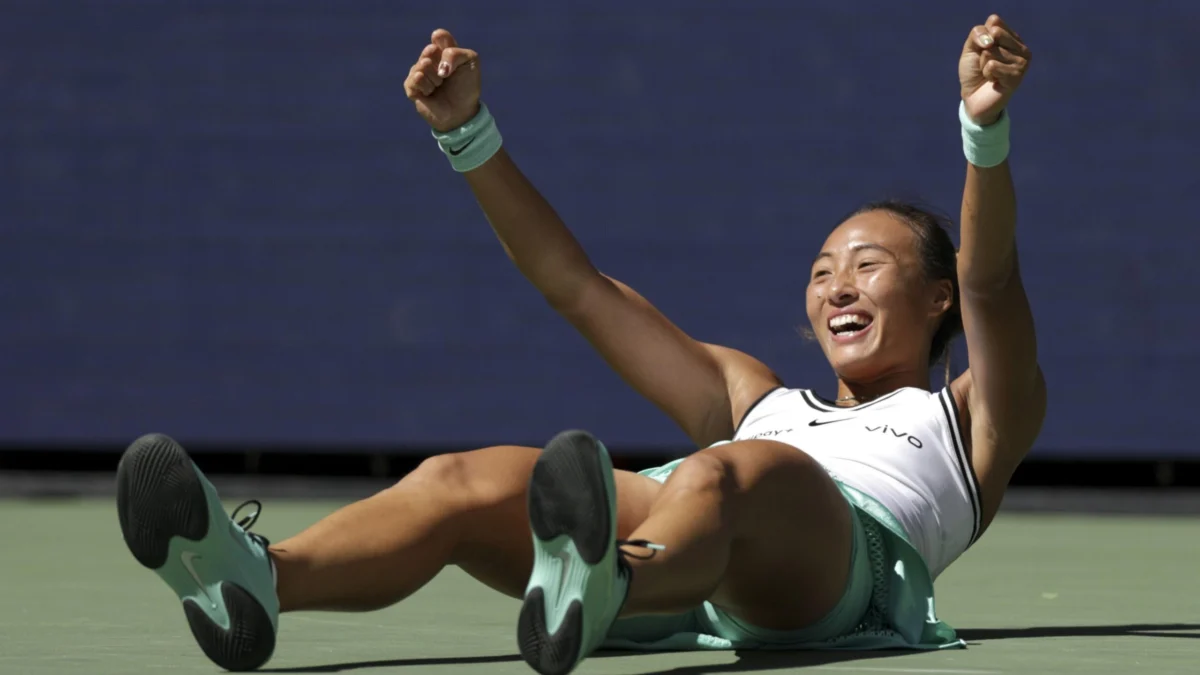
In a stunning display of unwavering resolve and tactical prowess, Zheng Qinwen orchestrated a remarkable upset at the 2026 US Open, dethroning former champion Iga Swiatek in a gripping fourth-round encounter that underscored her dramatic return to elite form. The Chinese sensation, whose journey through the draw has been nothing short of extraordinary, secured her place in the quarter-finals with a 7-5, 6-3 victory on Arthur Ashe Stadium, confounding expectations and setting a new benchmark for her resurgent career.
The dramatic narrative of Zheng’s performance against Swiatek was amplified by a recurrence of her previous match’s heroics. For the second consecutive round, Zheng found herself staring down a 5-0 deficit in a set, only to engineer an improbable turnaround. Against Madison Keys in the third round, she rallied from 0-5 down in the deciding set to win seven straight games. This time, facing the formidable eighth seed, Iga Swiatek, Zheng replicated the feat in the opening set, clawing back from 0-5 to seize it 7-5. This astonishing display of mental fortitude and tactical adaptation not only captivated the Flushing Meadows crowd but also signaled a profound shift in momentum, ultimately paving the way for her straight-sets triumph.
Zheng Qinwen’s trajectory in the professional tennis circuit has been a tumultuous one, marked by both meteoric rises and challenging setbacks. A former world number four and the reigning Olympic champion from the 2024 Paris Games, her career seemed to be on an unyielding ascent. However, a significant elbow surgery in July 2025 forced her off the tour, leading to a precipitous drop in her ranking, pushing her outside the world’s top 100 earlier this year. Her current run at the US Open is therefore not merely a series of wins but a powerful testament to her rehabilitation, resilience, and unwavering belief in her capabilities. Having navigated three demanding rounds of qualifying, her current streak of seven consecutive victories in New York is a potent indicator of her rediscovered rhythm and confidence. This latest win is projected to catapult her back towards the cusp of the top 50, a significant stride in her ongoing climb back to the sport’s upper echelons.

The psychological impact of Zheng’s comebacks cannot be overstated. To recover from a 5-0 deficit in two consecutive high-stakes Grand Slam matches speaks volumes about her mental strength and ability to problem-solve under extreme pressure. Against Swiatek, the early games of the first set saw the Pole asserting her characteristic dominance, employing her powerful groundstrokes and tactical precision to quickly establish a commanding lead. Spectators and analysts alike were likely preparing for a routine set victory for Swiatek. Yet, Zheng, often referred to as "Queen Wen" by her fans, refused to yield. Her service games became more potent, her returns more aggressive, and her movement more fluid. She began to find her range, unleashing powerful forehands and backhands that started to penetrate Swiatek’s defense, slowly chipping away at the lead. The shift in dynamic was palpable, as Zheng’s audacious shot-making gradually unsettled Swiatek, leading to a series of unforced errors from the usually composed Pole. The momentum swing was complete when Zheng clinched the first set, sending a clear message that she was not to be underestimated.
The second set, while not featuring another dramatic 5-0 comeback, was equally indicative of Zheng’s sustained pressure. It remained on serve until the crucial seventh game, where Zheng executed a perfectly timed, powerful backhand return winner to secure a decisive break. This pivotal moment visibly deflated Swiatek, who had also received treatment for her left thigh earlier in the set, perhaps indicating underlying physical discomfort. Zheng capitalized on her opponent’s vulnerability, breaking serve once more two games later to seal the 7-5, 6-3 victory. Her ability to maintain a high level of play and convert critical opportunities showcased a maturity in her game that belies her 23 years.
For Iga Swiatek, the 2026 US Open exit in the fourth round marks a disappointing conclusion to her Grand Slam season. A six-time major winner, Swiatek has endured a challenging year on the sport’s biggest stages. Her best result at a major this year was a quarter-final appearance at the Australian Open, followed by a fourth-round exit at her beloved French Open and a third-round defense of her Wimbledon title. This series of results means that, for the first time since 2021, Swiatek will conclude a year without adding a major title to her impressive resume. This slump raises questions about the pressures on former champions and the increasing depth of talent in women’s tennis.
Swiatek had entered the US Open in formidable form, having recently claimed the WTA 1000 event in Toronto and reaching the semi-finals in Cincinnati. She had also progressed through the opening rounds in New York without dropping a single set, suggesting she was peaking at the right time. However, her reflection on the match against Zheng pointed to a breakdown in execution rather than a mental lapse. "My focus was the same as always," Swiatek stated, "I wanted to play the same as always. [I] just started to miss too much, wanted to adjust it, but nothing kind of worked at that point." She further elaborated, "I wouldn’t say it had anything to do with mentality. It was more that I started making mistakes from easy balls and Qinwen stopped doing mistakes. She played the balls better." This self-assessment, while acknowledging Zheng’s improved play, underscores the fine margins at the elite level, where even slight dips in consistency can be exploited by an in-form opponent. The inability to adjust or regain her precision after building such a dominant lead will be a significant point of reflection for her team.

The wider context of Zheng’s phenomenal run brings to mind the "year of the qualifier" phenomenon, drawing parallels with other remarkable Grand Slam performances by unseeded players. The most recent and iconic example is Great Britain’s Emma Raducanu, who, as a qualifier, astonishingly swept to the US Open title in 2021. More recently, Poland’s Maja Chwalinska, ranked 114th in the world at the start of the 2026 French Open, made a Cinderella run to the final at Roland Garros, ultimately falling to Russian teenager Mirra Andreeva. These instances highlight a recurring theme in modern tennis: the increasing depth of talent and the ability of players, regardless of their ranking, to perform at peak levels when momentum aligns. Daniela Hantuchova, a former world number five, succinctly captured the sentiment, stating, "She [Zheng] is starting to be very dangerous for the rest of the players left. I don’t want to say she’s playing the best tennis out of everyone, but if you have Iga Swiatek panicking on the other side of the court, not knowing what to do, that says a lot." This expert observation reinforces the idea that Zheng’s current form is not just about her individual brilliance but also her psychological impact on seasoned opponents.
Looking ahead, Zheng Qinwen now faces a formidable challenge in the quarter-finals, where she will meet the winner of the highly anticipated clash between former US Open champion Naomi Osaka and second seed Elena Rybakina. Both Osaka and Rybakina possess Grand Slam-winning pedigree and powerful games, promising another stern test for the Chinese qualifier. Her ability to maintain her high level of play, particularly her potent serve and aggressive groundstrokes, will be crucial against either of these elite players. The quarter-final stage at a major is a different beast, often requiring an even greater depth of tactical planning and mental resilience.
Beyond Zheng’s heroics, the women’s draw continued to unfold with other compelling narratives. French Open winner Mirra Andreeva, aged 19, showcased her own brand of resilience, recovering from losing the first set to Austria’s Anastasia Potapova to secure her maiden quarter-final appearance at the US Open. Their match on Louis Armstrong Stadium was a hard-fought battle that unfortunately ended with Potapova injuring her knee in the final game. Andreeva, demonstrating admirable sportsmanship, was quick to console her opponent. "Anastasia is my good friend and seeing what a battle we had and seeing her fall like that in the last game, it’s not easy," Andreeva shared, adding, "I told her that she’s been playing amazing and having one of her best seasons. I’m sure she’ll come back even stronger – she’s a warrior and an even better fighter than me." Andreeva’s 5-7, 6-4, 6-3 victory sets up a quarter-final clash against either Coco Gauff or Iva Jovic, promising another exciting all-American encounter.
The implications of Zheng’s victory extend beyond the immediate tournament. Her Olympic gold in 2024 and this deep run at the US Open firmly establish her as a top contender, capable of challenging for the sport’s biggest prizes. Her story of overcoming injury and fighting back from a ranking slump resonates deeply, inspiring both within the sport and beyond. For Chinese tennis, Zheng’s success provides a significant boost, further cementing the country’s growing presence on the international tennis stage. Her ability to deliver under pressure, coupled with her formidable game, suggests that this US Open run is not an anomaly but a harbinger of continued success. The competitive landscape of women’s tennis appears more open and unpredictable than ever, with a new generation of talent, alongside resurgent veterans, making every Grand Slam a captivating spectacle. As the tournament progresses, all eyes will be on Zheng Qinwen to see if she can continue her astonishing journey and etch her name into the annals of US Open history.




 Aura Kasih
 Ayu Aulia

 Safa Marwah