Ayu Aulia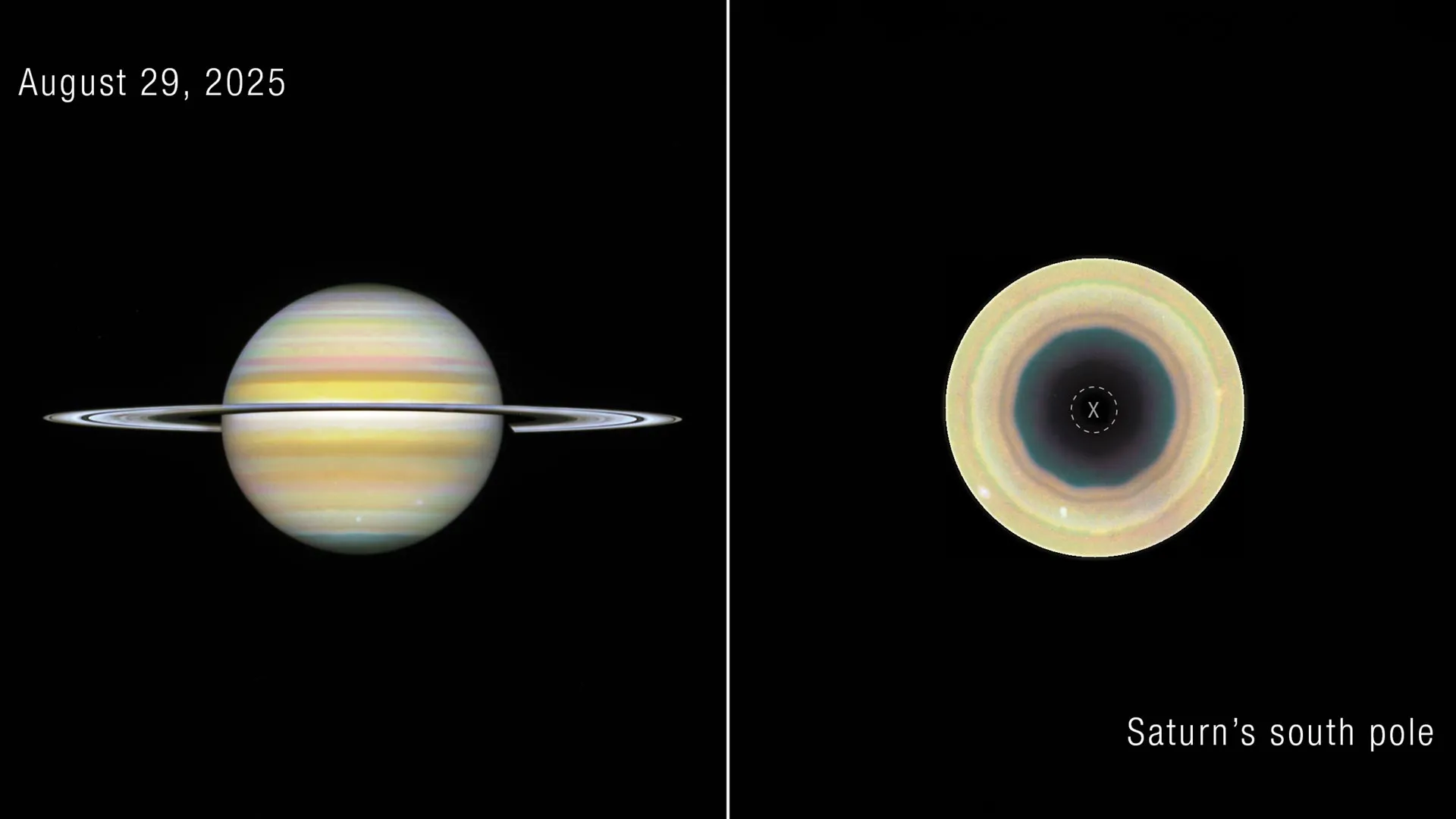
Astronomers leveraging the capabilities of the Hubble Space Telescope have documented the emergence of a colossal, dynamically evolving ten-sided wave structure encircling Saturn’s southern polar region, representing the inaugural observation of a substantial, geometrically organized jet stream pattern within the planet’s southern hemisphere. This newly identified phenomenon bears some superficial resemblances to the iconic hexagonal vortex situated at Saturn’s northern pole, yet critical distinctions suggest researchers may be witnessing a profoundly different and still-unfolding atmospheric process. The comprehensive findings from this investigation have been formally presented in the esteemed journal Science Advances.
Saturn, a colossal gas giant renowned for its spectacular ring system, also harbors an incredibly complex and dynamic atmosphere. Its upper reaches are characterized by powerful, eastward-flowing jet streams and colossal storms, some of which persist for centuries. For decades, one of the most enigmatic features of this planetary behemoth has been the stable, six-sided storm system dominating its north pole – a vortex of such immense scale that Earth could comfortably fit inside it. This persistent hexagonal shape, first observed by the Voyager spacecraft in the early 1980s and subsequently studied in detail by the Cassini mission and Hubble, has long puzzled planetary scientists, representing a unique example of large-scale atmospheric geometry. The discovery of a comparable, albeit distinct, multi-sided pattern in the planet’s southern hemisphere therefore marks a significant advancement in understanding the intricate fluid dynamics governing such alien worlds.
The Emergence of an Unprecedented Southern Pattern
The revelation of this southern decagon did not occur instantaneously but rather through a meticulous reconstruction of several years of observational data from the Hubble Space Telescope, tracing back to early 2023. Initial images from this period contained only faint, almost imperceptible indications of the nascent structure. However, subsequent observations revealed a progressive intensification and refinement of the pattern, culminating in the much more defined and clearly discernible decagon observed in recent times. These crucial data points were primarily gathered through Hubble’s Outer Planet Atmospheres Legacy (OPAL) program, an ambitious long-term initiative that has systematically captured annual imagery of the outer planets for over a decade. This sustained observational commitment proved indispensable, transforming isolated snapshots into a continuous narrative of atmospheric evolution.
Dr. Amy Simon, a co-author of the study and the principal investigator for the OPAL program at NASA’s Goddard Space Flight Center in Greenbelt, Maryland, emphasized the unprecedented nature of this finding. "We have never encountered anything quite like this within Saturn’s southern hemisphere before," stated Dr. Simon. "The northern hexagon has been a constant fixture, observable every time we’ve directed our instruments towards it for more than four decades. This new feature exhibits a different character; it appears to be actively strengthening and developing, affording us the extraordinary opportunity to monitor the genesis and evolution of a colossal atmospheric pattern in real-time."
A critical factor contributing to this discovery was Saturn’s progression through its distinct seasonal cycle. Like Earth, Saturn experiences seasons, albeit over much longer timescales due to its extended orbital period. As the planet gradually transitioned, its southern pole, previously obscured from Earth’s direct line of sight, became increasingly visible. This improved viewing geometry allowed astronomers, initially those utilizing ground-based observatories, to first discern the unusual structure emerging within the polar vortex.
Collaborative Astronomy: Amateur Contributions to the Decagon’s Detection
The initial identification of the decagon was a testament to the power of collaborative science, involving both professional researchers and dedicated amateur astronomers. The study’s lead author, Dr. Agustín Sánchez-Lavega, a distinguished researcher at the University of the Basque Country in Spain, spearheaded this effort. His institution operates the Planetary Virtual Observatory Laboratory, an invaluable online platform that aggregates and archives ground-based telescopic images of solar system planets submitted by observers across the globe.
In images acquired during 2024, Dr. Sánchez-Lavega, alongside accomplished amateur astronomers Trevor Barry and Jean-Paul Oger, noted the presence of a subtle, undulating band positioned near Saturn’s south pole. This initial observation, while intriguing, required further corroboration. Subsequent ground-based data collected in 2025 provided substantially stronger evidence, indicating that the feature had indeed evolved into a distinct decagonal shape. With this compelling preliminary evidence, the research team then turned to the Hubble Space Telescope to obtain a far more detailed and definitive view. The inherent advantage of a space-based observatory like Hubble lies in its ability to capture exceptionally sharp images across entire rotations of Saturn, entirely unhindered by the blurring and distortion caused by Earth’s turbulent atmosphere.
Dr. Sánchez-Lavega further elaborated on the long-standing quest for such a feature: "Given the inherent symmetry observed in Saturn’s north-south jet stream system, our team has actively sought a southern counterpart to the northern hexagon in Hubble images since as far back as 1990." He continued, "Even the extensive dataset from NASA’s Cassini spacecraft, which meticulously orbited Saturn between 2004 and 2017, provided no indication of a long-lived, geometrically regular formation at the southern pole. It was the recent Hubble data that definitively confirmed the feature’s presence, tracing its origins back to 2023." This historical context underscores the truly novel nature of the decagon’s appearance.
Delving into the Depths: The Decagon as a Vertically Extended Structure
Crucially, the newly identified wave is not merely a superficial cloud pattern. Scientific observations indicate that it is intricately embedded within one of Saturn’s powerful, high-velocity jet streams. Furthermore, the data demonstrate that this structure extends significantly through multiple atmospheric layers, implying that it is not confined solely to the planet’s cloud tops. Instead, the decagon manifests as a vertically extended atmospheric formation, a "deep atmospheric structure" that influences the planet’s weather patterns at considerable altitudes.
The apparent location of the decagon exhibits subtle variations depending on the specific wavelength of light employed by Hubble during observation. This phenomenon is highly informative: different wavelengths of light penetrate to varying depths within Saturn’s gaseous atmosphere. Consequently, these wavelength-dependent shifts in the decagon’s perceived position provide invaluable insights into its three-dimensional structure and its vertical extent, revealing that it is indeed a complex, multi-layered feature rather than a simple surface phenomenon.
Dr. Simon reiterated the profound questions this discovery raises: "The most captivating aspect for me is that this appears to be a very recent formation. The fundamental question we must now address is: why has it suddenly emerged now, given that we have observed no such feature previously?" This inquiry delves into the very mechanisms that drive large-scale atmospheric patterns on gas giants, prompting scientists to reconsider previously held assumptions about the stability and variability of such systems.
The precise triggers for the decagon’s formation remain an area of active investigation, and its long-term stability is currently unknown. The research team emphasizes that continued observations from both the Hubble Space Telescope and its successor, NASA’s James Webb Space Telescope, will be indispensable. These observations, combined with advanced computational modeling, will be crucial for deciphering the intricate processes that led to its formation, predicting its potential longevity, and meticulously comparing its characteristics to those of Saturn’s enduring northern hexagon.
Decades of Hubble’s Vigilance: Unveiling Planetary Transformations
The extensive operational history of the Hubble Space Telescope has bestowed upon astronomers an unparalleled capability to meticulously track changes occurring on planets and other celestial bodies over protracted periods. This sustained observational capacity is particularly vital for studying dynamic systems like planetary atmospheres, which evolve on timescales ranging from days to decades.
The OPAL program exemplifies this value, providing far more than isolated snapshots of planetary phenomena. Its regimen of repeated, annual observations empowers scientists to precisely monitor subtle seasonal shifts, track the genesis and dissipation of transient storms, and, critically, identify large-scale atmospheric patterns that develop gradually over many years. This longitudinal data collection transforms astronomy from a study of static objects into a vibrant exploration of cosmic evolution.
Mike Wong, a co-author of the study from the University of California, Berkeley, underscored the profound impact of this long-term approach. "When we initially conceived the OPAL program, we fully anticipated compelling surprises, but the specifics remained entirely unknown," Wong stated. "A significant proportion of the groundbreaking discoveries emanating from OPAL are not predicated on a single observation, but rather on the synthesis of years, even decades, of accumulated data. These systematic, regular observations over extended periods are unequivocally enabling a wealth of novel scientific findings."
Researchers are committed to maintaining continuous surveillance of Saturn, keenly observing whether this southern decagon will eventually stabilize and persist as a long-lived, fixed feature, akin to the iconic northern hexagon, or if it will continue its dynamic evolution, potentially dissipating or transforming into an entirely different configuration.
Future observations are also expected to illuminate the underlying energy mechanisms that power this immense wave structure. More broadly, such findings promise to significantly enhance humanity’s understanding of atmospheric behavior not only on giant planets across our solar system but also potentially offer profound insights into fundamental atmospheric dynamics that govern weather and climate systems even on Earth. The study of distant worlds, therefore, continues to yield invaluable lessons applicable to our own terrestrial environment.



 Lisa Mariana
 Aura Kasih
 Safa Marwah