Safa Marwah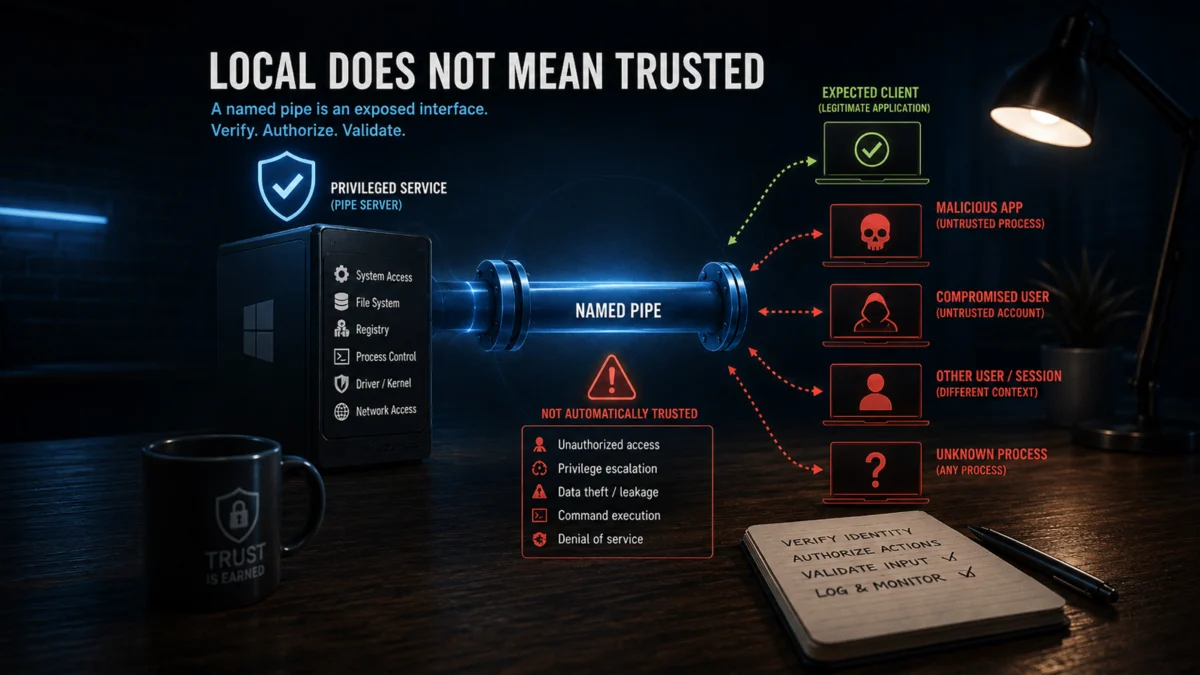
Inter-process communication (IPC) mechanisms are fundamental to modern operating systems, enabling diverse applications to interact efficiently. On Windows platforms, named pipes stand out as a widely adopted method for local IPC, valued for their efficiency and direct operating system support. However, their pervasive use introduces significant security complexities, particularly when bridging privilege boundaries within a single system, demanding rigorous security practices to prevent exploitation.
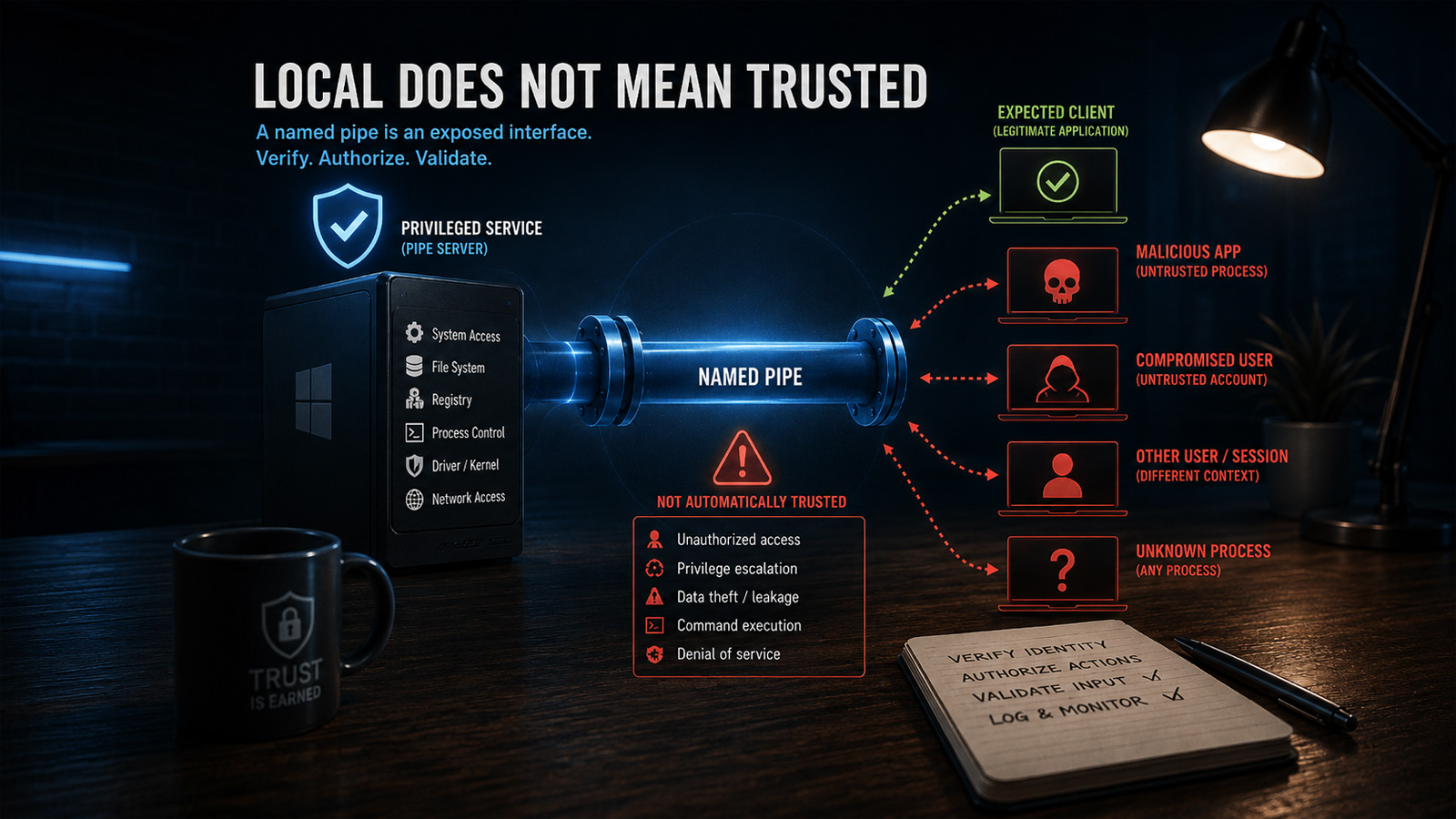
Named pipes facilitate communication between various components on a Windows machine, including system services, desktop applications, background agents, and command-line utilities. A typical architectural pattern involves a highly privileged Windows service operating as a named pipe server, responding to requests from a less privileged user-facing client application. Developers frequently assume that because both processes reside on the same computer, this communication is inherently secure and can be implicitly trusted. This assumption, however, represents a critical security oversight.
The Illusion of Local Trust
The notion that local communication inherently implies trust is a dangerous misconception in the realm of cybersecurity. A Windows workstation is a complex ecosystem, hosting a multitude of processes operating under disparate security contexts. These contexts range from the highly privileged LocalSystem account to standard user accounts, service accounts, and even processes running within isolated interactive or remote sessions. Furthermore, any given system may harbor third-party software, administrative scripts, diagnostic tools, or malicious payloads operating under a compromised user or service account.
Any process possessing knowledge of a named pipe’s identifier and adequate access rights can attempt to establish a connection. The Windows operating system does not possess intrinsic mechanisms to ascertain which specific executable the developer intended to utilize a particular pipe. Consequently, a named pipe must be approached as an exposed local interface, similar to a network port. Before any request is processed, an application must meticulously verify the identity of the connecting entity, evaluate its authorization level for the requested operation, and meticulously scrutinize the integrity and safety of any submitted data. Failure to adhere to this principle creates avenues for unauthorized access and privilege escalation.
Establishing Robust Identity, Access Control, and Privilege Boundaries
The most pronounced security risks emerge when a highly privileged Windows service communicates with a less privileged client application. A service operating with LocalSystem privileges, for instance, possesses the capability to modify protected system files and registry keys, initiate new processes, alter system-wide configurations, access sensitive data belonging to other users, or interact directly with kernel drivers. When such potent operations are exposed via a named pipe, the pipe effectively transforms into an Application Programming Interface (API) for privileged functionality, necessitating stringent controls.
A successful connection to a named pipe merely confirms that the client possessed the requisite permissions to open the pipe. It does not validate:
- The client’s true identity or the process it originates from.
- The client’s specific authorization to perform the requested operation.
- The integrity of the data transmitted through the pipe.
Therefore, explicit and granular pipe permissions are paramount. These permissions must be precisely defined and restricted to the smallest appropriate set of trusted identities. Broad permissions granted to groups like Everyone, Authenticated Users, or all interactive users significantly expand the attack surface, potentially allowing unrelated or malicious processes to connect to and interact with the pipe.
Authentication and authorization must be treated as distinct security layers. While a user might be authenticated and permitted to query the status of a service, this does not automatically grant permission to stop the service, alter protected settings, launch arbitrary processes, or access sensitive files. Critical and sensitive commands must undergo individual authorization checks.
Impersonation can be a valuable tool, allowing the server to temporarily execute operations under the client’s security context. However, its implementation demands meticulous attention. The server must verify that impersonation was successful, strictly limit the scope and duration of operations performed under the client’s identity, and unfailingly revert to its original security context upon completion.
Mitigating Risks from Untrusted Servers, Commands, and Data
The security burden is not solely on the server; clients must also verify the server’s legitimacy. A predictable named pipe identifier is merely a label, not a secret, and offers no inherent proof of the creating process’s authenticity. An attacker could potentially create a named pipe with the expected name before the legitimate server initializes, leading clients to connect to a malicious, attacker-controlled process. While the "first-pipe-instance" option can help detect such name squatting, it does not substitute for robust access controls or explicit server identity verification.
Furthermore, all messages received through a named pipe must be treated as untrusted input. Even an authenticated and legitimate client application might be compromised, contain a vulnerability, or transmit user-controlled data that can be manipulated. Attackers can leverage such input to:
- Inject malicious code or commands.
- Manipulate file paths to achieve directory traversal or access unauthorized resources.
- Overload the server with excessive or malformed data, leading to denial of service.
- Trigger unexpected or dangerous behavior through crafted inputs.
A privileged service that directly translates untrusted input into file system, registry, process, or command-line operations becomes a "confused deputy." In this scenario, the attacker supplies the instruction, and the privileged service unwittingly executes it with elevated rights. To counteract this, requests must adhere to strict message framing, bounded sizes, command allowlists, rigorous schema validation, path normalization, operation-specific authorization, and secure error handling.
Addressing Availability and Remote Exposure Threats
Named pipe security extends beyond privilege escalation and unauthorized command execution to encompass availability and remote access risks. A malicious or malfunctioning process can initiate repeated connections, hold connections open indefinitely, transmit incomplete messages, or submit requests designed to consume excessive CPU, memory, or kernel resources. This can lead to a denial-of-service (DoS) attack, rendering the service unavailable to legitimate clients.
Servers should implement connection limits, timeouts, cancellation mechanisms, bounded message sizes, controlled concurrency, and rate limiting to maintain service availability. It is also a critical error to assume that named pipes are exclusively reachable from the local computer. Windows named pipes can, in certain configurations, support remote access. Pipes designed solely for local IPC must explicitly block network identities, such as NT AUTHORITYNETWORK, or leverage mechanisms that guarantee local-only communication. The correct threat model dictates that every named pipe connection must be considered potentially hostile until the identity of both client and server, their permissions, the requested operation, and the message contents have all been thoroughly verified.
Named Pipes as Security Boundaries: Deconstructing the Attack Surface
A named pipe invariably becomes a security boundary when the interacting processes operate under different privilege levels or trust domains. The classic example involves a Windows service running as LocalSystem and a desktop application under a standard user account. The service possesses capabilities (e.g., modifying protected system files, initiating processes, accessing other users’ data) that the desktop application cannot directly perform. When the service accepts commands via a named pipe, this pipe effectively becomes an interface to these privileged capabilities. Any vulnerability in the pipe’s permissions, identity verification, command validation, or authorization logic can allow an untrusted local process to exploit the service’s elevated privileges.
A successful connection merely indicates sufficient permission to open the pipe, not that the client is the intended application. Another process operating under the same user account might possess identical access rights. Therefore, the server must validate the security identity associated with the connection, rather than relying on the process name, executable path, or the perceived secrecy of the pipe name.
Furthermore, each operation must be authorized independently. A client permitted to query service status should not automatically be granted permission to stop the service, modify critical configuration, launch a process, or request access to an arbitrary file. Authentication confirms who connected; authorization determines what that identity is permitted to do.
This distinction is particularly vital when the server processes client-controlled inputs such as file paths, command-line arguments, registry locations, executable names, or serialized commands. Without stringent validation, the service can become a "confused deputy," where the client dictates the action, and the privileged service executes it. For instance, a seemingly innocuous request to "Read file: C:ProgramDataProductstatus.json" can become highly dangerous if an attacker substitutes the path with "Read file: C:WindowsSystem32configSAM," gaining access to sensitive system credentials.
Secure named pipe servers must implement a multi-layered verification strategy:
- Strict Security Descriptors: Apply explicit Access Control Lists (ACLs) to the pipe, granting access only to authorized Windows identities.
- Client Identity Verification: Confirm the security identity of the connecting client (e.g., user SID, process ID, executable path, digital signature).
- Command Validation: Ensure that the requested command is part of an allowed set and that its parameters conform to strict specifications.
- Resource-Specific Authorization: Verify that the identified client is authorized to perform this specific command on this specific resource.
- Data Integrity Checks: Validate all input data for format, bounds, and content safety.
The more generalized a pipe protocol becomes, the more it resembles a privileged local API, and thus, the more rigorously it must be secured. The core design principle remains: a pipe server must never perform an operation solely because a client requested it. It must only act after confirming the requestor’s identity, their authorization for the specific action, and that the request adheres to narrowly defined security boundaries.
Impersonation and Prudent Privileged Operations
When a named pipe server operates with higher privileges than its client, unbridled execution of client requests under the server’s identity can lead to indirect privilege escalation. Named pipe impersonation offers a mechanism for the server to temporarily execute code within the security context of the connected client. This shifts resource access checks from the service account’s token to the client’s token.
In environments like .NET, NamedPipeServerStream.RunAsClient provides a controlled way to achieve this. This approach is beneficial when an operation should only succeed if the client’s own Windows account possesses the necessary permissions, such as reading a user-owned file or accessing a user-specific registry key.
However, impersonation is a complementary control, not a substitute for comprehensive authorization. The server must still verify that the client is authorized to request the operation itself. Impersonation merely alters the security context for access checks; it does not validate the appropriateness of the command. Moreover, privileged services must avoid unnecessary context switching. If a file is read under client impersonation but then installed as configuration under LocalSystem, the client still influences a privileged operation.
The safest approach involves separating operations into distinct stages:
- Receive and Validate Request: Under the service’s original context.
- Impersonate Client: Only for specific, client-scoped access checks.
- Perform Client-Scoped Operation: While impersonating.
- Revert to Self: Immediately after the client-scoped task.
- Authorize and Execute Privileged Operation: Under the service’s context, using validated data from the client-scoped stage.
The scope of impersonation should be minimal. Long-running tasks, asynchronous operations, or unrelated service logic should never execute under a client’s identity. When using native Windows APIs like ImpersonateNamedPipeClient and RevertToSelf, robust error handling is critical. A failed impersonation attempt must lead to request rejection, not a silent fallback to the server’s privileged account.
Privileged pipe commands should be narrow and purpose-specific. Broad commands like "Write any value to any registry key" significantly increase the attack surface compared to "Update the application’s approved policy setting." Each privileged command must define precisely which resources are accessible, which values are accepted, and which client identities are authorized to invoke it. Impersonation, therefore, is most effective as one layer within a comprehensive security design that includes restrictive pipe permissions, client verification, command authorization, strict input validation, and narrowly scoped privileged operations.
Treating Pipe Messages as Fundamentally Untrusted Input
Even after a client’s process is verified, its messages cannot be blindly trusted. The legitimate application itself might be compromised, contain a vulnerability, or transmit user-controlled data that can be maliciously manipulated. A malicious process might also obtain or inherit a valid pipe handle. Consequently, every message received through a named pipe must be treated as untrusted input. The server is responsible for validating both the message’s structure and the legitimacy of the requested operation before executing any privileged action.
A dangerous implementation might directly deserialize and execute requests: File.WriteAllText(request.Path, request.Content). Even if the request has the expected structure, values like Path and Content remain client-controlled, potentially allowing a privileged service to overwrite system files or consume excessive disk space. The secure approach dictates exposing narrowly defined commands and validating every field against an allowlist or a tightly defined range. General-purpose operations like WriteFile(path, content) should be avoided in favor of application-specific requests like UpdateApplicationConfiguration(configuration).
Protocols must define explicit message framing (e.g., fixed-size headers with length-prefixed payloads) to prevent message boundary issues. The declared payload length must be validated against a maximum size before memory allocation to prevent resource exhaustion attacks. Furthermore, successful deserialization only confirms type conversion, not value acceptability. File paths, for instance, must be normalized and strictly checked against an approved directory. The same applies to registry paths, process arguments, URLs, and configuration values.
Malformed or unauthorized messages must be rejected immediately without partial processing. Error responses to the client should be generic and controlled (e.g., InvalidRequest, Unauthorized, InternalError), avoiding the exposure of stack traces, internal paths, or sensitive diagnostic information. Detailed logs should be written to protected service logs for internal auditing. The processing sequence should always involve connection establishment, client identity verification, message deserialization, command validation, authorization, and finally, execution. A named pipe is merely a transport; it does not guarantee data trustworthiness or prevent malicious requests.
Denial-of-Service and Remote-Access Risks: Maintaining Availability and Isolation
A named pipe endpoint, even if protected against unauthorized commands, can remain vulnerable to denial-of-service (DoS) attacks. An attacker may not need to perform privileged operations; merely disrupting legitimate application communication can be sufficient. Malicious or malfunctioning processes can repeatedly connect, exhaust available pipe instances, hold connections open without completing messages, or continuously reconnect. This can prevent legitimate clients from establishing connections.
Post-connection, a client can send data at an extremely slow pace (slowloris attack), declare an oversized payload, terminate transmission mid-message, or flood the server with valid but resource-intensive requests. Without appropriate limits, these actions can exhaust threads, memory, CPU, and kernel resources. Named pipe buffers themselves consume kernel nonpaged pool, making unrestricted instance creation or excessively large buffers contributors to system resource exhaustion.
A robust server must implement clear limits for:
- Maximum number of concurrent connections.
- Connection idle timeouts.
- Maximum message size.
- Overall processing time for a request.
- Rate limits per client or user.
- Bounded internal queues.
Blocking operations must support cancellation and avoid indefinite waiting. When limits are exceeded, the server should promptly terminate the connection and release resources. Limits should be enforced before resource-intensive work begins (e.g., rejecting an oversized payload before buffer allocation). Authorization and basic validation should precede disk access, process creation, or cryptographic operations.
Furthermore, availability controls cannot solely rely on the client PID, as processes can restart or attackers can leverage multiple processes under the same user account. A global limit is always necessary.
A frequently overlooked risk is remote accessibility. Windows named pipes are not inherently restricted to local communication; they can support network communication. Microsoft explicitly states that named pipes may be remotely accessible if the Windows Server service is running. This implies that using a local pipe name does not automatically guarantee local-only communication. Pipes intended exclusively for local IPC must explicitly enforce this. Native pipe servers can specify PIPE_REJECT_REMOTE_CLIENTS to automatically block remote connections. Alternatively, the pipe’s access-control list can deny access to the NT AUTHORITYNETWORK identity. For strict interactive session restriction, access should be granted to specific logon SIDs rather than broad user groups. These protections should be combined for maximum security.
Designing a Secure Named Pipe Architecture: Principles for Resilience
A secure named pipe architecture minimizes both the number of exposed operations and the volume of privileged code directly processing client-controlled data. The pipe should function as a narrow, well-defined communication boundary, not a general-purpose interface to the operating system. A practical architecture separates connection handling, validation, authorization, and privileged execution into distinct, manageable layers.
The client should never interact directly with general-purpose privileged functionality. Instead, it submits narrowly defined requests to a pipe gateway. This gateway validates the message format and forwards only structured, validated requests to an authorization layer. Privileged work commences only after all security checks have successfully passed.
Key Architectural Principles:
- Narrow Protocol Design: The pipe protocol should expose business operations (e.g.,
RequestPolicyRefresh,InstallApprovedUpdate) rather than operating system primitives (WriteFile,StartProcess). This facilitates practical authorization and validation. - Separation of Access and Permission: Permission to connect to the pipe should not imply permission to utilize every feature. The pipe’s security descriptor controls connection, while the server identifies the client and authorizes each command independently. For highly sensitive operations, separate named pipes (
Product.Status,Product.Admin) with distinct ACLs may be preferable. - Multi-Layered Identity Verification: No single identity check is conclusive. Combine explicit security descriptors, client security identity validation (user SID), process ID checks, executable path verification, and optional digital signature validation. PID and path checks serve as defense-in-depth controls, acknowledging that processes can change or handles can be transferred.
- Isolation of Privileged Execution: The component responsible for reading pipe messages should perform minimal privileged work. Connection handling, deserialization, and basic validation, being exposed to attacker-controlled input, should be isolated from privileged operations. For highly sensitive applications, the pipe gateway and privileged worker can be separated into distinct processes, with the gateway running with reduced privileges and forwarding only approved operations via a second, restricted channel.
- Controlled Connection Lifecycles: Every accepted connection must have a clear, bounded lifecycle, including idle timeouts, request deadlines, connection limits, cancellation support, and bounded queues. Long-running operations should not block the pipe’s reader; instead, requests can be accepted, an identifier assigned, and progress queried separately.
- Server Authority: The client requests an outcome, but the server determines how that outcome is achieved. For instance, the client requests an update by identifier, and the server resolves the package location, verifies its signature, and enforces the installation destination. The server must independently verify any security claims previously made by the client.
- Security-Relevant Activity Auditing: Implement robust logging for security-relevant events, including connection attempts (success/failure), client identity, peer PID, command types, and results. Avoid logging raw secrets or sensitive payloads.
The recommended architecture for most privileged Windows service scenarios includes a restrictive pipe security descriptor, explicit client identity verification, strict message schema validation, command allowlisting, granular operation-level authorization, and a bounded concurrency model with timeouts and resource limits. The fundamental principle is to expose the smallest possible interface between trust levels, preventing arbitrary privileged operations.
Practical Named Pipe Security Checklist
Before deploying any application functionality exposed via named pipes, developers and security professionals should confirm adherence to the following critical measures:
- Explicit Security Descriptors: Are pipe permissions precisely defined and restricted to the minimum necessary Windows identities?
- Local-Only Enforcement: Is
PIPE_REJECT_REMOTE_CLIENTSused, or are network identities explicitly denied access for local IPC? - Client Identity Verification: Does the server verify the client’s actual Windows security identity (user SID, process details) before processing commands?
- Command Allowlisting: Does the server only accept a predefined set of narrowly scoped, application-specific commands?
- Strict Input Validation: Is every field in every message validated for type, range, format, and content safety (e.g., path normalization)?
- Message Framing: Is the message protocol robust against partial reads, ensuring complete and correctly delimited messages?
- Resource Limits: Are maximum message sizes, connection counts, timeouts, and processing limits enforced to prevent DoS?
- Privilege Separation: Is the amount of privileged code directly processing client input minimized?
- Operation-Level Authorization: Is each sensitive command individually authorized based on the client’s identity?
- Impersonation Best Practices: If used, is impersonation brief, error-checked, and always reverted in a
finallyblock? - Secure Error Handling: Do error responses avoid revealing sensitive internal information?
- No Trust in Client Claims: Does the server independently verify all security-sensitive information (e.g., file signatures, user roles)?
- Audit Logging: Are security-relevant events logged for monitoring and incident response?
- Regular Security Review: Are named pipe implementations subjected to periodic security audits and penetration testing?
A secure named pipe implementation never relies on a single protection layer. The strongest designs integrate restrictive access controls, robust endpoint verification, granular operation-level authorization, meticulous input validation, bounded resource usage, and narrowly scoped privileged functionality to create a resilient inter-process communication channel.




 Lisa Mariana
 Aura Kasih
 Ayu Aulia