Safa Marwah
A sophisticated supply-chain attack has been uncovered, leveraging seemingly legitimate device update channels to implant malicious software onto Android-based car head units, subsequently enrolling them into a clandestine proxy botnet and exploiting them for widespread advertising fraud. This groundbreaking operation marks a critical evolution in cyber threats targeting the automotive sector, demonstrating a financially motivated pivot towards exploiting connected vehicle components.
Cybersecurity analysts have thoroughly examined the sophisticated malware campaign, attributing its development and deployment to the MoYu group, a known threat actor with a history of involvement in large-scale botnet operations, including the previously documented BadBox malware. This particular campaign represents a significant first: the initial documented instance of a dedicated malware infection chain specifically engineered to target and compromise automotive head units. The novelty of this approach underscores a growing threat landscape where traditionally isolated vehicle systems are becoming increasingly attractive targets for cybercriminals.
The intricate operation primarily targets infotainment systems manufactured by DoFun, a prominent Chinese provider of automotive software and hardware, operating under the umbrella of Shenzhen Driving Control Technology Co., Ltd. DoFun specializes in delivering comprehensive automotive solutions, including cloud services and generic Android-based head units. These units serve as the central control hubs for a vehicle’s infotainment, navigation, and critical settings, making them high-value targets for attackers seeking broad access to connected car ecosystems.
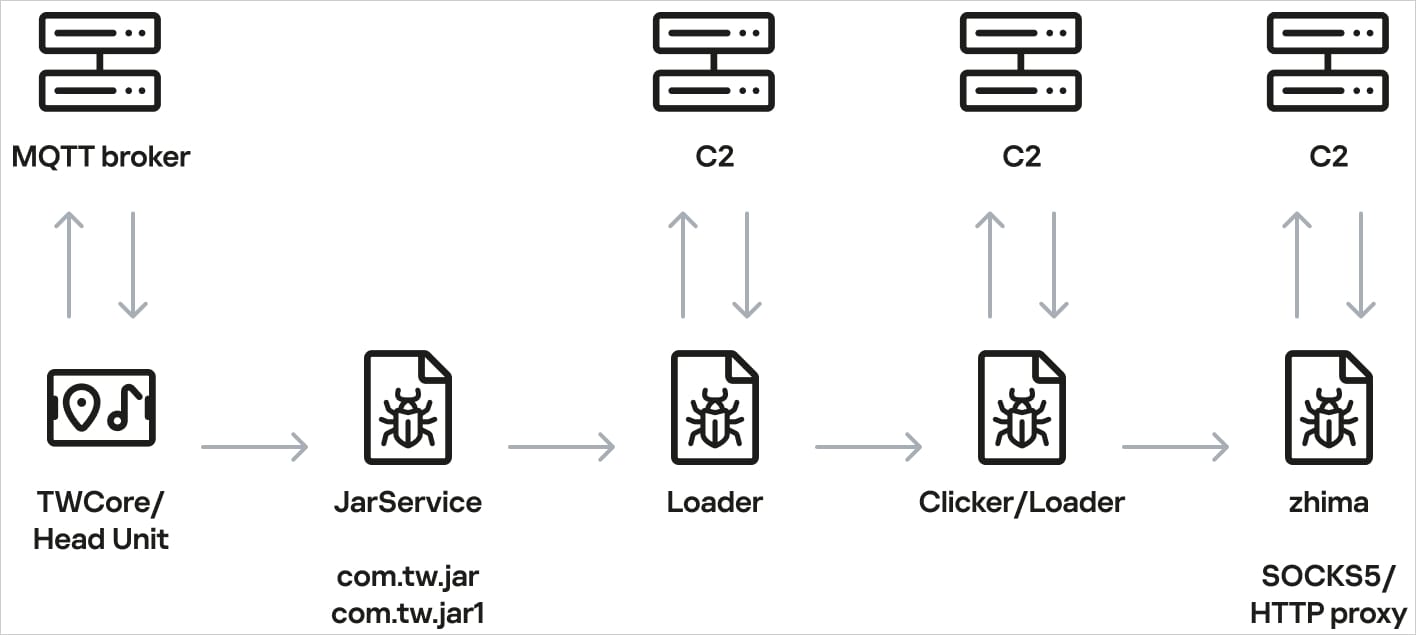
The initial compromise vector for this advanced persistent threat was identified in June, when cybersecurity researchers observed a rogue APK file being illicitly downloaded through a legitimate DoFun system application known as TWCore. This application, designed for device updates, receives instructions via an MQTT server hosted at cardoor[.]cn, a seemingly innocuous channel that was secretly co-opted for malicious distribution. This exploitation of a trusted update mechanism highlights the inherent vulnerabilities within complex supply chains, where a single compromised link can have far-reaching consequences across an entire product ecosystem.
Upon successful download, the malicious APK file, which operates without any discernible user interface, functions as a piece of malware designated "JarService." Its activation initiates a multi-stage infection process: JarService first decrypts and executes a second-stage loader. This loader is engineered to establish covert communication with a command-and-control (C2) server, a central hub managed by the attackers. Subsequently, it downloads an additional encrypted payload, meticulously designed to evade detection and further entrench the malware within the compromised system.

The final payload, once deployed, represents the operational core of the botnet. It systematically collects and periodically transmits sensitive device information back to the attackers. This data includes critical identifiers such as the device model, display resolution, Wi-Fi SSID, and MAC address. Beyond data exfiltration, the payload is equipped to receive and execute a diverse array of commands from the C2 server. While specific commands were not exhaustively detailed, the malware’s observed behavior indicates its capacity to facilitate a spectrum of illicit activities, including advanced data collection, dynamic payload deployment, and the activation of its primary monetization modules.
Crucially, cybersecurity experts have confirmed that the malware’s design deliberately avoids interference with the vehicle’s critical driving functions or safety systems. This strategic decision aligns with the attackers’ clear objective: to maintain stealth and longevity within the compromised units, focusing instead on covert financial exploitation rather than disruptive sabotage. The primary goals identified for this sophisticated campaign are twofold: orchestrating elaborate advertising fraud schemes and transforming the vast network of internet-connected car head units into a distributed residential proxy botnet for illicit monetization.
Further deep analysis revealed that the attackers predominantly loaded a specialized reverse-proxy module, internally named ‘zhima’. This module is the linchpin of the proxy botnet, effectively converting each compromised head unit into a node within a vast, distributed network of residential proxies. Such proxy networks are highly prized in the cybercrime underworld, allowing threat actors to route malicious traffic through legitimate residential IP addresses, thereby masking their true origin and bypassing geo-restrictions, CAPTCHAs, and other security measures. These proxy services are often sold on underground forums, enabling activities such as credential stuffing, spam distribution, and other forms of online fraud. In parallel, the malware was observed generating numerous web requests, indicative of sophisticated click-fraud activities, designed to artificially inflate advertising metrics and illicitly siphon revenue from legitimate advertisers.
Following the thorough investigation and public disclosure of these findings, the relevant threat intelligence firm formally notified DoFun of the severe vulnerabilities and active compromises. The Chinese firm has since indicated that it has addressed and resolved the identified issues, though specifics regarding the nature of the initial compromise vector and the remediation steps taken remain under wraps.
The Expanding Horizon of Automotive Cybersecurity Threats
The discovery of this novel malware campaign targeting Android car head units serves as a stark reminder of the rapidly evolving threat landscape in the automotive industry. As vehicles become increasingly connected and integrated with sophisticated software platforms, they present lucrative new attack surfaces for cybercriminals. This incident underscores several critical aspects of modern cybersecurity:

1. Supply Chain Vulnerabilities as a Primary Attack Vector:
The exploitation of a legitimate device update app highlights the profound risks associated with supply chain compromises. In an ecosystem as complex as automotive manufacturing, which relies on numerous hardware and software vendors, vetting every component and update becomes an monumental challenge. A single weak link can propagate vulnerabilities across millions of devices, making robust supply chain security paramount. This often requires stringent third-party risk management, continuous security auditing, and transparent vulnerability disclosure frameworks.
2. The Allure of IoT Botnets for Financial Gain:
The transformation of car head units into proxy botnet nodes exemplifies a growing trend in cybercrime: leveraging the vast network of Internet of Things (IoT) devices for financial gain. Unlike traditional server-based botnets, IoT botnets benefit from the sheer number of devices, their often-lax security, and their residential IP addresses, which lend an air of legitimacy to malicious traffic. The monetization potential is significant, ranging from selling proxy access to facilitating large-scale ad fraud, phishing, and denial-of-service attacks. This incident broadens the definition of "IoT devices" to include embedded systems within vehicles, traditionally viewed through a different security lens.
3. The Blurring Lines Between IT and OT Security:
Historically, automotive systems were considered part of operational technology (OT), distinct from enterprise IT networks. However, the integration of Android-based infotainment systems, telematics, and over-the-air (OTA) update capabilities has effectively merged these two domains. This convergence means that traditional IT cybersecurity principles – such as patch management, network segmentation, and endpoint protection – must now be rigorously applied to vehicle architectures. The challenge lies in adapting these practices to systems with unique lifecycle management, real-time operational requirements, and safety-critical functions.
4. Data Privacy Implications for Drivers:
While the malware reportedly avoids critical driving systems, the exfiltration of device information such as model, display resolution, Wi-Fi SSID, and MAC address raises significant privacy concerns. This data, while seemingly innocuous, can be used for targeted attacks, device fingerprinting, and potentially correlated with other personal information to build comprehensive user profiles. The risk of future, more invasive malware being deployed through the same channels also looms large, potentially compromising location data, call logs, or even in-car microphone access.
Forward-Looking Strategies and Recommendations
To mitigate these evolving threats, a multi-faceted approach involving manufacturers, regulators, and consumers is essential:
For Automotive Manufacturers and Suppliers:
- Secure by Design: Implement security from the earliest stages of product development, incorporating threat modeling, secure coding practices, and rigorous security testing.
- Supply Chain Resilience: Establish stringent security requirements for all third-party vendors and components. Implement continuous monitoring and auditing of the supply chain for vulnerabilities and compromises.
- Robust Update Mechanisms: Develop and maintain secure, authenticated, and encrypted over-the-air (OTA) update processes to prevent unauthorized code injection. Ensure updates are verifiable and tamper-proof.
- Segmentation and Isolation: Architect vehicle systems with strong network segmentation to isolate critical driving functions from infotainment and other internet-connected components.
- Threat Intelligence Sharing: Participate in industry-wide threat intelligence sharing initiatives to proactively identify and respond to emerging automotive cybersecurity threats.
- Regular Security Audits and Penetration Testing: Conduct independent security assessments and penetration tests on all vehicle software and hardware components throughout their lifecycle.
For Regulators and Policymakers:
- Standardized Security Frameworks: Develop and enforce clear cybersecurity standards and regulations specifically tailored for connected vehicles, mirroring those in critical infrastructure sectors.
- Vulnerability Disclosure Programs: Encourage and potentially mandate responsible vulnerability disclosure programs to facilitate timely remediation of security flaws.
- Consumer Protection: Implement policies that protect consumer data privacy in connected vehicles and ensure transparency regarding data collection and usage.
For Consumers:
- Stay Updated: Ensure that vehicle software and infotainment systems are regularly updated to the latest versions provided by the manufacturer.
- Be Wary of Unauthorized Modifications: Avoid installing unofficial apps or making unauthorized modifications to car head units, as these can introduce vulnerabilities.
- Monitor for Unusual Behavior: Be alert to any unusual performance issues, excessive data usage (if on a metered plan), or unexpected advertisements, which could signal a compromise.
The incident involving the MoYu group and Android car head units serves as a crucial wake-up call for the entire automotive industry and for consumers alike. As vehicles become increasingly sophisticated mobile computing platforms, the imperative for robust, proactive cybersecurity measures has never been greater. The battle for securing the connected car is a continuous endeavor, demanding constant vigilance, innovation, and collaboration across the globe.




 Lisa Mariana
 Aura Kasih
 Ayu Aulia