
 Lisa Mariana
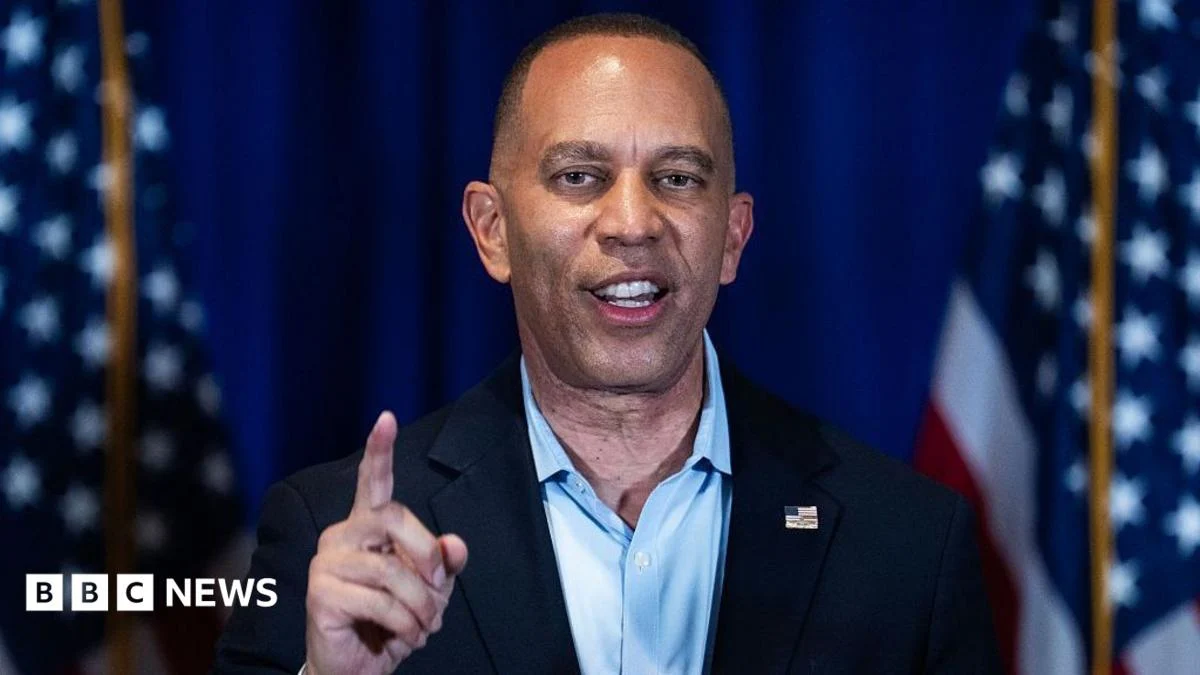
A significant constitutional confrontation is poised to unfold in the United States Congress, as the presumptive incoming Speaker of the House, Representative Hakeem Jeffries, has unequivocally declared his support for initiating impeachment proceedings against Defense Secretary Pete Hegseth, citing grave allegations of executive overreach and a unilateral engagement in military conflict.
The political landscape of Washington D.C. is rapidly shifting following recent midterm elections, heralding a period of intensified legislative oversight over the executive branch. In a decisive statement that portends an early challenge to the current administration, Congressman Jeffries, a prominent figure from New York and the anticipated leader of the next House majority, confirmed his firm commitment to the impeachment of Defense Secretary Hegseth. Appearing on a nationally broadcast public affairs program, Jeffries asserted that Secretary Hegseth had “egregiously misused his authority, jeopardized national security interests, and unilaterally instigated a perilous and financially draining military intervention in Iran.” This declaration sets the stage for a contentious battle between the legislative and executive branches, marking a powerful assertion of congressional checks and balances.
The impetus for this extraordinary move originates from an unexpected quarter: outgoing Republican Congressman Thomas Massie of Kentucky, a notable critic of President Donald Trump. Congressman Massie has publicly announced his intention to introduce a resolution as early as the upcoming Monday, outlining articles of impeachment against Secretary Hegseth. Should this resolution gain traction and pass the House, it would formally accuse the Defense Secretary of misconduct, potentially leading to his removal from office through a subsequent Senate trial. Massie’s initiative, though from an opposition party, finds strong resonance with the incoming Democratic leadership, underscoring a rare bipartisan alignment on the principle of congressional authority regarding military action.
Secretary Hegseth and the Pentagon have vehemently rejected these accusations. A spokesperson for the Department of Defense stated that all actions undertaken by Secretary Hegseth adhered strictly to legal frameworks and that the Secretary would not be deterred by what they termed “baseless inquiries.” Secretary Hegseth himself addressed the burgeoning impeachment threat in a recent public video, dismissing the proposed articles as “spurious accusations.” He characterized the impeachment effort as mere “political theatrics,” a distraction fueled by opponents whose policies are failing, and an attempt to “malign and dismantle adversaries.” He drew parallels to previous attempts to discredit the President, confidently asserting that such tactics would prove equally ineffective against him.
As the current Democratic minority leader, Representative Jeffries is widely expected to ascend to the speakership in January, following his party’s decisive triumph in last week’s midterm elections, which granted them control of the House of Representatives. His emphatic statement, "I am definitively in favor of the Hegseth resolution," made during his Sunday television appearance, left no ambiguity regarding his position. He further reiterated, with palpable conviction, that "Pete Hegseth must be relieved of his duties," signaling the depth of the incoming majority’s resolve.
The resolution drafted by Congressman Massie comprises eight distinct articles of impeachment. These articles principally contend that Secretary Hegseth initiated military operations against Iran without obtaining the necessary legislative authorization, thereby violating the explicit stipulations of the War Powers Resolution of 1973. This landmark legislation was enacted to reassert congressional authority over the deployment of U.S. armed forces into hostile situations, a power that presidents had increasingly expanded in the post-World War II era.
Representative Jeffries has consistently affirmed that the newly empowered Democratic House will diligently fulfill its constitutional duty to serve as a vital check and balance on the Trump administration. However, in the immediate aftermath of the midterm results, he also indicated that House Democrats were not currently prioritizing impeachment proceedings against President Trump, who had previously faced impeachment twice during his initial term in office. This nuanced stance suggests a strategic prioritization, focusing on specific alleged abuses of power by cabinet officials rather than a broad, immediate challenge to the presidency itself.
Just last week, prior to the full extent of the Democratic midterm victory becoming clear, Secretary Hegseth released a nearly six-minute video appeal. In it, he urged Congress to approve the Pentagon’s latest budget request before the Republican-controlled legislature concluded its final session days. Within this address, he directly confronted the discussions surrounding Congressman Massie’s impeachment initiative, branding the threat as "specious claims." He articulated his perspective, stating, "Their policy prescriptions have proven ineffective. Consequently, their preoccupation with political spectacle, masquerading as substantive governance, compels them to attempt to discredit their adversaries. This is fundamentally about the politics of personal destruction. It failed against President Trump, and it will likewise fail against me."
Impeachment represents a formidable constitutional mechanism, rarely invoked, through which the House of Representatives can formally accuse a federal official of severe misconduct. A simple majority vote in the House is sufficient to impeach. Subsequently, the process moves to the Senate, where a two-thirds majority vote is required to convict the official and remove them from office. It is a process designed for the gravest offenses, encompassing "high crimes and misdemeanors," and underscores the principle of accountability within the highest echelons of government.
The Democratic party’s electoral gains have provided them with a substantial 254-seat majority in the House of Representatives, significantly exceeding the 218-vote threshold necessary to pass articles of impeachment. This numerical advantage means that a House vote to impeach Secretary Hegseth is highly probable if the Democratic caucus unites behind the resolution. However, the path to removal from office presents a far more formidable challenge. Democrats are projected to fall considerably short of the two-thirds Senate majority required for conviction. Achieving such a supermajority would necessitate a significant number of Republican senators breaking ranks and siding with the Democrats, a politically arduous feat in the current polarized climate. This implies that while impeachment in the House is a distinct possibility, actual removal from office remains a remote prospect, highlighting the often-symbolic yet impactful nature of impeachment proceedings.
The Constitutional Underpinnings: Impeachment and the War Powers Resolution
The potential impeachment of Secretary Hegseth illuminates two foundational aspects of American constitutional law: the power of impeachment and the War Powers Resolution. Impeachment, enshrined in Article II, Section 4 of the Constitution, serves as the ultimate check on executive power, designed to ensure that federal officials, including the President, Vice President, and all civil officers, are held accountable for "Treason, Bribery, or other high Crimes and Misdemeanors." Historically, this process has been exceedingly rare, invoked only a handful of times against presidents (Andrew Johnson, Bill Clinton, and Donald Trump twice) and a few federal judges. Its gravity stems from its potential to annul a democratic mandate or to remove an appointed official from a position of immense authority. The House acts as the grand jury, deciding whether sufficient grounds exist to bring charges, while the Senate conducts the trial, determining guilt or innocence.
At the heart of the allegations against Secretary Hegseth lies the War Powers Resolution of 1973. Enacted in the shadow of the Vietnam War, this resolution aimed to restore congressional authority over the initiation of military conflict, which many felt had been eroded by presidential actions. It mandates that the President must consult with Congress "in every possible instance" before introducing U.S. armed forces into hostilities or situations where hostilities are imminent. Crucially, it requires the President to report to Congress within 48 hours of deploying forces into armed conflict and imposes a 60-day limit on such deployments without a declaration of war or specific congressional authorization, with a possible 30-day extension for troop withdrawal. Presidents across the political spectrum have often viewed the resolution as an unconstitutional infringement on their role as Commander-in-Chief, leading to perennial disputes over its interpretation and enforcement. The accusation that Secretary Hegseth waged a "war of choice in Iran" without explicit congressional approval strikes at the very core of this enduring constitutional tension, directly challenging the executive’s prerogative in foreign policy and military engagement.
Political Calculus and Strategic Implications for the Incoming House
The decision by Representative Jeffries to wholeheartedly endorse impeachment proceedings against Secretary Hegseth is laden with significant political and strategic implications for the incoming Democratic majority. First, it signals an immediate and forceful assertion of congressional power, fulfilling Jeffries’ promise that the new House would act as a robust check on the administration. This proactive stance contrasts with the previous Republican-led House, which largely declined to challenge the executive’s foreign policy decisions in a similar manner.
Second, the rare bipartisan genesis of this impeachment effort—initiated by a Republican and embraced by Democrats—lends it a veneer of principle over pure partisanship. While Massie is an outlier in his party regarding Trump, his articulation of constitutional concerns around war powers creates a unique alignment that could potentially attract broader support than a purely partisan Democratic initiative. This could be a deliberate strategy by Jeffries to highlight what he perceives as a non-partisan issue of constitutional integrity, rather than a mere political attack.
Third, by focusing on a cabinet secretary rather than the President directly, Jeffries may be seeking to establish a precedent of accountability within the administration without immediately reigniting the highly divisive debates surrounding presidential impeachment. This approach could be viewed as a more measured and strategic first step for the new majority, demonstrating their resolve to oversee the executive without being immediately consumed by a protracted and potentially fruitless presidential impeachment battle, especially given their stated intention not to pursue Trump’s impeachment "currently."
However, the political risks are also considerable. The administration is likely to frame the impeachment effort as a politically motivated witch hunt, designed to undermine a successful defense secretary and distract from policy achievements. Secretary Hegseth’s own preemptive defense, characterizing the move as "political theatre," indicates the likely narrative from the executive branch. This could lead to a protracted and contentious public debate, consuming valuable legislative time and potentially diverting attention from the Democrats’ own policy agenda, which they promised to deliver after their midterm victory.
The Road Ahead: House Vote and Senate Hurdles
The procedural path for this impeachment effort will be complex and politically charged. Congressman Massie’s resolution, once introduced, will likely be referred to the House Judiciary Committee, which holds primary jurisdiction over impeachment matters. The committee would then conduct hearings, gather evidence, and debate the articles of impeachment. Should the committee vote to recommend impeachment, the resolution would then proceed to a full vote on the House floor. Given the Democratic majority of 254 seats, well above the 218 required, a House vote to impeach Secretary Hegseth appears highly probable, assuming party unity and some potential crossover Republican support, particularly from those aligned with Massie’s constitutional concerns.
However, the journey to actual removal from office presents an almost insurmountable obstacle in the Senate. A conviction requires a two-thirds majority vote, meaning 67 senators must vote in favor of removal. With Democrats falling short of this supermajority, they would need a substantial number of Republican senators to cross party lines and vote against a cabinet secretary appointed by a Republican president. This is an exceptionally high political bar, particularly in a highly polarized Senate where party loyalty often trumps bipartisan consensus on such matters. Republican senators would face immense pressure from their party leadership, their base, and the President himself to defend Secretary Hegseth and dismiss the impeachment as a partisan attack.
Therefore, while the House’s action would carry immense political weight, formally accusing Secretary Hegseth of misconduct and demonstrating congressional resolve, the practical outcome of removal from office is unlikely. The process could, however, serve as a potent form of censure, sending a clear message to the administration about the limits of executive power, particularly in foreign policy and military engagements. It could also galvanize public opinion, shaping the narrative around the administration’s conduct and potentially influencing future elections.
Broader Impact on Executive-Legislative Relations
The impeachment effort against Defense Secretary Hegseth, regardless of its ultimate outcome in the Senate, will undoubtedly have a profound and lasting impact on the delicate balance of power between the executive and legislative branches. It represents a significant reassertion of congressional oversight, particularly in the critical domain of war powers. For future administrations, this episode could serve as a stark reminder of Congress’s constitutional prerogative and its willingness to challenge executive actions that bypass legislative authorization for military force.
This development could force presidents to engage more proactively and transparently with Congress before deploying troops or engaging in military interventions, potentially leading to a more collaborative and constitutionally aligned foreign policy process. Conversely, it could also harden executive resolve to protect presidential prerogatives, leading to further constitutional clashes.
Ultimately, the unfolding impeachment saga against Secretary Hegseth signifies a pivotal moment for the incoming Democratic House. It will be an early test of their leadership, their strategic acumen, and their commitment to upholding the constitutional framework of checks and balances. For the Trump administration, it represents a direct challenge to its authority and a potential distraction from its policy objectives, setting the stage for a period of heightened political tension and constitutional debate in Washington D.C.



 Aura Kasih

 Safa Marwah

 Ayu Aulia