Safa Marwah
The Brave browser has significantly augmented its privacy toolkit with the introduction of a sophisticated email alias functionality in its latest iteration, version 1.94. This innovative feature empowers users to generate temporary, disposable email addresses when interacting with new online services, thereby creating a robust shield between their primary digital identity and the vast landscape of data collection and potential security vulnerabilities. This strategic enhancement represents a pivotal step in the ongoing effort to fortify user anonymity against pervasive tracking mechanisms and unsolicited digital communications.
The Persistent Challenge of Email Privacy in the Digital Age
In the contemporary digital ecosystem, an email address transcends its traditional role as a simple communication conduit; it has evolved into a foundational identifier, a persistent digital fingerprint that underpins a user’s online presence. This singular piece of information serves as a lynchpin for myriad online activities, from account creation and password recovery to receiving transactional notifications and promotional materials. However, its omnipresence also renders it a prime target for data exploitation, becoming a critical vulnerability in the architecture of personal privacy.
The inherent design of the internet, initially conceived without the foresight of pervasive commercial tracking, has allowed for the proliferation of practices that monetize user data. Email addresses, once submitted to a service, can become part of extensive databases, often shared with or sold to third-party data brokers. These entities meticulously aggregate information from disparate sources, constructing detailed profiles of individuals that encompass browsing habits, purchasing patterns, demographic data, and more. The consequence is a highly personalized, yet often opaque, digital experience where users are constantly subjected to targeted advertising and content, frequently without explicit consent or full understanding of how their data is being utilized.
Furthermore, the exposure of a primary email address carries substantial security implications. Data breaches, regrettably common occurrences across industries, frequently expose vast repositories of user credentials, including email addresses and associated passwords. Once compromised, these addresses become fodder for sophisticated phishing campaigns, where malicious actors craft deceptive communications designed to trick users into divulging further sensitive information. They also fuel spam operations, overwhelming inboxes with unsolicited and often harmful content. The longevity of an exposed email address in these compromised datasets means that individuals can be subjected to these threats for years, highlighting the critical need for mechanisms that decouple one’s primary digital identity from the myriad services encountered online.
Brave’s Strategic Response: Introducing Email Aliases
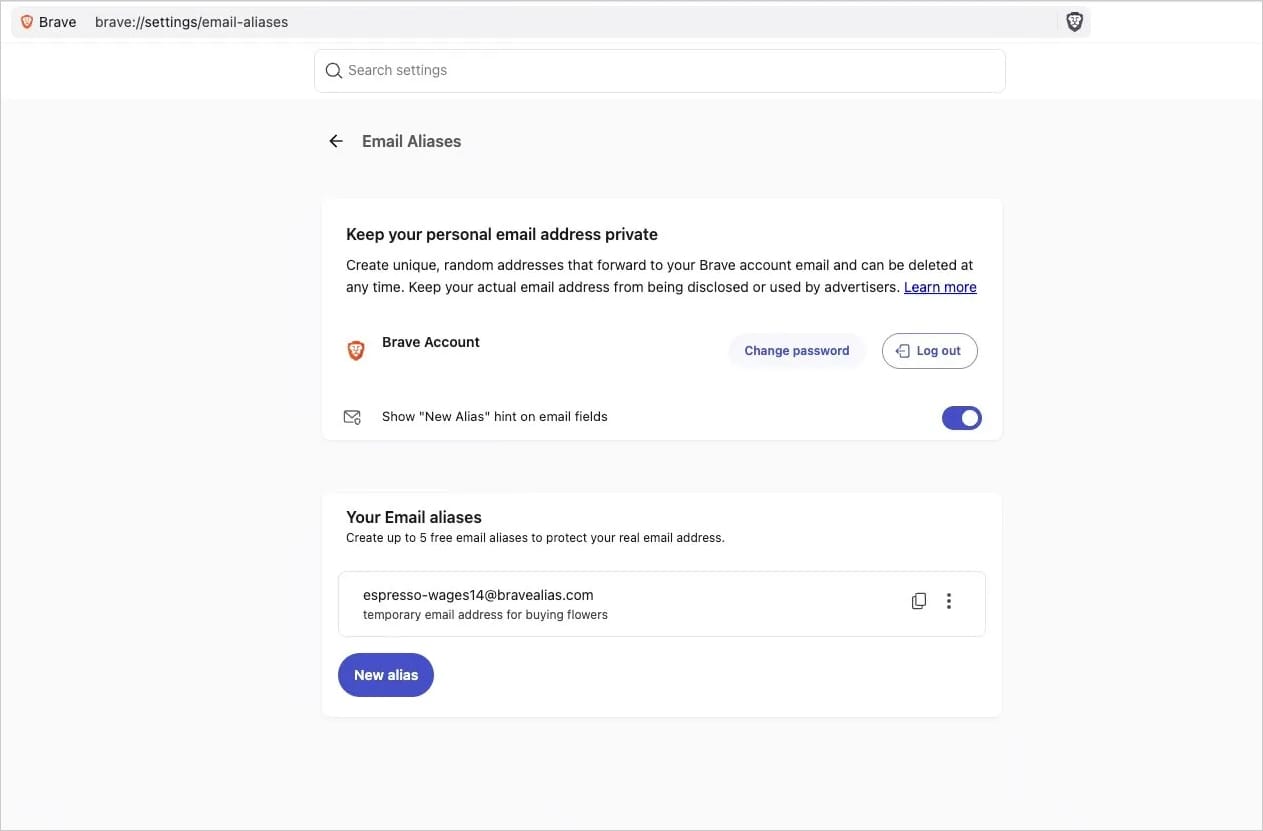
Brave’s integration of email aliases directly addresses this fundamental privacy deficit. While the browser has long employed advanced techniques such as data isolation to prevent websites from correlating user identities based on transient identifiers like cookies or cached data, the immutable nature of an email address stored on a server has remained a significant "privacy gap." The new alias system is engineered to bridge this gap by offering users an on-demand mechanism to generate unique, obfuscated email addresses for each service signup.
The core functionality of this feature lies in its ability to serve as an intermediary. When a user creates an account with an online service, they provide a generated alias instead of their actual email address. All communications from that service are then routed to this alias, which subsequently forwards them to the user’s registered primary email address. From the perspective of the online service, the alias is the legitimate contact point, effectively concealing the user’s true identity. This methodology offers several immediate and profound benefits:
Firstly, it significantly curtails cross-site identity matching. Without a consistent, identifiable email address across different platforms, data brokers and advertising networks struggle to stitch together a comprehensive profile of an individual’s online activities. Each alias acts as a distinct, isolated identifier, making it exponentially harder to correlate user behavior across the web.
Secondly, the system acts as a potent spam deterrent. Should an alias become compromised or be sold to a spammer, the user can simply deactivate that specific alias without affecting their primary email address or other online accounts. This granular control over communication channels empowers users to effectively mute unwanted solicitations originating from specific sources.
Finally, and perhaps most critically from a security standpoint, email aliases offer a robust layer of defense against phishing attacks and the fallout from data breaches. As Brave itself articulates, "If a website you signed up for is hacked, your information can be leaked and end up with data brokers or worse… Your email address then circulates far beyond the company you originally trusted with it, and can show up in phishing campaigns for years afterward." By providing an alias, users ensure that even in the event of a breach, their core digital identity remains unexposed, thereby mitigating the risk of long-term phishing vulnerabilities and unsolicited contact.
Architectural Integrity and User Authentication
To facilitate the forwarding of messages from aliases to a user’s primary inbox, Brave requires the creation of a free Brave Account and the registration of the user’s main email address within this account. This distinction is important; it operates independently of any Brave Premium subscription. The design of this account infrastructure is predicated on advanced cryptographic principles, underscoring Brave’s commitment to user privacy even in the foundational elements of its service.
Central to the security of Brave Accounts is the implementation of OPAQUE, a password-authenticated key exchange protocol standardized as RFC 9807. Unlike traditional authentication systems where user passwords (or their hashed equivalents) are transmitted to and stored on server infrastructure, OPAQUE operates differently. It allows users to authenticate themselves without ever transmitting their actual password or its hash to Brave’s servers. Instead, a cryptographic exchange occurs where both the client and server can verify the password’s correctness without either party ever learning the other’s secret.
This innovative approach yields significant security advantages. It drastically reduces the attack surface for password-related exploits. Since Brave’s servers never possess the user’s password, they are immune to common threats such as password logging, where credentials might be intercepted during transmission, or memory-scraping attacks, which aim to extract sensitive data from server memory. Furthermore, it prevents the bulk cracking of leaked password databases, as Brave itself would not possess such a database even if its servers were compromised. This architectural choice places a high degree of trust in the client-side cryptographic operations and offers a superior model for protecting user authentication credentials.
However, even with such robust cryptographic protections, Brave candidly acknowledges that OPAQUE does not confer immunity against all forms of attack. Specifically, it does not protect users from phishing attacks, where users might be tricked into entering their credentials on a malicious look-alike site, nor does it mitigate the risks associated with weak or easily guessable passwords. These vulnerabilities remain the responsibility of the user, underscoring the complementary need for robust security practices alongside advanced technical safeguards.
Operationalizing Privacy: Message Forwarding and Data Handling
The effectiveness of an email alias system hinges not only on its ability to obscure the primary address but also on how it handles the actual message forwarding process, particularly regarding user data privacy. Brave has outlined a stringent protocol for this, designed to minimize any potential exposure of user information.
Crucially, both the user’s primary email address and all generated aliases are stored in an encrypted state within Brave’s infrastructure. This ensures that even if there were an unauthorized access attempt to Brave’s servers, these sensitive identifiers would remain unintelligible without the appropriate decryption keys, which are not held by Brave in a manner that would compromise user privacy.
Furthermore, the content of forwarded messages is subjected to a minimal level of processing. Brave explicitly states that messages are not inspected beyond automated spam and malware filtering. This limited scanning is a standard practice across virtually all email providers to protect users from malicious content and ensure deliverability, but it avoids any deeper content analysis that could infringe on privacy. Significantly, messages are purged from Brave’s servers "within seconds after delivery," preventing any long-term storage of user communications on their infrastructure. This ephemeral storage policy is a critical component of maintaining user privacy and trust.
Any personal notes that users may attach to their aliases for organizational purposes remain entirely local to the user’s device. If these notes are synced across multiple devices using Brave Sync, they are protected with end-to-end encryption, meaning that Brave itself cannot access their content. This ensures that personal annotations, which might contain sensitive context about why an alias was created or for which service it is used, remain confidential.
One practical consideration for early adopters of this feature is the potential for forwarded messages to initially land in spam folders. As a relatively new email provider in this specific forwarding capacity, Brave will need to establish its reputation with other email service providers. Users testing the system are advised to monitor their spam or junk folders to ensure timely receipt of important communications.
The initial rollout offers up to five email aliases for free, with Brave indicating plans to introduce a paid Premium version in the future that will lift this restriction, likely appealing to power users or those with extensive online footprints.
Broader Implications for Digital Identity and User Empowerment
Brave’s introduction of email aliases extends beyond a mere feature addition; it represents a significant pushback against the pervasive data collection practices that characterize the modern internet. By empowering users with a simple, integrated tool to obfuscate their digital identity, Brave contributes to a broader movement towards user sovereignty over personal data.
The impact on the digital advertising ecosystem could be profound, particularly if such features gain widespread adoption. The ability to generate disposable identifiers undermines the very foundation of highly targeted advertising, which relies on consistent, identifiable user profiles. While advertisers will undoubtedly seek new methods of audience segmentation, a future where primary email addresses are routinely protected would necessitate a shift towards less intrusive, contextual advertising models or a greater reliance on first-party data.
From a competitive standpoint, this feature positions Brave squarely in the vanguard of privacy-focused browsers, further differentiating it from competitors like Google Chrome, which is deeply intertwined with an advertising-centric business model. It also places Brave in direct competition with specialized privacy services like Apple’s "Hide My Email," ProtonMail’s SimpleLogin, or Firefox Relay, integrating similar functionality directly into the browsing experience. This integration simplifies the user journey, removing the need for separate extensions or services.
Ultimately, email aliases contribute to a paradigm shift in how users manage their online identities. They move beyond passive acceptance of data collection towards active, granular control. This is particularly relevant in an era where regulatory frameworks like GDPR and CCPA are attempting to mandate greater transparency and control over personal data. Browser-level tools like Brave’s aliases provide a tangible mechanism for users to exercise these rights proactively.
Navigating the Ecosystem: Comparative Analysis and Limitations
While Brave’s email alias system offers substantial advantages, it operates within an evolving landscape of similar privacy solutions. Services like Apple’s "Hide My Email," integrated into iCloud+, offer a seamless experience for Apple device users, generating unique, private email addresses. Firefox Relay provides a similar forwarding service, often as a browser extension. Dedicated services like SimpleLogin (now part of Proton) and AnonAddy offer even more advanced features, including custom domains and greater control over forwarding rules.
Brave’s approach differentiates itself by integrating this functionality directly into the browser, making it readily accessible without additional installations or separate subscriptions (for the basic tier). This native integration can lead to a smoother user experience and potentially higher adoption rates among its user base.
However, like all technological solutions, email alias systems come with inherent limitations. The primary dependency remains on the alias provider (in this case, Brave) to maintain the integrity and security of the forwarding service. While Brave’s use of OPAQUE and its ephemeral message storage policy inspire confidence, users ultimately place trust in the provider’s infrastructure. Deliverability issues, as Brave itself cautioned, can also be a temporary challenge as new forwarding services establish their reputation with email providers. Furthermore, while aliases protect against data breaches, they do not inherently prevent social engineering tactics or instances where users willingly provide information through other channels.
The Path Forward: Evolution of Privacy Tools and Future Trends
The introduction of email aliases by Brave is indicative of a broader trend in digital privacy: the continuous evolution of tools designed to empower users and mitigate the risks associated with an increasingly data-intensive online environment. Future enhancements in this space could include more sophisticated alias management interfaces, greater customization options for forwarding rules, or even integration with decentralized identity solutions.
Beyond email aliases, the frontier of online privacy is likely to involve verifiable credentials, where users can prove attributes about themselves (e.g., age, nationality) without revealing the underlying identity information. Zero-knowledge proofs, a cryptographic technique, could allow for authentication and verification without disclosing any sensitive data. As the digital landscape matures, the focus will increasingly shift from simply blocking trackers to fundamentally reshaping how identity and trust are managed online.
The role of open-source projects and privacy-centric companies like Brave in developing these solutions is crucial. They often push the boundaries of what is technically possible and set new standards for user protection, influencing the broader industry and contributing to a more privacy-respecting internet.
Conclusion: Reinforcing User Sovereignty in a Data-Driven World
Brave’s integration of email aliases into its browser marks a significant advancement in the pursuit of user privacy and digital sovereignty. By offering a practical, accessible tool to obscure primary email addresses, the browser directly confronts the challenges of persistent tracking, unsolicited communications, and the fallout from data breaches. Bolstered by robust cryptographic authentication via OPAQUE and a commitment to ephemeral message handling, this feature reinforces Brave’s position as a leading proponent of user control in the digital realm. As the online world continues to evolve, such innovations are not merely conveniences but essential safeguards in the ongoing battle to protect individual privacy against the inexorable forces of data aggregation and exploitation.



 Lisa Mariana
 Aura Kasih
 Ayu Aulia