
 Ayu Aulia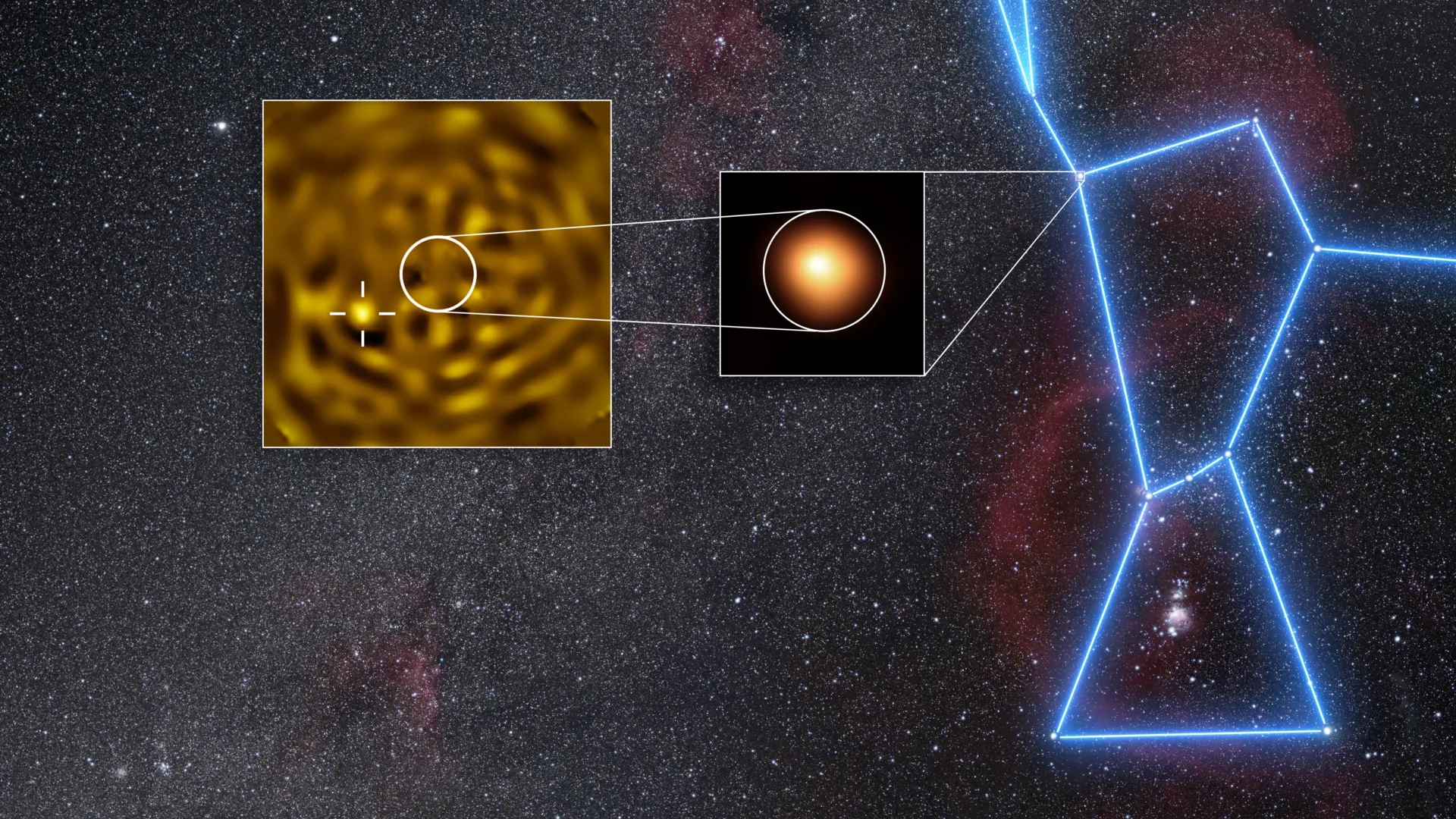
Astronomers have recently attained the most compelling empirical data to date, substantiating the long-held hypothesis that Betelgeuse, one of the most recognizable stellar bodies in the nocturnal sky, possesses a companion star. A research consortium, spearheaded by French astronomer Miguel Montargès, utilized the advanced capabilities of the European Southern Observatory’s Very Large Telescope (ESO’s VLT) to capture the clearest direct imagery of what is now strongly believed to be Betelgeuse B, a stellar entity gravitationally bound to the renowned red supergiant. This landmark observation represents a significant advancement in our comprehension of this enigmatic star system.
For millennia, Betelgeuse, a luminous reddish star situated in the constellation Orion and readily discernible to the unaided eye, has captivated human observers. Its pronounced variability in brightness has been a subject of both ancient lore and modern scientific inquiry. Even after centuries of dedicated telescopic scrutiny and astrophysical analysis, the star continues to unveil unexpected characteristics, challenging prevailing models of stellar evolution. This latest revelation regarding its binary nature underscores the profound complexities inherent in understanding massive stars.
The Culmination of a Century-Long Astronomical Pursuit
The initial postulation of a companion star to Betelgeuse emerged approximately a century ago, primarily as a potential explanatory framework for certain observed fluctuations in its luminosity. For decades, despite increasingly sophisticated observational techniques, astronomers encountered considerable challenges in definitively detecting such a star. The immense brightness of Betelgeuse A, the primary red supergiant, effectively overwhelmed any faint signal from a nearby companion, making its direct imaging akin to discerning a firefly next to a lighthouse. This inherent difficulty perpetuated the companion’s status as a theoretical construct rather than a confirmed celestial body.
The scientific landscape dramatically shifted following the publication of two pivotal studies in 2024. These investigations, employing advanced astrometric and photometric analyses, furnished robust predictions regarding the orbital parameters and precise location where the elusive companion, Betelgeuse B, was most likely to be observed. Crucially, these studies indicated that Betelgeuse B would attain its maximal apparent angular separation from Betelgeuse A in December 2024, presenting an unprecedented observational window for direct detection. This confluence of theoretical prediction and optimal viewing conditions set the stage for the recent breakthrough.
In response to these predictions, Montargès and his collaborative team meticulously planned and executed observations of Betelgeuse using the highly specialized instruments of ESO’s VLT during the predicted December 2024 window. The subsequent months involved an intensive period of data processing and rigorous analytical evaluation of the acquired observations. The initial skepticism concerning the detectability of Betelgeuse B, given its anticipated faintness, was profound. Montargès candidly recounts the moment of discovery: "I jumped from my chair when I saw the processed images." This visceral reaction encapsulates the profound significance of witnessing direct evidence for a stellar companion whose existence had been theorized for generations but remained unconfirmed. The unexpected clarity of the image, revealing a companion significantly more massive than previously modeled, provided the crucial factor for its successful detection.
Earlier scientific estimations had posited Betelgeuse B as possessing a mass roughly equivalent to that of our Sun. However, the new observations compel a substantial revision of this estimate, suggesting that the companion star is considerably more substantial, with a mass approximately two to three times that of the Sun. This revised mass directly contributed to its detectability, as a more massive star is inherently more luminous. Montargès reflects on this unexpected finding: "The fact that we can still discover a nearby companion, more massive and brighter than the Sun, around such a well-studied star is remarkable. These are among the best moments in science: seeing something new, unexpected." This sentiment underscores the enduring capacity of astronomical inquiry to yield groundbreaking insights even into seemingly familiar celestial objects.
Advanced Imaging Techniques and Definitive Evidence
The successful direct imaging of Betelgeuse B signifies that researchers were able to capture and analyze light emitted directly from the companion star itself, rather than inferring its presence through indirect gravitational effects or photometric perturbations. This monumental achievement was realized through the sophisticated capabilities of the SPHERE instrument integrated with ESO’s VLT, strategically positioned in Chile’s Atacama Desert. The VLT, a leading facility for ground-based astronomy, provides unparalleled resolution and light-gathering power, while SPHERE (Spectro-Polarimetric High-contrast Exoplanet Research) is specifically engineered for high-contrast imaging of faint objects in close proximity to much brighter stars.
SPHERE accomplishes this feat through a combination of cutting-edge technologies, most notably adaptive optics and coronagraphy. Adaptive optics systems continuously measure and correct for the distortions introduced by Earth’s turbulent atmosphere, effectively creating images that rival those obtained from space. Coronagraphy involves physically blocking out the overwhelming light from the primary star (Betelgeuse A in this case), allowing the much fainter light from its companion to be detected. Coupled with advanced post-processing algorithms designed to filter out residual scattered light and enhance signal-to-noise ratios, these techniques enabled the isolation and clear visualization of Betelgeuse B.
While prior observations had offered tantalizing hints of the companion’s existence, including a possible direct detection facilitated by the Gemini North Telescope in Hawai‘i, USA, the latest VLT observations represent a qualitative leap. They furnish the most compelling empirical evidence to date and, crucially, the clearest and most unambiguous image of Betelgeuse B. This corroboration across different observatories and methodologies significantly bolsters the credibility of the discovery. Co-author Anthony Boccaletti, also an astronomer at the Observatoire de Paris, emphasizes the instrumental prowess: "It is remarkable to see how SPHERE and advanced post-processing techniques, originally developed to find exoplanets, also excel at detecting a companion around a massive, evolved star like Betelgeuse." This highlights the versatility and interdisciplinary applicability of advanced astrophysical instrumentation.
Despite the strength of the current evidence, the scientific community maintains a rigorous standard for definitive confirmation. Astronomers are now awaiting an additional observation that shows the candidate companion precisely where its predicted orbital trajectory dictates it should next appear. This future observation will serve as the ultimate validation. Montargès acknowledges this scientific prudence: "To be certain that the companion is really there, we still need to observe it in one year on the other side of the star, but there is very little space left for doubt." This commitment to empirical verification is a cornerstone of scientific methodology.
Revisiting Betelgeuse’s Famous Dimming Event
Betelgeuse garnered widespread global attention several years ago, specifically between late 2019 and early 2020, when its visual brightness underwent a dramatic and unprecedented dimming. This profound decrease in luminosity, reaching nearly two-thirds of its typical peak, fueled intense public and scientific speculation. Given Betelgeuse’s classification as an evolved red supergiant, a stellar phase preceding its ultimate cataclysmic demise as a supernova, the sudden dimming prompted widespread conjecture that the star might be on the precipice of explosion.
Subsequent investigations, also led by Montargès and utilizing ESO’s VLT, conclusively demonstrated that this dramatic dimming was not a precursor to a supernova. Instead, the phenomenon was attributed to a substantial ejection of gas from Betelgeuse’s surface, which then cooled to form a dense cloud of dust. This newly formed dust cloud effectively obstructed a significant portion of the star’s emitted light from reaching Earth, creating the illusion of a precipitous decrease in intrinsic brightness. This event, dubbed the "Great Dimming," provided invaluable insights into the dynamic processes occurring on the surfaces of red supergiants.
Now, the highly probable discovery of Betelgeuse B introduces an entirely new dimension of complexity that astronomers must integrate into their understanding of the primary star’s intrinsic variability and long-term evolution. The presence of a close stellar companion inherently complicates stellar dynamics, potentially influencing mass loss events, atmospheric pulsations, and even the overall structural stability of the red supergiant. This necessitates a re-evaluation of previous models that treated Betelgeuse as an isolated entity.
Profound Implications for Supernova Evolution
The confirmed existence of Betelgeuse B opens a critical avenue for future research: assessing the extent to which this companion star might influence the future evolutionary trajectory of the red supergiant, including the timing, characteristics, and ultimate energetics of its eventual supernova explosion. Stellar binaries, particularly those involving massive stars, exhibit intricate interactions that can profoundly alter their individual life cycles compared to solitary stars.
Potential interactions could include tidal forces exerted by Betelgeuse B on Betelgeuse A, which might affect the primary star’s rotation, internal mixing processes, and even its mass loss rate. While direct mass transfer (where one star siphons material from the other) is not currently observed, the proximity and relative masses of the two stars suggest that such interactions could have played a significant role earlier in their evolutionary history or could become relevant as Betelgeuse A expands further in its final stages. A common envelope phase, where the primary star’s outer layers engulf the companion, is also a theoretical possibility that would dramatically impact both stars.
The presence of a companion could also lead to an asymmetric supernova explosion, where the ejecta are not uniformly distributed in space. Such asymmetries could be driven by orbital motion at the moment of explosion, or by prior mass loss channeled by the companion’s gravitational pull. Understanding these dynamics is crucial for interpreting the remnants of supernovae in other binary systems. Montargès succinctly encapsulates the scientific challenge and excitement: "The question is truly opened whether this companion is going to have an impact on the evolution of the red supergiant."
This research, detailed in a paper titled "VLT/SPHERE images the candidate companion of Betelgeuse" slated for publication in the esteemed journal Astronomy & Astrophysics, represents a pivotal moment in observational astrophysics. The collaborative team, comprising researchers from numerous prestigious institutions including the Observatoire de Paris, the University of Amsterdam, and the Center for Astrophysics-Harvard & Smithsonian, exemplifies the international cooperation essential for such groundbreaking discoveries. The identification of Betelgeuse B not only resolves a century-old mystery but also inaugurates a new era of inquiry into the intricate lives of massive binary star systems, pushing the boundaries of our understanding of stellar death and the universe’s most dramatic cosmic events. Future observations and theoretical modeling will undoubtedly unravel the full implications of this remarkable stellar pairing.




 Lisa Mariana
 Aura Kasih


 Safa Marwah