Safa Marwah
A sophisticated new memory-tampering technique, dubbed "GPUThor," has demonstrated the capacity to circumvent robust error-correcting code (ECC) protections on specific NVIDIA graphics processing units, potentially enabling severe denial-of-service conditions and critical root-level privilege escalation on host systems. This development signals a significant escalation in the ongoing challenge of hardware-level vulnerabilities, particularly within environments heavily reliant on high-performance computing, artificial intelligence, and cloud infrastructure.
The Genesis of Hardware Vulnerabilities: Understanding Rowhammer
The phenomenon known as Rowhammer represents a class of hardware vulnerabilities that exploit the physical characteristics of dynamic random-access memory (DRAM) chips. These attacks operate by repeatedly accessing (or "hammering") specific rows of memory cells at a high frequency. This intense activity induces electrical interference that can cause unintended bit flips—a change in a memory cell’s binary state from 0 to 1 or vice-versa—in adjacent, unaccessed memory rows. Initially discovered as a theoretical concept, Rowhammer has evolved into a practical threat capable of compromising system integrity and security.
The core principle behind Rowhammer stems from the continuous miniaturization of DRAM cells. As memory densities increase, the physical distance between adjacent memory rows diminishes, making them more susceptible to electromagnetic interference. Each memory cell requires periodic refreshing to maintain its charge and data state. However, during rapid access patterns, the charge stored in a "hammered" row can slightly deplete the charge in a neighboring, inactive row, eventually causing its state to flip. This vulnerability is not a software bug but an inherent physical characteristic of the hardware itself, making it notoriously difficult to patch through conventional software updates alone.
Early Rowhammer exploits primarily targeted CPU-attached DDR3 and DDR4 memory modules, demonstrating the ability to achieve privilege escalation by corrupting critical operating system data structures. The transition of this threat model to GPUs, however, presents a distinct set of challenges and implications. GPUs possess their own dedicated high-bandwidth memory (such as GDDR6 or HBM), often operating at significantly higher frequencies and featuring architectural differences that necessitate specialized attack methodologies. Previous attempts, like GPUHammer and GPUBreach, laid foundational research but often struggled with the practicality of achieving consistent, exploitable bit flips, particularly after the widespread adoption of ECC on GPU memory.
NVIDIA’s Defense Mechanism: Error-Correcting Code (ECC)
In response to the growing awareness of memory integrity issues, including early Rowhammer research, hardware manufacturers like NVIDIA implemented error-correcting code (ECC) as a primary defense. ECC is a data protection scheme that detects and corrects a certain number of bit errors that can occur spontaneously due to various factors, including cosmic rays, manufacturing defects, or, crucially, malicious interference like Rowhammer.
The most common form of ECC employed in high-performance computing and server-grade memory is Single Error Correction, Double Error Detection (SECDED). This mechanism works by appending redundant parity bits to each block of data. When data is read from memory, these parity bits are used to perform a calculation. If a single bit flip has occurred within the data block, SECDED ECC can identify its precise location and automatically correct it, thus maintaining data integrity and preventing system instability. If two bit flips occur within the same block, SECDED ECC can detect their presence but cannot correct them, typically flagging an uncorrectable error. More advanced ECC schemes exist that can correct multiple bits, but they come with increased overhead in terms of memory footprint and latency.
The integration of ECC into NVIDIA’s Ampere-class workstation GPUs, such as the RTX A4000, A4500, A5000, and A6000 models—which are foundational components in AI training clusters, professional visualization, and data centers—was widely regarded as a robust countermeasure against Rowhammer-type attacks. The expectation was that any induced bit flips would be either silently corrected or, at worst, detected as uncorrectable errors, preventing malicious exploitation. ECC’s presence was believed to render previous GPU Rowhammer concepts largely impractical, pushing researchers to seek more sophisticated bypass techniques.
GPUThor: A Paradigm Shift in GPU Memory Exploitation
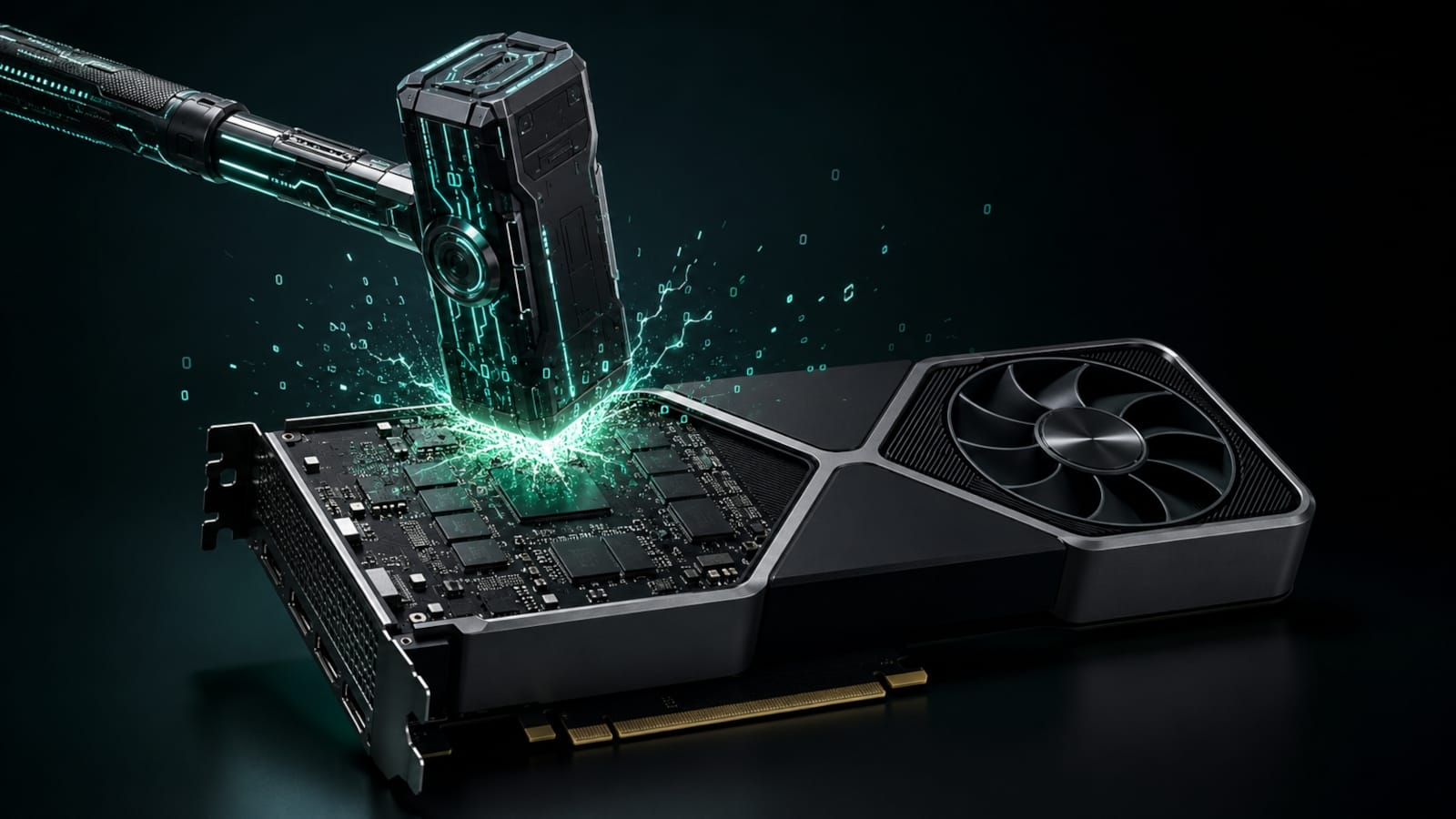
The newly unveiled GPUThor attack represents a significant leap forward in Rowhammer exploitation against GPU memory, specifically targeting and circumventing NVIDIA’s SECDED ECC protections. Developed by researchers at the University of Toronto, GPUThor distinguishes itself by achieving substantially higher and more practical bit-flip rates compared to its predecessors, effectively nullifying the protective barrier of ECC in certain scenarios.
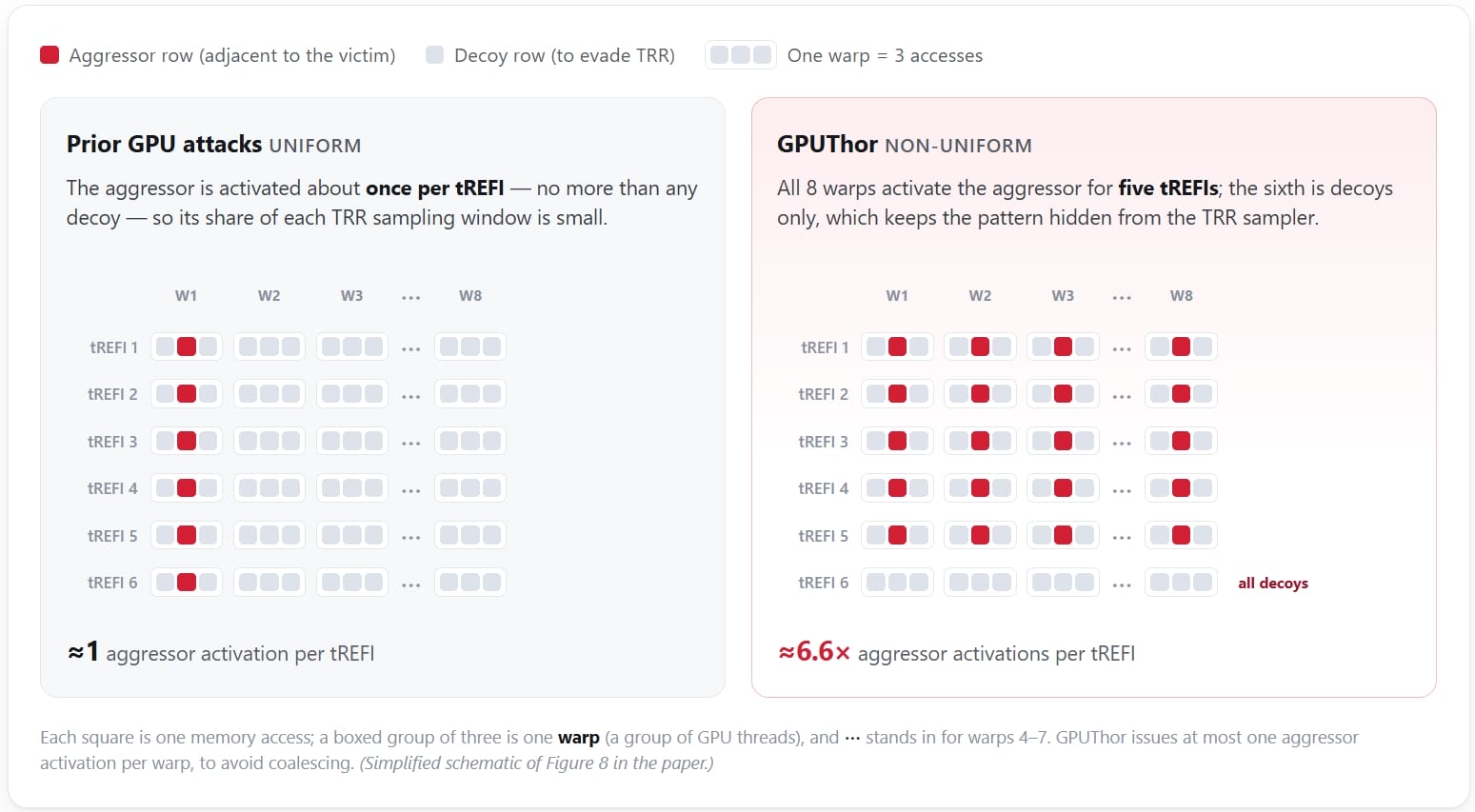
The key to GPUThor’s efficacy lies in its meticulously crafted "non-uniform hammering" pattern. Unlike simpler Rowhammer attacks that might indiscriminately hammer rows, GPUThor leverages a sophisticated understanding of undocumented GPU memory behaviors. This includes how repeated memory requests are coalesced by the GPU’s memory controller and, critically, the activation frequency of Target Row Refresh (TRR) mitigations embedded within GDDR6 memory modules. TRR is an in-DRAM defense mechanism designed to proactively refresh adjacent rows when a specific row is heavily accessed, thereby preventing charge leakage and mitigating Rowhammer effects.
By precisely tuning its hammering frequency and pattern, GPUThor manages to avoid triggering TRR mitigations while simultaneously maximizing the stress on adjacent memory cells. This nuanced approach allows the attack to generate an unprecedented number of aggressor-row activations without alerting the built-in defenses, leading to a far higher incidence of bit flips.
Technical Breakthroughs: How GPUThor Achieves Unprecedented Bit-Flip Rates
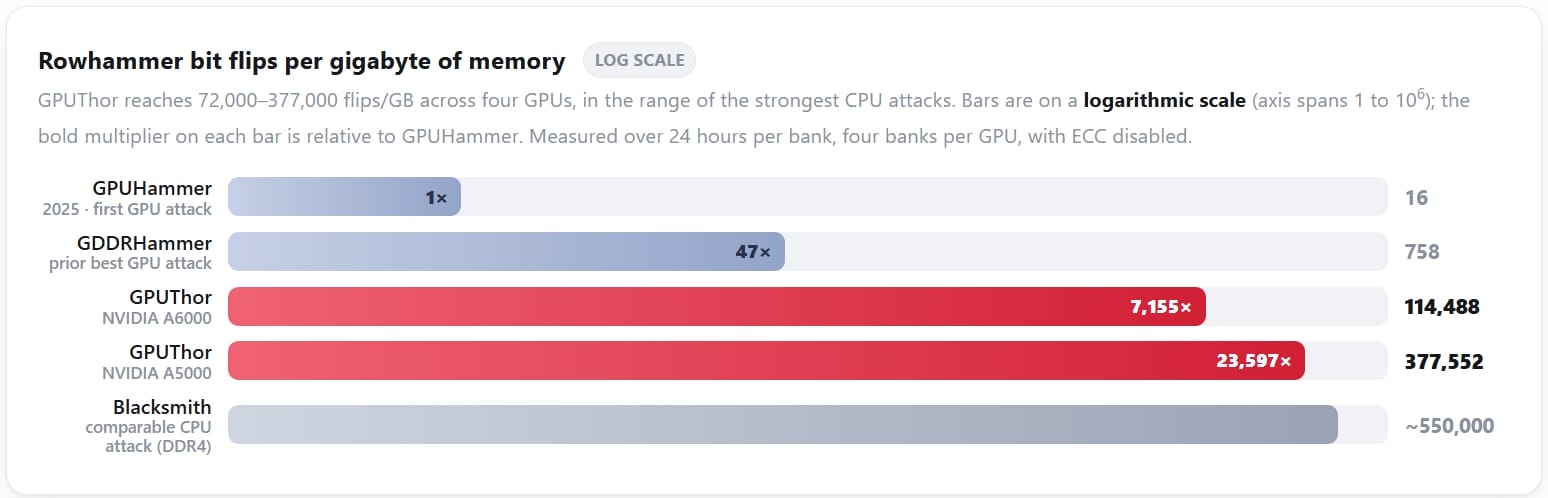
The quantitative results presented by the University of Toronto researchers underscore the severity of GPUThor’s advancements. When tested on Ampere-class GPUs without ECC enabled (for baseline comparison), GPUThor generated between 72,000 and 377,000 bit flips per gigabyte of memory. This represents an astonishing improvement, yielding 4,548 to 23,597 times more bit flips than the researchers’ previous GPUHammer attack. These figures approach the bit-flip rates observed in highly potent CPU Rowhammer attacks, such as Blacksmith, which have demonstrated significant exploitability.
The practical implication of these dramatically increased bit-flip rates is a reduction in the time required to find an exploitable bit flip. What once took GPUHammer approximately 21.9 hours, GPUThor can achieve in roughly 1.1 minutes. This shift from hours to minutes transforms the attack from a theoretical curiosity into a genuinely practical and rapid exploitation vector.
Crucially, even with ECC enabled on the target GPUs, GPUThor demonstrated its ability to bypass these defenses. The attack successfully induced 387 double-bit errors, which SECDED ECC can detect but cannot correct, leading to unrecoverable data corruption. More alarmingly, GPUThor also triggered two triple-bit errors. In these instances, the SECDED ECC system, designed for single-bit correction and double-bit detection, miscalculated and incorrectly "repaired" the data, leading to subtle yet critical data corruption that goes undetected and uncorrected, potentially propagating incorrect information throughout the system. This phenomenon highlights a fundamental limitation of SECDED ECC when faced with multi-bit errors induced by highly effective Rowhammer attacks.
Profound Impact: Denial-of-Service and Privilege Escalation
The implications of GPUThor’s capabilities are multifaceted and severe, ranging from system instability to complete compromise. The researchers successfully demonstrated two primary attack vectors: denial-of-service (DoS) and root-level privilege escalation.

In the DoS scenario, GPUThor was shown to induce a state on an ECC-enabled RTX A6000 GPU where the device would reset approximately every two hours, effectively terminating all running workloads. Repeated application of the attack on the same hardware eventually led the GPU to flag itself as requiring replacement, indicating permanent damage or severe degradation of its operational integrity. Such an attack could cripple critical AI training jobs, halt scientific simulations, or disrupt cloud services, incurring significant financial losses and operational downtime.
The more critical and far-reaching consequence is the demonstrated ability to escalate privileges to root level. By meticulously corrupting GPU page tables, an unprivileged CUDA program executing on the GPU could gain arbitrary memory access across the host system. This level of access is equivalent to having administrative control, allowing the attacker to read, write, and execute code anywhere in the system’s memory. The researchers successfully exploited this to open a root shell on the host system, granting full control to the attacker. This capability could be leveraged by malicious actors to install malware, exfiltrate sensitive data, or establish persistent backdoors, profoundly compromising the security of the entire infrastructure.
Wider Implications for AI, Cloud Computing, and Data Integrity
The discovery of GPUThor carries profound implications for various sectors heavily reliant on GPU-accelerated computing. The primary targets, Ampere-class workstation GPUs, are ubiquitous in professional environments, including AI research labs, data centers, and cloud computing platforms.
In the realm of Artificial Intelligence, the integrity of data and computations is paramount. AI models are trained on vast datasets, and even subtle data corruption introduced by bit flips could lead to model inaccuracies, biases, or even direct manipulation of model outputs. For critical applications like autonomous driving, medical diagnostics, or financial fraud detection, compromised AI models could have catastrophic real-world consequences. Furthermore, the DoS aspect could bring AI training pipelines to a grinding halt, causing significant delays and resource wastage.
Cloud computing providers, who often share GPU resources among multiple tenants, face an elevated risk. A malicious tenant could potentially use GPUThor to launch attacks not only against their own allocated GPU but also, through privilege escalation, against the underlying host system and potentially other tenants sharing the same physical hardware. This cross-tenant attack vector undermines the isolation guarantees that are fundamental to cloud security models. The attack could lead to data breaches, unauthorized access to virtual machines, and widespread disruption across multi-tenant environments.
Beyond AI and cloud, the attack poses a threat to general data integrity. Any application processing sensitive or critical data on vulnerable GPUs could experience silent data corruption, leading to erroneous results that might go undetected for extended periods. This erodes trust in computational outcomes and necessitates enhanced validation mechanisms.
The researchers also highlighted that while server-class Ampere GPUs (e.g., A100) might exhibit improved resilience against DoS conditions due to architectural differences, they still rely on SECDED-level ECC, making them potentially vulnerable to privilege escalation. Even newer Blackwell GPUs with RAS (Reliability, Availability, Serviceability) Repair features might only slow down, but not prevent, a GPUThor attack. Furthermore, the paper suggests that even next-generation HBM3/e and GDDR7 GPUs, despite incorporating on-die ECC, could remain vulnerable if multi-bit flips can be triggered within their memory blocks, indicating a persistent challenge for future hardware designs.
Vendor Response and Current Mitigations
Upon receiving the researchers’ findings on April 29, NVIDIA acknowledged the vulnerability and subsequently issued a security advisory on August 21. The advisory provides guidance to mitigate the risks associated with GPUThor.
NVIDIA’s recommendations include:
- Enabling SYS-ECC: This refers to system-level ECC, which operates in conjunction with GPU-level ECC to provide an additional layer of memory integrity protection.
- Implementing IOMMU/DMA isolation: Input/Output Memory Management Units (IOMMUs) and DMA (Direct Memory Access) isolation techniques can restrict a GPU’s access to host system memory, thereby limiting the scope of potential privilege escalation even if the GPU itself is compromised.
- Monitoring GPU error telemetry: Actively tracking and analyzing ECC error counters can help detect unusual patterns of single or multi-bit errors, providing early warning signs of a potential Rowhammer attack or hardware degradation.
- Restricting the sharing or execution of untrusted workloads: This is a fundamental security best practice. In shared environments, only trusted and thoroughly vetted applications should be allowed to run on GPUs, especially those with sensitive data or access to critical system resources.
NVIDIA’s advisory also noted that the risk profile varies significantly based on specific DRAM devices, memory technology, platform design, in-DRAM defenses, and overall system configuration. Encouragingly, the company stated that no bit flips were observed on tested GDDR6X or HBM2e GPUs using the same attack patterns, suggesting that certain memory technologies or their implementations might offer inherent resistance or better integrate TRR.
The researchers independently recommended additional measures, such as avoiding cross-tenant GPU sharing whenever possible, intensifying ECC error counter monitoring, and strictly controlling untrusted CUDA workloads. They also emphasized that a complete and robust defense will likely necessitate stronger multi-bit ECC implementations and more sophisticated hardware-level defenses embedded directly into future GPU architectures.
The Path Forward: Enhancing Hardware Resilience
The emergence of GPUThor underscores the persistent and evolving nature of hardware-level security challenges. While software patches can address logical vulnerabilities, physical phenomena like Rowhammer demand architectural solutions. The industry must move towards more resilient memory designs that can withstand increasingly sophisticated hammering patterns.
Future GPU architectures will likely require a re-evaluation of ECC strategies. Relying solely on SECDED ECC, while effective against random single-bit errors, proves insufficient against targeted multi-bit flips induced by advanced Rowhammer attacks. Stronger ECC schemes, capable of correcting multiple bits (e.g., QED for quad-bit error detection and correction), or even dynamic ECC capabilities that can adapt to perceived threat levels, may become imperative.
Beyond ECC, advancements in in-DRAM defenses are crucial. Current TRR mechanisms, as demonstrated by GPUThor, can be circumvented. Researchers and manufacturers need to collaborate on developing next-generation TRR or similar proactive refresh technologies that are more robust and less predictable, making it harder for attackers to bypass them through pattern analysis.
Furthermore, architectural changes at the GPU and system-on-chip (SoC) level could include improved memory isolation, hardware-enforced boundaries between memory regions, and more sophisticated monitoring capabilities that can detect anomalous memory access patterns indicative of Rowhammer attacks. Integrating hardware-level threat detection directly into the memory controller could provide real-time defense.
The disclosure of GPUThor serves as a critical reminder that security is a continuous process, extending beyond software to the very silicon layer. As AI and high-performance computing become increasingly central to global infrastructure, the integrity and security of the underlying hardware will dictate the trustworthiness and resilience of entire digital ecosystems.
Conclusion: A Persistent Challenge in Hardware Security
GPUThor represents a significant milestone in the ongoing arms race between hardware security researchers and silicon manufacturers. By demonstrating a practical method to bypass NVIDIA’s ECC protections and achieve root-level privilege escalation on widely used Ampere GPUs, it highlights a critical vulnerability that demands immediate attention and long-term architectural foresight. The implications for data integrity, system stability, and cloud security are substantial, necessitating a multi-pronged approach involving enhanced hardware defenses, stringent operational policies, and continuous vigilance. The challenge of securing physical memory from Rowhammer attacks remains a persistent and evolving frontier in the complex landscape of hardware security.



 Aura Kasih
 Lisa Mariana