Safa Marwah
A recent, highly targeted social engineering campaign aimed at cybersecurity firm ReliaQuest was successfully contained, preventing significant data compromise despite initial credential theft. This incident, later claimed by the notorious ShinyHunters extortion collective, highlights the enduring challenge posed by human-centric attack vectors even against security-focused organizations, while simultaneously demonstrating the critical effectiveness of robust, layered defensive architectures, particularly device-trust controls and adaptive multi-factor authentication. The attempted breach underscores a sophisticated evolution in threat actor tactics, forcing a renewed examination of identity and access management strategies across the digital enterprise.
The meticulously orchestrated attack commenced with a classic social engineering ploy, wherein malicious actors impersonated members of ReliaQuest’s internal security team. This sophisticated vishing tactic involved directly contacting multiple employees, attempting to manipulate them into navigating to a fraudulent single sign-on (SSO) portal. The counterfeit authentication page was meticulously crafted, hosted on a deceptive domain designed to mimic legitimate ReliaQuest infrastructure, specifically reliaquest.claims, and delivered via a content delivery network to enhance its apparent legitimacy and evade basic security filters. This approach leverages a potent combination of social manipulation and technical subterfuge, aiming to exploit human trust and circumvent traditional perimeter defenses.
Further insights reveal that this particular method aligns with a broader campaign previously identified by ReliaQuest’s own threat intelligence unit. Prior to the incident, the company’s research team had publicly detailed ShinyHunters’ predilection for registering .claims top-level domains, using patterns like company[.]claims to create convincing impersonations of help desks and IT support teams for various target organizations. This pre-existing knowledge ironically placed ReliaQuest in the crosshairs, turning their own analytical insights into a direct challenge from the very group they were tracking. The audacious nature of ShinyHunters directly targeting a cybersecurity firm, especially one that had publicly exposed their tactics, signals a growing confidence and a calculated escalation in their operational methodology.
The initial phase of the attack proved partially successful. One ReliaQuest employee, caught unaware by the deceptive impersonation and the convincing facade of the fake SSO page, inadvertently entered their legitimate credentials. Following this, the employee was prompted to approve a multi-factor authentication (MFA) push notification, which, regrettably, they also granted. This action provided the attackers with temporary, but critically, view-only access to a segment of ReliaQuest’s identity dashboard. Such an initial compromise, even if limited, represents a significant breach of an organization’s first line of defense, often paving the way for more extensive lateral movement and data exfiltration in less fortified environments.
However, it was at this juncture that ReliaQuest’s inherent security architecture demonstrated its formidable strength. The organization’s integrated device-trust controls immediately identified subsequent attempts by the threat actors to leverage the compromised credentials for accessing additional internal applications. These controls, designed to verify the security posture and legitimacy of the accessing device in addition to user credentials, successfully blocked all further attempts to penetrate deeper into ReliaQuest’s systems. This crucial layer of defense ensured that the attacker’s access remained confined to the initial, view-only scope, preventing any engagement with critical applications, sensitive customer data, or proprietary information. The company’s official statement unequivocally affirmed, "The extent of the access was view-only. No ReliaQuest applications or systems were accessed, and no customer data was ever touched."
The swift and decisive response from ReliaQuest’s security team was paramount in containing the incident. Upon detection, the organization immediately terminated the attacker’s active sessions, revoked the exposed employee password, and initiated a comprehensive reset of all associated authentication tokens. An exhaustive post-incident investigation was subsequently launched, meticulously auditing system logs and network activity. This detailed forensic analysis found no evidence of unauthorized access to any other accounts, applications, or data repositories beyond the initial, limited identity dashboard view. Crucially, the investigation also confirmed that the threat actor failed to establish any form of persistent access within ReliaQuest’s digital infrastructure, indicating a complete failure in their objective to entrench themselves within the network. Furthermore, a thorough audit of control fidelity, device trust mechanisms, and on-network access since the incident’s inception on August 21st confirmed the absence of any suspicious activity, validating the efficacy of their defensive posture.

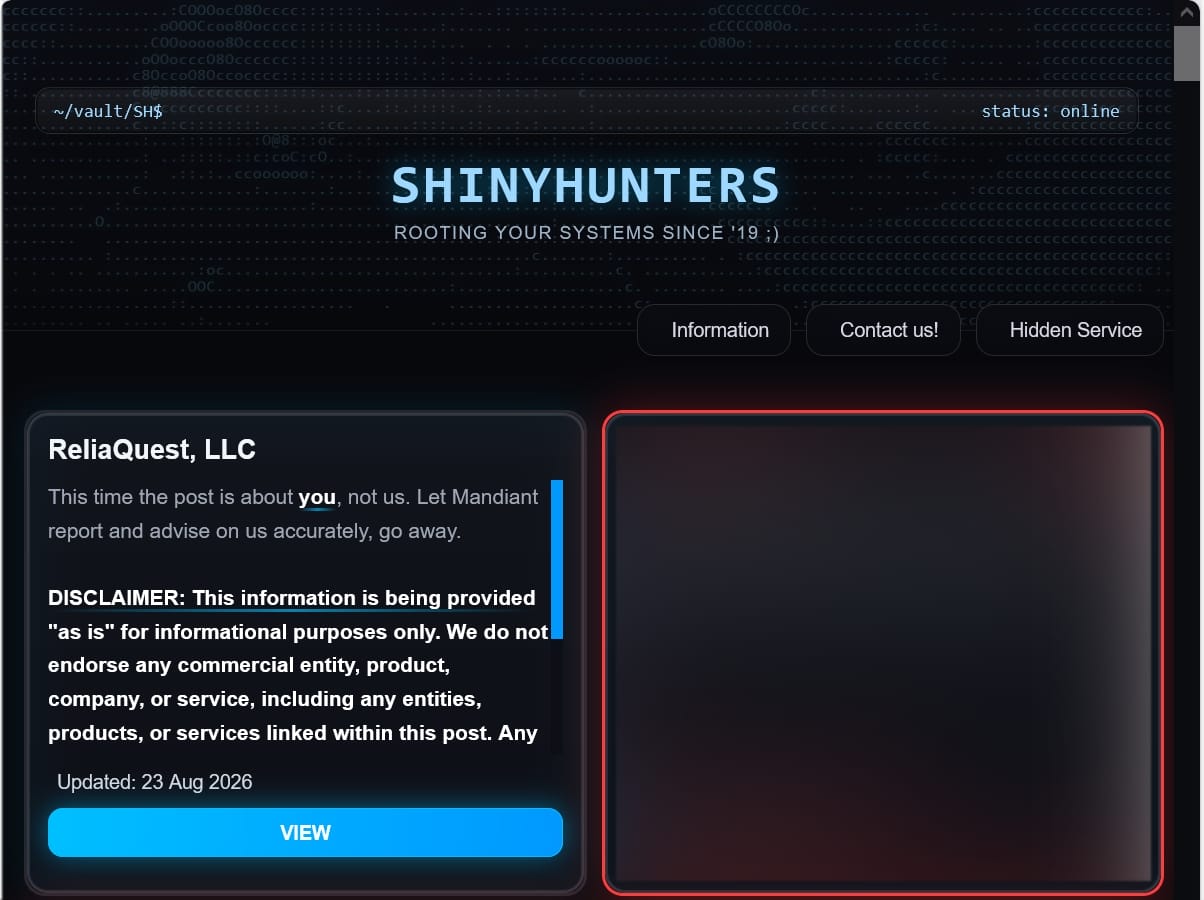
The notorious data extortion collective, ShinyHunters, swiftly moved to claim responsibility for the attack. In a new entry posted on their dark web extortion portal, the group overtly referenced ReliaQuest’s prior threat intelligence reporting on their activities, posting a provocative message stating, "this time the post is about you, not us." The group subsequently published screenshots purporting to show evidence of their access, specifically an image depicting a compromised Okta SSO account associated with a ReliaQuest employee. These screenshots were also briefly shared on a newly created X (formerly Twitter) account believed to be linked to the threat actors, before both their social media posts and ReliaQuest’s original threat intelligence post were subsequently removed. Notably, ShinyHunters themselves, in communication with reporting outlets, corroborated ReliaQuest’s assessment, confirming that their access was indeed view-only and did not extend to any deeper applications, systems, or sensitive data. This alignment between the victim organization’s and the attacker’s statements, while unusual, provides a clear picture of the attack’s limited success.
This incident serves as a potent case study in the evolving landscape of cyber threats, particularly the persistent and growing danger posed by sophisticated social engineering. Even organizations at the forefront of cybersecurity are not immune to attacks that skillfully manipulate the human element. The initial success of the ShinyHunters campaign in compromising an employee’s credentials and gaining limited access highlights the critical need for continuous, advanced security awareness training that extends beyond basic phishing simulations. Employees must be equipped to recognize increasingly nuanced impersonation tactics, understand the risks associated with approving unexpected MFA prompts, and be empowered to question suspicious requests, even when they appear to originate from within their own organization.
Moreover, the ReliaQuest incident powerfully underscores the indispensable value of a multi-layered security strategy, particularly the implementation of a robust Zero Trust framework. While MFA is a vital defense, its susceptibility to push notification fatigue or social engineering manipulation necessitates additional layers. Device-trust controls, which verify the integrity and compliance of an endpoint before granting access to resources, proved to be the decisive factor in preventing a more severe breach in this scenario. These controls operate on the principle that trust should never be implicitly granted, regardless of network location or user identity, requiring continuous verification at every access attempt. This principle is fundamental to modern enterprise security, acknowledging that an initial compromise is always a possibility and focusing on limiting its impact.
The "cat-and-mouse" dynamic between threat actors and cybersecurity defenders is vividly illustrated by this event. ReliaQuest’s proactive intelligence on ShinyHunters’ tactics was a testament to their expertise, yet it simultaneously made them a direct target. This perpetual adversarial cycle necessitates constant innovation in defensive strategies and a commitment to real-time threat intelligence. Organizations must not only defend against known threats but also anticipate the evolution of attack vectors, adapting their defenses accordingly. The use of .claims domains, for instance, represents a tactical shift that organizations must integrate into their domain monitoring and threat detection capabilities.
Looking ahead, the ReliaQuest incident reinforces several critical imperatives for enterprise security. First, the human element remains the weakest link; investing in advanced, scenario-based security awareness training is no longer optional but foundational. Second, identity and access management (IAM) systems must move beyond simple credential verification to incorporate behavioral analytics, adaptive MFA, and comprehensive device-trust policies. Third, the principle of least privilege, ensuring users and devices only have the minimum access required for their function, is crucial in limiting the blast radius of any successful initial compromise. Finally, proactive threat intelligence, both internal and external, coupled with robust incident response capabilities, will continue to be the cornerstones of organizational resilience in an increasingly hostile cyber landscape. The successful containment of this sophisticated attack by ReliaQuest offers a valuable lesson: while breaches may be inevitable, their impact can be effectively minimized through strategic investment in advanced security controls and a proactive, adaptive defense posture.


 Aura Kasih
 Lisa Mariana