Safa Marwah
The pervasive encroachment on individual digital autonomy has become a defining characteristic of the modern internet. For decades, the digital ecosystem has incrementally reconfigured itself around an economic paradigm that necessitates the granular accumulation of personal information. Virtually every interaction, from application usage and account creation to website navigation and data entry, contributes to an ever-expanding dossier within a sophisticated infrastructure engineered for tracking, profiling, and monetizing user behavior and identity.
This systemic aggregation of personal data forms the bedrock of what is often described as the attention economy or profiling economy, where individual attention and personal data are the commodities, and users represent the primary source material. The operational mechanisms of this data collection are frequently subtle, almost imperceptible in daily digital life. A singular email address, for instance, can serve as a connective thread, linking disparate aspects of an individual’s online footprint—such as purchasing patterns, health-related inquiries, geographical movements, and social connections—into a coherent and exploitable profile.
Specialized entities known as data intermediaries or information aggregators actively participate in this ecosystem. Their core business model involves acquiring, trading, and cross-referencing fragments of personal data, progressively constructing comprehensive user profiles that often surpass an individual’s own awareness of their digital footprint. Critically, this extensive data consolidation does not typically stem from illicit breaches or unauthorized access; rather, it represents the default operational model of the contemporary internet. These data brokers frequently operate with minimal consumer awareness or explicit, informed consent, acting as central conduits for sensitive personal information.
Consequently, the expectation of online privacy has largely eroded. It is no longer a passive state but an active construct, requiring deliberate effort and strategic action against the inherent design of most online services. The detrimental effects of this model are often diffuse and delayed, manifesting not as immediate financial theft but as a gradual erosion of control over one’s digital persona. Over time, the consequences can include an influx of unsolicited communications, discriminatory pricing practices, heightened vulnerability to identity fraud, and a general diminishment of individual agency in the digital sphere. The consolidation of an individual’s entire online activity under a single, unified digital identity significantly amplifies these risks. In the event of a data compromise, the entirety of an individual’s interconnected digital life becomes susceptible to exposure and correlation, providing data aggregators with invaluable information for sale and exploitation.
The advent and rapid advancement of Artificial Intelligence (AI) systems have profoundly exacerbated this challenge. Information aggregators now leverage sophisticated AI algorithms to establish connections between seemingly unrelated digital actions, achieving levels of correlation previously considered unattainable. AI’s core strength lies in its capacity for advanced data analysis, enabling it to process immense volumes of information, discern complex patterns, and synthesize disparate actions into highly valuable and predictive user profiles. This technological amplification introduces new dimensions of complexity to the privacy landscape, raising critical questions about the feasibility of restoring individual privacy and security in the digital realm.
The Strategic Imperative of Compartmentalization
If the prevailing model of data aggregation thrives by unifying an individual’s diverse online activities into a single, exploitable profile, then a fundamental counter-strategy lies in structural disaggregation. This approach, known as compartmentalization, transcends mere legal or political interventions, focusing instead on dismantling the correlating identifiers that enable pervasive tracking.

Compartmentalization mandates a deliberate departure from the conventional practice of utilizing a single set of identifiers—such as one email address, one telephone number, one payment method, or one communication handle—across all online contexts. Instead, it advocates for the deliberate segmentation of online activities into distinct, purpose-built digital identities or personas. For example, an individual might maintain one persona dedicated solely to online retail, another for social networking or dating applications, a separate one for travel bookings, yet another for online marketplace transactions, and even a transient persona for interacting with new or untrusted digital services, such as newsletters or trial subscriptions.
Each of these digital personas functions as a self-contained entity, equipped with its own unique set of identifiers: a dedicated email address, a distinct phone number, an isolated payment mechanism, a segregated browser profile, and a unique communication handle. Crucially, these personas are architecturally designed to remain unlinked to one another and, most importantly, to the individual’s actual core identity, making it exceedingly difficult for data brokers, advertisers, or other third parties to establish correlation.
The inherent advantage of this segmented approach is its resilience. Should a particular persona become compromised in a data breach, inundated with spam, or sold to a marketing database, the damage is effectively contained within that specific persona. The incident does not cascade across an individual’s entire digital footprint or directly expose their core identity. This represents a fundamental divergence from the security paradigms underpinning most conventional digital protection tools. Traditional security measures typically aim to fortify a single, primary identity through robust passwords, advanced encryption, and meticulous permission management. While essential, these tools operate under the assumption that a single, unified identity is the target.
Compartmentalization, conversely, operates on the premise that any singular digital identity is eventually susceptible to correlation and potential compromise. It proactively mitigates risk by ensuring that no single identity holds disproportionate value due to its inherent changeability and isolation. This strategy shifts the focus from constructing an impenetrable digital fortress to strategically distributing and diversifying one’s digital assets, thereby minimizing the impact of any single point of failure.
The elegance of this architectural solution lies in its independence from broader internet infrastructure changes. It does not necessitate that every online service or company fundamentally alter its data collection practices. Instead, it relies on an intermediary layer—a platform or system—that sits between the individual and the vast array of online services, dynamically generating and managing these discrete digital personas on the user’s behalf. This approach allows individuals to navigate the existing data-driven internet while imposing their own structural boundaries on data aggregation.
Anonyome Labs, for instance, has been at the forefront of innovating and patenting many of the foundational concepts related to the creation and management of online personas and compartmentalization, recognizing the profound need for such capabilities in the current digital landscape.
Operationalizing Persona Management for the Everyday User
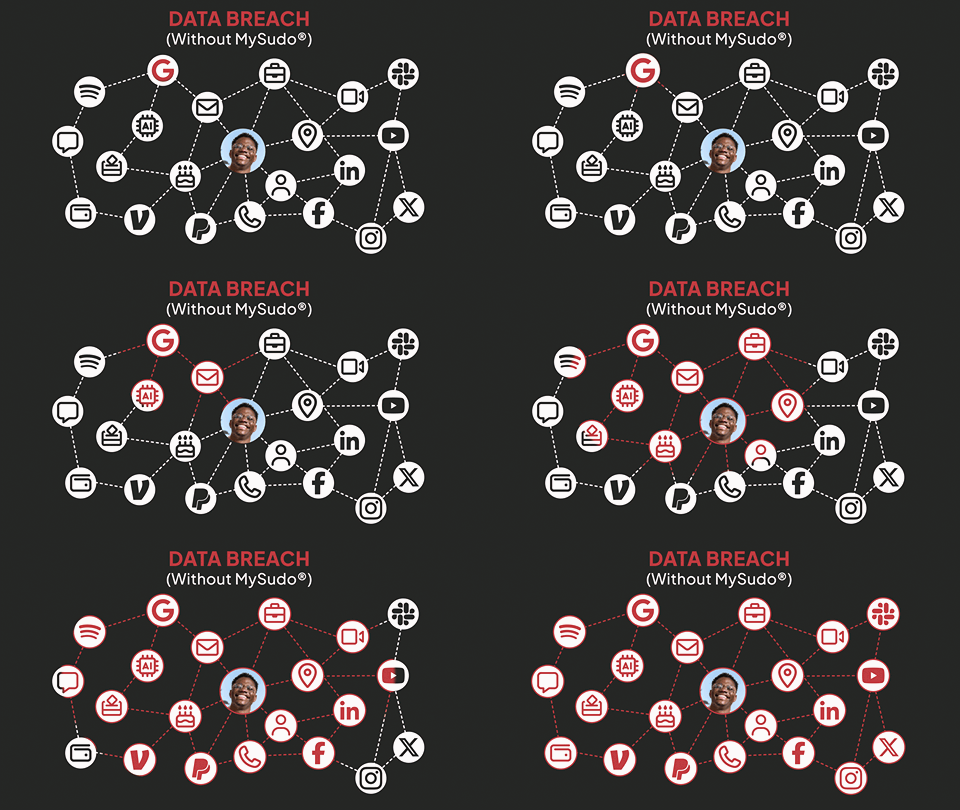
While the theoretical benefits of compartmentalization and digital personas are compelling, the practical implementation for the average user presents a significant challenge. The complexity of manually managing multiple email accounts, phone numbers, and payment methods for different online activities can be overwhelming, creating friction that hinders consistent adoption. A critical objective, therefore, is to transform this sophisticated privacy paradigm into a user-friendly and automated process, accessible without specialized technical expertise.
Platforms designed to implement this paradigm, such as MySudo, aim to empower users to create and manage multiple distinct digital identities, often referred to as "Sudos." Each Sudo is engineered to provide a comprehensive and unique set of digital attributes, effectively isolating different facets of an individual’s online life. These attributes typically include:
- Dedicated Email Addresses: For communications tied to specific activities, preventing cross-correlation.
- Unique Phone Numbers: Virtual numbers for calls and texts, shielding personal numbers from exposure.
- Virtual Payment Methods: Disposable or limited-use payment cards linked to specific personas, enhancing financial security.
- Isolated Web Browsers: Sandboxed browsing environments that prevent cross-site tracking and cookie leakage between personas.
- Distinct Communication Handles: Separate messaging and social media identities for different contexts.
These integrated features allow users to conduct various online activities—from shopping and banking to communicating and browsing—through distinct, self-contained digital identities. This prevents the aggregation of data points back to a single, master profile, significantly complicating the efforts of data brokers and other surveillance entities.
Solutions like MySudo are typically offered in various form factors, such as standalone mobile applications or integrated Software Development Kits (SDKs) that can be embedded into other applications, extending their privacy-enhancing capabilities. Furthermore, these platforms often integrate with a broader suite of privacy and security tools, including privacy-focused Virtual Private Networks (VPNs) to anonymize internet traffic and secure Password Managers to manage credentials across multiple personas without compromising security.
The journey toward individual online privacy has been an uphill battle, marked by continuous surveillance and persistent attacks on personal data. However, the emergence of identity-based tools that leverage the power of compartmentalization and digital personas offers individuals a potent defense mechanism. By consciously creating and managing multiple segmented identities, users can proactively reclaim control over their digital footprint and mitigate the pervasive risks of data aggregation.
In an era where personal data is meticulously collected and pieced together, adopting a strategy of segmented digital identities represents a crucial step in asserting digital sovereignty. It empowers individuals to cease inadvertently contributing to the construction of comprehensive, exploitable profiles, thereby fortifying their privacy against the relentless forces of the data economy.



 Lisa Mariana
 Aura Kasih
 Ayu Aulia