Ayu Aulia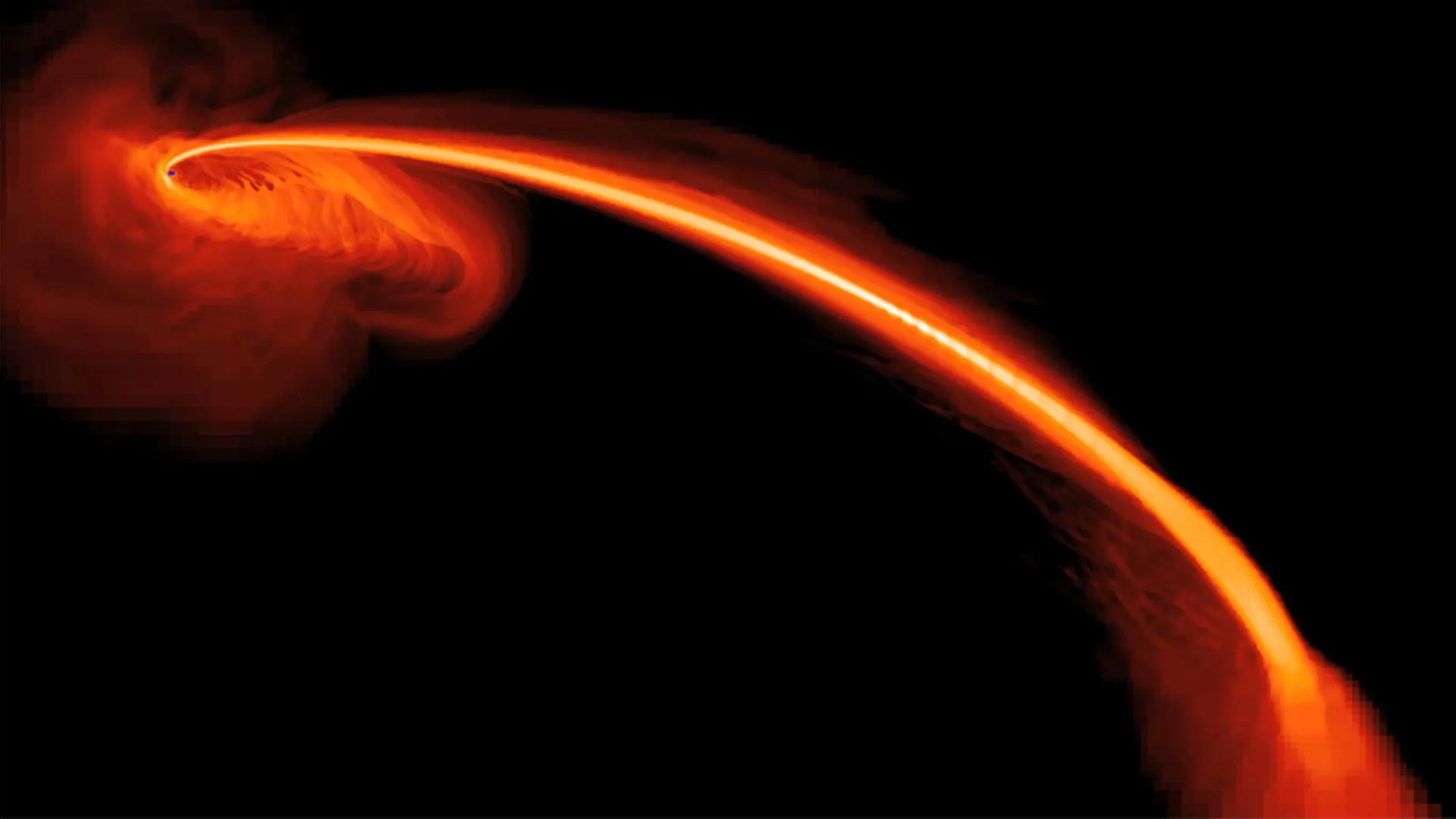
The colossal gravitational influence of supermassive black holes, residing at the nuclei of most galaxies, frequently subjects celestial bodies to extreme cosmic encounters. These enigmatic behemoths, with masses millions to billions of times greater than our sun, generate the most potent gravitational fields known, profoundly shaping their immediate environments. While often synonymous with ultimate destruction, recent astrophysical investigations reveal a more nuanced narrative: some stars, rather than succumbing entirely, endure repeated close approaches to these gravitational titans, offering unprecedented insights into stellar resilience and black hole dynamics.
These recurring stellar interactions, termed repeating partial tidal disruption events (rpTDEs), present a unique opportunity for astronomers to scrutinize the same star’s ongoing struggle against the same black hole’s immense pull across multiple instances. Modern wide-field time-domain astronomical surveys, which meticulously scan vast swathes of the cosmos for variations in celestial brightness, have been instrumental in identifying these rare phenomena. However, a persistent puzzle has challenged theoretical understanding: a subset of these systems exhibits progressively fainter luminous outbursts with each subsequent encounter, a behavior that conventional models struggled to replicate.
Groundbreaking research from astrophysicists at Syracuse University now posits that a previously underestimated intrinsic characteristic of the star—its initial rotational velocity prior to its inaugural close encounter—may resolve this long-standing discrepancy. Published in The Astrophysical Journal, this pivotal study, spearheaded by doctoral student Ananya Bandopadhyay alongside postdoctoral researcher Benjamin Amend and associate professor Eric Coughlin, in collaboration with external institutions, introduces a critical new parameter into the complex simulations governing these extreme events.
The Mechanics of Cosmic Disintegration: Tidal Forces and Stellar Fates
To comprehend the significance of rpTDEs, it is essential to first understand the broader context of tidal disruption events (TDEs). In a standard TDE, a star ventures too near a supermassive black hole, crossing a critical boundary known as the tidal radius. At this point, the black hole’s gravitational gradient—the differential pull exerted across the star’s diameter—becomes so extreme that it overwhelms the star’s own self-gravity, effectively stretching and tearing it apart. This process is analogous to spaghettification, where the star is elongated and shredded into a stream of stellar debris.
Following such a catastrophic event, a significant portion of the stellar material does not escape but instead falls back towards the black hole, forming a temporary accretion disk. As this matter spirals inward, losing orbital energy due to friction and viscous forces, it heats up to incandescent temperatures, emitting powerful bursts of electromagnetic radiation across various wavelengths, from X-rays to visible light. While black holes themselves are intrinsically dark, these luminous flares provide an indirect yet invaluable beacon, illuminating the otherwise invisible immediate vicinity of the central supermassive object for periods ranging from days to many months. This transient glow serves as a crucial diagnostic tool for probing the properties of quiescent black holes and their surrounding environments.
However, not all close encounters culminate in the complete obliteration of the star. If a star’s trajectory brings it sufficiently close to a black hole but just outside the threshold for total disruption, it can survive, albeit losing a fraction of its mass. This scenario defines a partial TDE. In an rpTDE, the resilient stellar core, having shed some of its outer layers, remains gravitationally bound in an eccentric orbit around the black hole. It then repeatedly returns to the black hole’s vicinity, undergoing successive partial disruptions and shedding additional material during each passage. These subsequent encounters can occur on timescales ranging from a few months to several years, each generating a new, albeit potentially weaker, luminous flare. The ability to observe these multiple interactions with the same system provides a unique laboratory for studying stellar evolution under extreme gravitational stress.
The Fading Flare Conundrum: A Theoretical Impasse
The amount of stellar material stripped away during each encounter in an rpTDE is profoundly influenced by the star’s internal composition and structure. For instance, a lower-mass star, characterized by a more diffuse, "fluffy" internal structure, akin to a meringue, might become increasingly susceptible to the black hole’s tidal forces over time, potentially losing a larger fraction of its remaining mass in subsequent passages. Conversely, a higher-mass star, possessing a denser core and a more concentrated mass distribution, resembling an onion with distinct layers, might primarily lose its outer envelopes while its robust core remains largely intact. This differential mass loss could intuitively suggest that less material would lead to weaker flares.
Yet, this intuitive assumption failed to align with observations for a significant subset of rpTDEs. Of the approximately ten repeating systems identified to date, four have consistently exhibited flares that diminish in brightness with each return. This observation posed a considerable challenge to existing theoretical frameworks. Earlier hydrodynamical simulations, which model the fluid dynamics of stellar material under tidal forces, consistently predicted a complication: even when the star lost progressively less mass during successive passages, the models still projected flares of approximately the same peak luminosity. This theoretical rigidity puzzled researchers for an extended period.
The underlying reason for this discrepancy lay in another critical consequence of the black hole’s tidal forces: beyond simply stripping material, these forces also impart significant torque on the surviving star. This torque causes the star to spin up, or rotate faster, after each close encounter. The increased rotational velocity, in turn, influences the dynamics of the stripped material. While less material might be removed, the accelerated spin means this material returns to the black hole and accretes over a shorter timescale. This more concentrated infall rate effectively compensated for the reduced mass, maintaining a similar peak fallback rate and, consequently, a roughly constant predicted flare brightness in the previous models. The mechanism for fading flares remained elusive.
The Pivotal Role of Initial Stellar Rotation
To reconcile theoretical predictions with the observed fading flares, the Syracuse University team identified a crucial "new ingredient": a star that was already rotating rapidly before its very first encounter with the supermassive black hole. The new suite of sophisticated simulations demonstrates that such a pre-existing rapid rotation fundamentally alters the star’s response to subsequent tidal torques.
In this revised scenario, a star already spinning quickly cannot be significantly spun up further by later close passages. Its initial angular momentum effectively saturates its rotational state, limiting the additional acceleration it can gain from the black hole’s torque. Without a substantial increase in rotation after each encounter, the characteristic timescale for the stripped material to fall back toward the black hole remains relatively stable and does not shorten dramatically.
This altered dynamic fundamentally changes the outcome. As progressively less material is stripped from the star with each passage, and the fallback timescale remains comparatively constant, the peak fallback rate also decreases proportionally. Consequently, the predicted flare luminosity can then become progressively fainter with each encounter, providing a compelling and elegant explanation that precisely matches the observational data collected by astronomers. This breakthrough underscores the profound importance of initial conditions in determining the long-term behavior of these extreme astrophysical systems.
The Hills Mechanism: Explaining Rapid Spin and Tight Orbits
The discovery that a rapidly spinning star is key to explaining fading rpTDE flares naturally raises a secondary, yet equally significant, question: why would a star approaching a supermassive black hole already possess such a high rotational velocity? Furthermore, as Professor Coughlin notes, it is extraordinarily challenging for a single star to become gravitationally bound to a supermassive black hole in such a tight orbit that its orbital period is measured in mere months, as is observed in rpTDEs.
The solution to both these peculiarities may lie in a well-established astrophysical process known as the Hills mechanism. This mechanism, originally proposed to explain the existence of hypervelocity stars ejected from galactic centers, describes the dynamic interaction between a binary star system and a supermassive black hole.
In the Hills mechanism, two stars orbiting closely around each other venture too close to a supermassive black hole. The black hole’s immense gravity intervenes, dramatically disrupting the binary system. One of the stars is violently ejected from the galactic center at extremely high speeds, becoming a hypervelocity star. Simultaneously, its companion star is captured into a very tight, eccentric orbit around the black hole.
Critically, stars within a very close binary system can become tidally locked. Tidal locking is a phenomenon where the gravitational interaction between the two stars causes each star to rotate on its axis at the same rate that the pair orbits around their common center of mass. The tighter and more compact the original binary system, the shorter its orbital period, and consequently, the faster each tidally locked star must rotate. Therefore, to produce a captured star in the extraordinarily tight, short-period orbits observed in rpTDEs, the original binary system would necessarily have to be extremely compact. This same compact configuration would naturally result in a rapidly spinning, tidally locked star before its capture by the black hole.
As Professor Coughlin highlights, "Ananya’s work demonstrates that each of these peculiarities—both the rapid rotation and the unusually tight orbit—can be explained by the same underlying phenomenon: the tidal destruction of a binary system and the subsequent capture of one of its stellar components." From a theoretical perspective, this unified explanation represents a significant leap forward in our understanding of the intricate physics at play in these dynamically rich environments.
Broader Implications and a Glimpse into Our Galactic Core
The implications of this research extend far beyond the specific phenomenon of fading rpTDE flares. The insights gleaned from these distant repeating systems may offer a profound connection to the stellar populations and dynamics observed within our own Milky Way galaxy. Professor Coughlin suggests that the Hills mechanism, now reinforced by its ability to explain rpTDE characteristics, may also be responsible for the presence and properties of some of the stars currently orbiting Sagittarius A (Sgr A), the supermassive black hole at the center of the Milky Way.
The region immediately surrounding Sgr A is known to harbor a population of young, massive stars (the so-called S-stars) in surprisingly tight, eccentric orbits. The formation of such stars in situ at the galactic center, where strong tidal forces would typically inhibit star formation, presents a long-standing astrophysical paradox. The Hills mechanism offers a compelling alternative explanation: these stars could have formed much further out in a binary system, only to be subsequently torn apart and one component captured by Sgr A.
If the same mechanism that clarifies the puzzling fading of rpTDE flares also accounts for some of the unusual stellar populations orbiting Sgr A*, it would provide a powerful, unifying framework for understanding the extreme stellar dynamics in galactic nuclei across the cosmos. This research not only resolves a specific observational mystery but also enhances our understanding of the broader processes that sculpt the distribution and characteristics of stars in the immediate vicinity of supermassive black holes, offering new perspectives on the environment within "our own cosmological backyard."
Future research will likely focus on refining these hydrodynamical simulations further, exploring a wider range of initial stellar properties and binary configurations. Observational efforts, particularly with next-generation wide-field surveys and multi-wavelength telescopes, will continue to search for more rpTDEs, aiming to increase the sample size and provide more robust statistical insights into their diverse behaviors. These ongoing endeavors promise to deepen our comprehension of the violent yet strangely creative interplay between stars and the colossal gravitational engines that power galactic evolution.




 Lisa Mariana
 Aura Kasih
 Safa Marwah