Aura Kasih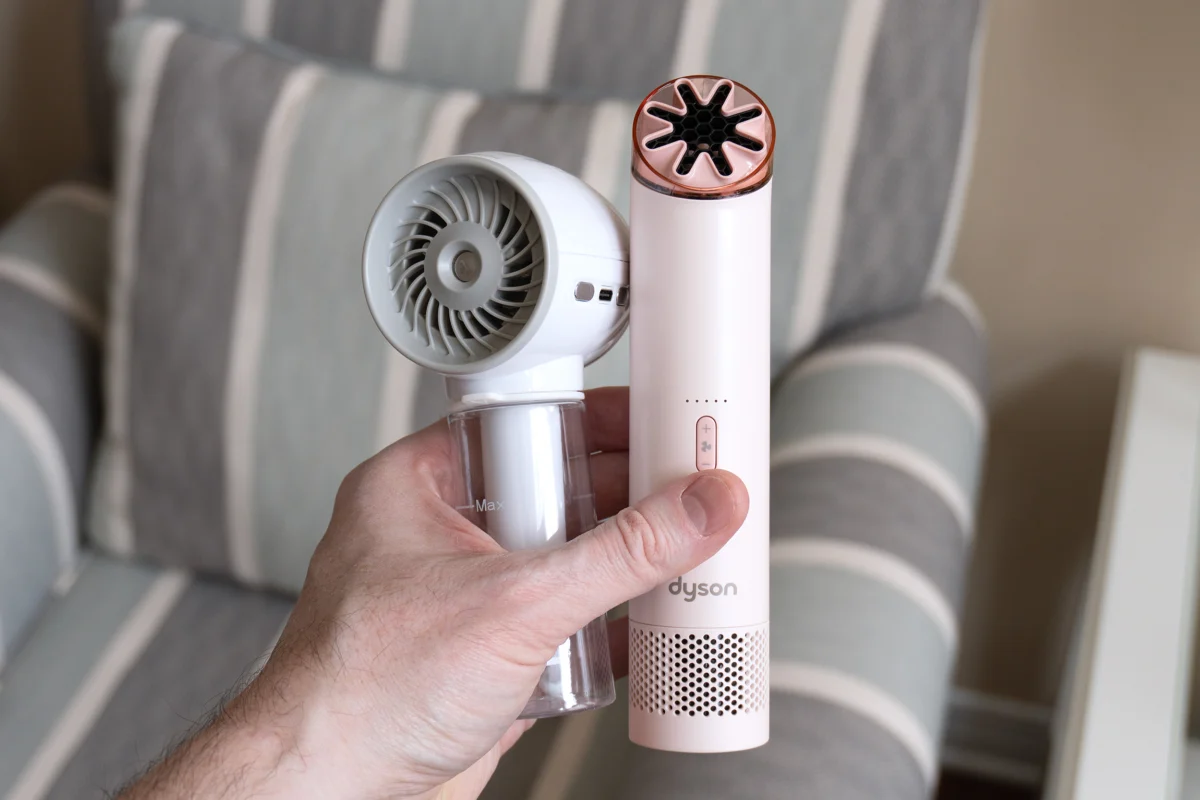
Dyson, a titan of innovative home appliance design, has unveiled its latest portable cooling solution, the HushJet Mini Cool. This compact device promises potent personal airflow in a sleek, pocketable form factor, aiming to redefine on-the-go comfort. However, initial assessments reveal that while the fan excels in power and design, its acoustic profile may challenge the "Hush" in its moniker.

The Dyson HushJet Mini Cool enters the market at a premium price point of $99.99, a figure that immediately signals its positioning as a high-end gadget. Recalling a particularly sweltering outdoor wedding event from two years prior, where guests sought refuge in air-conditioned vehicles, the potential utility of such a portable fan becomes apparent. The HushJet Mini Cool, with its remarkably slim silhouette, echoes the design philosophy seen in Dyson’s other sophisticated personal care and cleaning devices, such as its ultra-thin vacuums and professional-grade hair dryers. This aesthetic continuity suggests a deliberate effort by Dyson to imbue even its most portable products with a sense of premium engineering and sophisticated form.
A key differentiator of the HushJet Mini Cool lies in its internal engineering, a hallmark of Dyson’s product development. Unlike many handheld fans that feature exposed, flexible blades or bulky housing for their mechanical components, Dyson has ingeniously integrated the motor, a robust 5,000mAh rechargeable battery, and the spinning blades within a slender, cylindrical body measuring a mere 38mm in diameter. This design not only prioritizes safety, particularly for younger users, but also enhances portability. The absence of protruding blades and the slim profile allow the device to be easily slipped into a pocket or small bag, a significant advantage over more bulbous or unwieldy alternatives. This commitment to miniaturization and safety is a direct response to the limitations of conventional handheld fans, which often compromise on either pocketability or user safety due to exposed moving parts.

Weighing approximately 208 grams, the HushJet Mini Cool is comparable in weight to a modern high-end smartphone, making it a manageable accessory for extended use during heatwaves. Its operation is designed for intuitive user interaction. A simple toggle switch governs power, while a rocker button facilitates seamless navigation through five distinct fan speed settings. These speeds are visually indicated by a discreet array of five white LEDs. Furthermore, a dedicated Boost Mode offers an intensified airflow, accessible only through sustained pressure on the "plus" side of the rocker button, providing a surge of cool air when most needed.
A minor ergonomic consideration arises from the fan’s design: users must be mindful to avoid obstructing the air intake vents encircling the base. While the device’s form factor is otherwise user-friendly, the addition of subtle textural cues or grip indicators on the exterior could further refine the hand-placement experience, ensuring optimal airflow and preventing accidental blockage.

The battery performance of the HushJet Mini Cool presents a mixed but ultimately impressive picture. Dyson claims up to six hours of operation on the lowest setting. During testing, the fan sustained its highest speed (excluding Boost Mode) for a commendable 62 minutes before depleting its charge. This duration, while shorter than the advertised maximum, is still noteworthy given the fan’s powerful output at full speed. The remaining battery life is indicated by the five white LEDs, though this feedback is only available when the device is powered off. A feature allowing real-time monitoring of battery depletion while the fan is in operation would enhance user convenience, enabling more accurate estimations of remaining cooling duration.
The HushJet Mini Cool’s stability as a standalone unit is a notable design feature. Its bottom-heavy construction allows it to stand upright, and an included accessory expands the base for enhanced stability. However, this accessory, while functional, adds another small component that could potentially be misplaced. For continuous operation, the fan can be powered via USB-C. Nevertheless, this mode restricts the fan to its lowest speed setting, a compromise that limits its cooling efficacy at a distance. At this reduced setting, effective cooling is confined to approximately a five-foot radius.

Dyson’s marketing materials and product naming, particularly the "HushJet" designation, place a strong emphasis on acoustic engineering. The company asserts a focus on "tonal comfort," aiming to reduce frequencies, eliminate high-pitched whirring, and silence motor noise. This emphasis suggests a deliberate design objective to minimize auditory distraction. However, empirical observation indicates that the HushJet Mini Cool, while not reaching the decibel levels of some of Dyson’s more powerful appliances, is not entirely silent. Even at its lowest setting, a discernible level of noise is present. Furthermore, a characteristic high-pitched whine, similar to that found in other Dyson devices, is audible, despite the fan’s small motor operating at a significantly lower rotational speed than those in vacuums or hair dryers.
Comparisons with other portable cooling solutions highlight Dyson’s performance achievements. For instance, the Nitecore izzCool 10 Pro, a fan utilized by the reviewer’s household for the past year, presents a contrasting design. While the Nitecore fan is shorter, its form factor is less conducive to pocketability. At its maximum setting, its airflow is considerably less potent than the Dyson HushJet Mini Cool, even when the Dyson is operating at half power. Decibel measurements, taken using the NIOSH Sound Level Meter app on an iPhone, revealed that while both fans produced similar noise levels at their lowest settings, the Dyson’s output at full power exceeded the Nitecore’s by over 10 decibels. This disparity in loudness is directly correlated with the Dyson’s superior airflow and performance. However, the quality of the sound produced by the HushJet Mini Cool, characterized by higher frequencies, makes it more noticeable in quieter environments.

The implications of the HushJet Mini Cool’s acoustic profile are significant, particularly in diverse social settings. At high-energy, noisy events such as outdoor music festivals, crowded carnivals, or bustling fairs, operating the Dyson fan at its third or fourth speed setting would likely go unnoticed amidst the ambient sound. However, in more subdued environments, such as the aforementioned outdoor wedding, the fan’s audible output might be perceived as intrusive, potentially leading to social discomfort. This suggests a nuanced application for the HushJet Mini Cool, where its power is best leveraged in situations where ambient noise can mask its sonic footprint.
In the broader context of portable air management devices, the HushJet Mini Cool occupies a unique niche. Compact electric air dusters, while often more affordable and possessing considerable power, are engineered for different applications and tend to produce a louder, less directed sound. These devices are optimized for clearing dust and debris from electronics or workspaces, not for personal comfort. Dyson’s HushJet Mini Cool, by contrast, strikes a more balanced equation between portability, performance, and battery longevity, specifically tailored for personal cooling. The ability to operate for extended periods, even with powerful airflow, positions it as a compelling option for individuals who prioritize effective personal climate control on the move. While quieter alternatives certainly exist, the combination of compact size and potent airflow offered by the HushJet Mini Cool is arguably unmatched in its category.

The future outlook for Dyson’s portable cooling technology could involve further refinement of its acoustic engineering. As the company continues to innovate in appliance design, the development of even quieter, yet equally powerful, personal cooling solutions remains a compelling area of research. Enhancements to battery technology, such as improved energy density or faster charging capabilities, could also extend the operational lifespan of such devices. Furthermore, incorporating more advanced user interfaces, such as real-time battery status indicators or customizable sound profiles, could elevate the user experience. The HushJet Mini Cool represents a significant step in portable personal cooling, and its trajectory suggests a continued commitment from Dyson to push the boundaries of what is possible in this evolving market.




 Safa Marwah
 Ayu Aulia