Ayu Aulia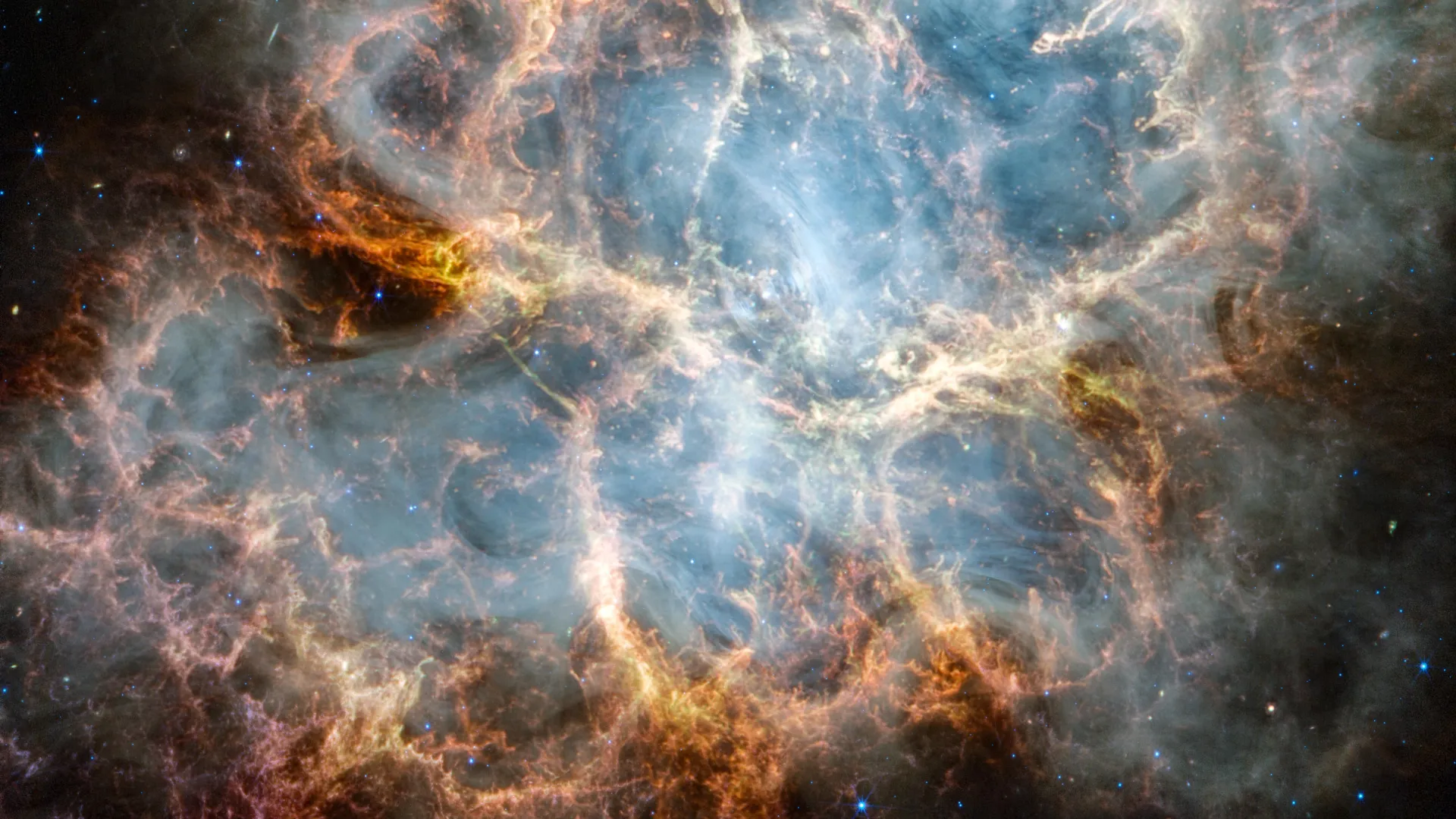
For over twenty years, the Crab Pulsar, a rapidly spinning neutron star forged from a supernova observed in 1054, has presented astronomers with an enduring enigma: a peculiar pattern of distinct, evenly spaced bright bands within its radio wave emissions, often likened to "zebra stripes." This perplexing spectral signature, unlike any observed from other pulsars, has long defied comprehensive explanation, challenging prevailing models of astrophysical radiation. However, a groundbreaking theoretical framework, building upon initial insights from 2024, has now fully elucidated this phenomenon by integrating the profound influence of spacetime curvature, positing that gravitational lensing, in concert with plasma dynamics, orchestrates these unique celestial markings.
This significant advance in theoretical astrophysics stems from the work of Mikhail Medvedev, a professor of physics and astronomy at the University of Kansas. His refined analysis, slated for presentation at the American Physical Society’s 2026 Global Physics Summit, definitively identifies gravity’s lensing effect as the critical, previously missing component required to reconcile theoretical predictions with observational data. An associated research paper, accepted for publication in the esteemed Journal of Plasma Physics, is currently accessible through the arXiv pre-print repository, offering a detailed exposition of the underlying physics.
The essence of this revelation lies in the interplay between two fundamental forces shaping electromagnetic radiation in extreme cosmic environments: the refractive properties of dense plasma and the warping of spacetime by immense gravity. As Professor Medvedev articulated, "Gravity inherently alters the geometry of spacetime. Light, rather than traversing a linear path, follows the curvature of space itself when subjected to a potent gravitational field. What would be perceived as a straight trajectory in flat spacetime becomes distinctly curved in the presence of strong gravity. In this context, gravity functions as a profound lens within the curved fabric of spacetime."
A Novel Cosmic Symphony: Gravity and Plasma in Concert
While the phenomenon of gravitational lensing is a well-established principle in the study of supermassive black holes and galaxy clusters, where mass concentrations are so immense they visibly distort the light from distant objects, its application in this specific context represents a novel frontier. Medvedev’s research marks the first empirically observed instance where both gravity and intervening plasma collectively modulate and shape an astrophysical signal detected from space.
"In the iconic images of black holes, the structure is solely sculpted by gravity," Medvedev elaborated. "Conversely, within the environment of the Crab Pulsar, both gravitational forces and the surrounding plasma collaborate. This discovery constitutes the inaugural real-world demonstration of this combined physical effect, opening new avenues for understanding complex astrophysical systems." This dual-mechanism scenario presents a far more intricate lensing problem than traditionally encountered, demanding a sophisticated theoretical approach that accounts for the simultaneous influence of both gravitational and electromagnetic interactions with light.
The Crab Pulsar, residing at the core of the Crab Nebula within the Perseus Arm of our Milky Way galaxy, approximately 6,500 light-years distant from Earth, holds a unique and privileged position in astronomical research. Its relative proximity and exceptional observational clarity render it an indispensable laboratory for probing the fundamental properties of neutron stars, the intricate dynamics of supernova remnants, and the complex interplay within nebulae. This accessibility has made the Crab Pulsar a cornerstone for various observational campaigns, yet its peculiar radio emissions have remained a persistent puzzle.
An Unparalleled Signal: The Crab Pulsar’s Distinctive Spectrum
Medvedev’s description of the pulsar’s radio signal underscores its profound uniqueness. Unlike conventional celestial radiation, such as the continuous spectrum of sunlight, which encompasses a smooth distribution across all electromagnetic frequencies, the Crab Pulsar emits discrete, sharply delineated bands.
"There is an extraordinary pattern embedded within the pulsar’s spectrum," Medvedev noted. "In contrast to typical broad spectra—like that of solar radiation, which exhibits a continuous range of colors—the Crab’s high-frequency inter-pulse displays distinct spectral bands. One might envision it as a rainbow where only specific ‘colors’ are visible, with absolute voids in between."
The majority of pulsars observed by astronomers typically generate radio waves characterized by broad, often noisy emissions distributed across a wide range of frequencies. The Crab Pulsar, however, deviates dramatically from this norm, presenting sharply defined bright stripes separated by regions of complete darkness.
"The integrity of these stripes is absolute, with total absence of emission between them," Medvedev emphasized. "One observes a bright band, then a complete void, followed by another bright band, and so forth. No other known pulsar exhibits this kind of striated emission pattern. This singular characteristic has rendered the Crab Pulsar particularly intriguing—and exceptionally challenging—to comprehend for decades." The absence of intermediate frequencies implies a highly selective and precise mechanism at play, a mechanism that prior theoretical models struggled to fully capture.
Gravity: The Pivotal Missing Piece
Earlier iterations of Medvedev’s theoretical model, developed in 2024, successfully reproduced the striped pattern qualitatively. These initial models posited that the dense plasma within the pulsar’s magnetosphere acted as a dispersive medium, bending and spreading electromagnetic waves through diffraction, thereby contributing to the formation of the observed pattern. However, a significant discrepancy persisted: these models consistently failed to replicate the profound contrast—the absolute darkness between the bright bands—that is unequivocally present in real-world observations.
The breakthrough arrived with the incorporation of Albert Einstein’s theory of general relativity, specifically its implications for gravitational lensing, into the existing plasma-diffraction model. "The previous theoretical framework could generate stripes, but not with the stark contrast observed empirically. The inclusion of gravity provides the definitive missing piece," Medvedev affirmed. He elucidated the intricate balance: "The plasma situated within the pulsar’s magnetosphere can be conceptualized as a lens, specifically a defocusing lens, which tends to diverge light rays. Gravity, conversely, functions as a focusing lens, drawing light rays inward. When these two opposing effects are superimposed, specific pathways emerge where they precisely compensate for each other."
Interference Patterns: The Genesis of the Zebra Stripes
This dynamic interplay between the defocusing influence of the magnetospheric plasma and the focusing power of the pulsar’s intense gravitational field creates a complex manifold of trajectories for the radio waves emanating from the neutron star. Crucially, this interaction gives rise to multiple, distinct paths through which the pulsar’s radio waves can reach an observer. When these multiple paths converge, the waves can either reinforce or cancel each other out, leading to the characteristic pattern of alternating bright and dark bands.
The KU researcher elaborated that this precise combination of a defocusing magnetospheric plasma and a focusing gravitational field generates conditions for both in-phase and out-of-phase interference among the radio waves. These interference patterns manifest as the observed variations in radio-wave intensity, creating the distinctive "zebra stripes" of the Crab Pulsar.
"By virtue of inherent symmetry, at least two such distinct paths exist for the emitted light," Medvedev explained. "When two nearly identical paths converge and deliver light to an observer, they effectively form an interferometer. The signals from these paths then combine. At certain frequencies, they coherently reinforce one another, being in phase, which results in the bright bands. At other frequencies, they destructively interfere, being out of phase, leading to the regions of darkness. This fundamental principle of interference is the core mechanism behind the observed pattern."
A Powerful New Instrument for Neutron Star Astrophysics
Medvedev expresses confidence that the fundamental physical mechanism underpinning the enigmatic zebra stripes is now largely comprehended, although further refinements to the model may enhance its quantitative precision. "It appears that little additional novel physics is required to qualitatively explain the existence of these stripes," Medvedev stated. "Quantitatively, however, there is scope for refinement. For instance, the current treatment incorporates gravity within a static, lowest-order approximation. The Crab Pulsar is a rapidly rotating object, and the integration of rotational effects could introduce quantitative adjustments, though unlikely to alter the qualitative nature of the explanation."
This newly developed model represents far more than a solution to a long-standing puzzle; it offers scientists an exceptionally potent new methodology for investigating rapidly rotating gravitational systems and for gaining deeper insights into the nature of pulsars, objects that are inherently challenging to directly visualize. Pulsars, with their extreme densities and powerful magnetic fields, are laboratories for physics under conditions unattainable on Earth.
Beyond merely explaining the stripes, this framework has the potential to enable precise mapping of the distribution of matter within the immediate vicinity of neutron stars. By analyzing subtle variations in the striped pattern, researchers might infer details about the plasma density and magnetic field configurations in the pulsar’s magnetosphere. Furthermore, through the nuanced effects of their immense gravitational fields on light, this model could offer tantalizing clues about the elusive internal structure of neutron stars—a realm of matter compressed to densities beyond imagination, where exotic states of matter are theorized to exist. This breakthrough not only resolves a two-decade-old mystery but also inaugurates a sophisticated new era of astrophysical investigation into the most extreme objects in the cosmos.




 Lisa Mariana
 Aura Kasih
 Safa Marwah