Ayu Aulia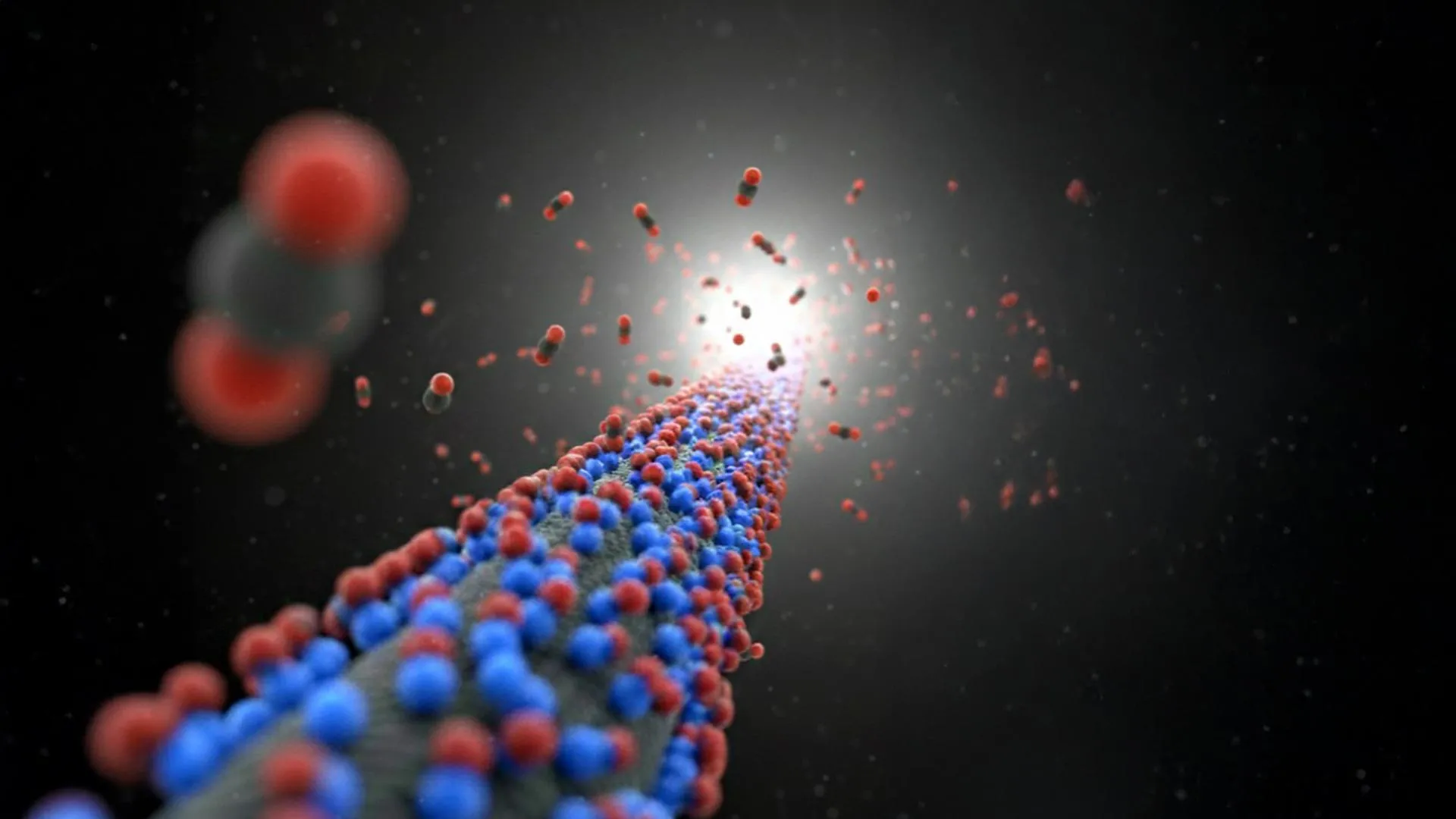
The imperative to mitigate atmospheric carbon dioxide (CO₂) levels, a primary driver of global climate change, has intensified the quest for effective greenhouse gas emission reduction strategies. Among these, carbon capture stands as a critical technological pillar, yet its widespread industrial adoption has been hampered by significant economic and operational hurdles. Traditional methods, particularly the prevalent aqueous amine scrubbing, demand substantial energy input for sorbent regeneration—specifically, heating vast quantities of liquid to temperatures exceeding 100°C to release captured CO₂ and prepare the solution for reuse. This profound energy penalty represents a major impediment to scalability and cost-effectiveness, necessitating innovative approaches to achieve viable carbon capture at the industrial scale.
Addressing these fundamental limitations, the scientific community has increasingly turned its attention to solid carbon materials as a more energetically favorable and cost-efficient alternative. These advanced materials offer several inherent advantages, including lower production costs, enhanced stability, and expansive surface areas conducive to efficient CO₂ adsorption. Crucially, their regeneration, or the release of captured CO₂, can often be achieved with considerably less thermal energy, particularly when their structure incorporates specific nitrogen-based functional groups. However, a persistent challenge in the development of such materials has been the inability to precisely control the placement of these nitrogen groups. Conventional synthesis techniques typically result in a random distribution of nitrogen across the material’s surface, making it exceedingly difficult to systematically investigate how specific atomic arrangements influence CO₂ capture and release performance. This lack of structural control has impeded the rational design of next-generation sorbents.
In a significant stride towards resolving this fundamental design constraint, a pioneering research initiative spearheaded by Associate Professor Yasuhiro Yamada from the Graduate School of Engineering and Associate Professor Tomonori Ohba from the Graduate School of Science at Chiba University, Japan, has unveiled a novel class of carbon materials termed ‘viciazites.’ These materials represent a paradigm shift in molecular engineering, as they are meticulously designed to feature nitrogen groups positioned adjacently in highly controlled configurations. The groundbreaking findings, co-authored by Mr. Kota Kondo of Chiba University, were recently published in the esteemed journal Carbon, detailing a sophisticated approach to synthesize carbon materials with unprecedented control over their nitrogen doping architecture.
Engineering Viciazites: Precision in Nitrogen Pairing
The cornerstone of this innovation lies in the researchers’ ability to create three distinct variants of viciazites, each characterized by a unique and precisely engineered neighboring nitrogen arrangement. This level of structural specificity is critical for dissecting the precise mechanisms by which nitrogen doping enhances CO₂ interaction.
To construct materials featuring adjacent primary amine groups (-NH₂ groups), the team devised an intricate three-step chemical synthesis pathway. This process commenced with the thermal treatment of coronene, a polycyclic aromatic hydrocarbon, followed by a bromination step, and concluded with treatment using ammonia gas. The meticulous control over reaction conditions yielded a remarkable 76% selectivity, signifying that a substantial majority of the introduced nitrogen atoms were strategically placed in the desired adjacent primary amine configurations. Such high selectivity is a testament to the sophistication of the synthetic methodology and critical for reproducible material properties.
Building upon this success, two additional viciazite materials were synthesized utilizing different precursor compounds, each designed to manifest a distinct adjacent nitrogen pairing. One variant showcased adjacent pyrrolic nitrogen groups, achieving an impressive 82% selectivity, indicative of an even greater precision in the placement of this specific nitrogen type. The third material incorporated adjacent pyridinic nitrogen, synthesized with a respectable 60% selectivity. The ability to reliably achieve these distinct, site-specific nitrogen configurations marks a significant advancement in the field of designer carbon materials, providing researchers with an invaluable toolkit for targeted property optimization.
Rigorous Structural Verification and Performance Assessment
To facilitate practical testing, each newly synthesized viciazite material was expertly applied to activated carbon fibers, creating robust and usable samples for comprehensive evaluation. The research team then embarked on a rigorous program of structural characterization to unequivocally confirm the precise placement and adjacent nature of the nitrogen groups. Employing an array of advanced analytical techniques, including nuclear magnetic resonance (NMR) spectroscopy, X-ray photoelectron spectroscopy (XPS), and sophisticated computational modeling, the researchers meticulously verified their synthetic achievements. These methods provided irrefutable evidence that the nitrogen atoms were indeed positioned side-by-side, in accordance with the design principles, rather than being randomly or haphazardly distributed throughout the carbon matrix. This meticulous verification process is paramount, underpinning the credibility of the research and validating the correlation between engineered structure and observed performance.
With the structural integrity confirmed, the materials were subjected to performance evaluation tests to assess their CO₂ capture capabilities. The results revealed discernible differences in adsorption capacities across the viciazite variants. Specifically, samples incorporating adjacent -NH₂ groups and those with pyrrolic nitrogen exhibited superior CO₂ capture performance compared to untreated carbon fibers, underscoring the positive impact of these specific nitrogen configurations. In contrast, the pyridinic nitrogen configuration offered only marginal improvement, suggesting that not all adjacent nitrogen arrangements are equally effective, highlighting the importance of the structure-property relationship.
The Desorption Breakthrough: Low-Temperature CO₂ Release and Energy Savings
Perhaps the most transformative discovery emanating from this research pertains to the desorption characteristics—the ease with which the materials release captured CO₂. This aspect is singularly crucial for the economic viability of carbon capture systems, as the energy required for regeneration often constitutes the largest operational cost.
Dr. Yamada highlighted the profound implications of their findings: "Performance evaluation revealed that in carbon materials where NH₂ groups are introduced adjacently, most of the adsorbed CO₂ desorbs at temperatures below 60°C. By combining this property with industrial waste heat, it may be possible to achieve efficient CO₂ capture processes with substantially reduced operating costs." This statement underscores a potential paradigm shift. The ability to release CO₂ at such low temperatures (below 60°C) is a monumental advantage over traditional amine scrubbing, which necessitates temperatures exceeding 100°C. This lower thermal requirement opens the door to leveraging abundant industrial waste heat—energy that is typically dissipated and lost—thereby dramatically cutting the energy footprint and, consequently, the operational expenses of carbon capture facilities.
While the material containing pyrrolic nitrogen required somewhat higher temperatures for CO₂ release, it may offer distinct advantages in terms of long-term operational stability due to its intrinsically stronger chemical structure. This trade-off between regeneration temperature and material robustness presents an interesting avenue for future optimization, allowing for tailored material selection based on specific industrial requirements and operating conditions.
Paving a New Path Towards Economically Viable Carbon Capture
This seminal work conclusively demonstrates that the precise arrangement of nitrogen groups in specific adjacent patterns within carbon materials is not only achievable but also profoundly impacts their CO₂ capture and release properties. This breakthrough provides a clear, validated strategy for the rational design and synthesis of highly optimized carbon capture materials. The ability to exercise molecular-level control over the functionalization of carbon surfaces is a critical enabler for developing next-generation technologies that are both highly effective and economically sustainable.
Dr. Yamada articulated the broader vision driving this research: "Our motivation is to contribute to the future society and to utilize our recently developed carbon materials with controlled structures. This work provides validated pathways to synthesize designer nitrogen-doped carbon materials, offering the molecular-level control essential for developing next-generation, cost-effective, and advanced CO₂ capture technologies." This sentiment reflects a deep commitment to addressing pressing global challenges through fundamental materials science innovation. The precise control over nitrogen architecture transforms carbon materials from generic sorbents into custom-engineered solutions.
Beyond the immediate and critical application in CO₂ capture, the versatile nature of these viciazite materials, characterized by their customizable surface properties, suggests a broader spectrum of potential applications. Their unique chemical characteristics could render them highly effective in other environmental remediation processes, such as the removal of hazardous metal ions from aqueous solutions. Furthermore, their precisely engineered surface chemistry makes them promising candidates for deployment as advanced catalysts in various industrial chemical reactions, potentially enhancing reaction rates and selectivities. This multifunctionality underscores the far-reaching impact of this research, extending its utility across diverse sectors.
Contextual Significance and Future Trajectory
The development of viciazites arrives at a crucial juncture in global efforts to combat climate change. Current carbon capture technologies, while technically proven, often struggle with economic viability, leading to limited deployment. The energy penalty associated with sorbent regeneration is the primary culprit, often consuming 25-40% of the energy produced by the power plant it serves. By enabling CO₂ desorption at temperatures compatible with industrial waste heat, viciazites offer a tangible pathway to drastically reduce this energy penalty, potentially making carbon capture economically competitive with other emissions reduction strategies.
The research also highlights the maturation of materials science towards "designer materials"—where properties are not discovered serendipitously but are engineered from the atomic scale upwards. This transition from empirical discovery to rational design is crucial for accelerating technological development in critical areas like energy and environment. Future research will likely focus on optimizing the loading density of these adjacent nitrogen groups, exploring alternative adjacent configurations, and scaling up the synthesis methods to industrial volumes. Long-term studies on the stability and robustness of viciazites under continuous cycling conditions in real-world industrial environments will also be essential for their eventual commercialization. The integration of these materials into modular capture units or their application in direct air capture (DAC) technologies represents another exciting frontier.
The work was made possible through the generous support of several key institutions, including the Mukai Science and Technology Foundation, the Japan Society for the Promotion of Science (JSPS KAKENHI Grant Number JP24K01251), and the "Advanced Research Infrastructure for Materials and Nanotechnology in Japan (ARIM)" of the Ministry of Education, Culture, Sports, Science and Technology (MEXT) under Grant Number JPMXP1225JI0008. Such collaborative funding underscores the strategic importance and potential impact of this research on a global scale. The development of viciazites represents not just a scientific achievement but a beacon of hope for a future where sustainable industrial practices are not only environmentally responsible but also economically attractive.



 Lisa Mariana
 Aura Kasih
 Safa Marwah