Ayu Aulia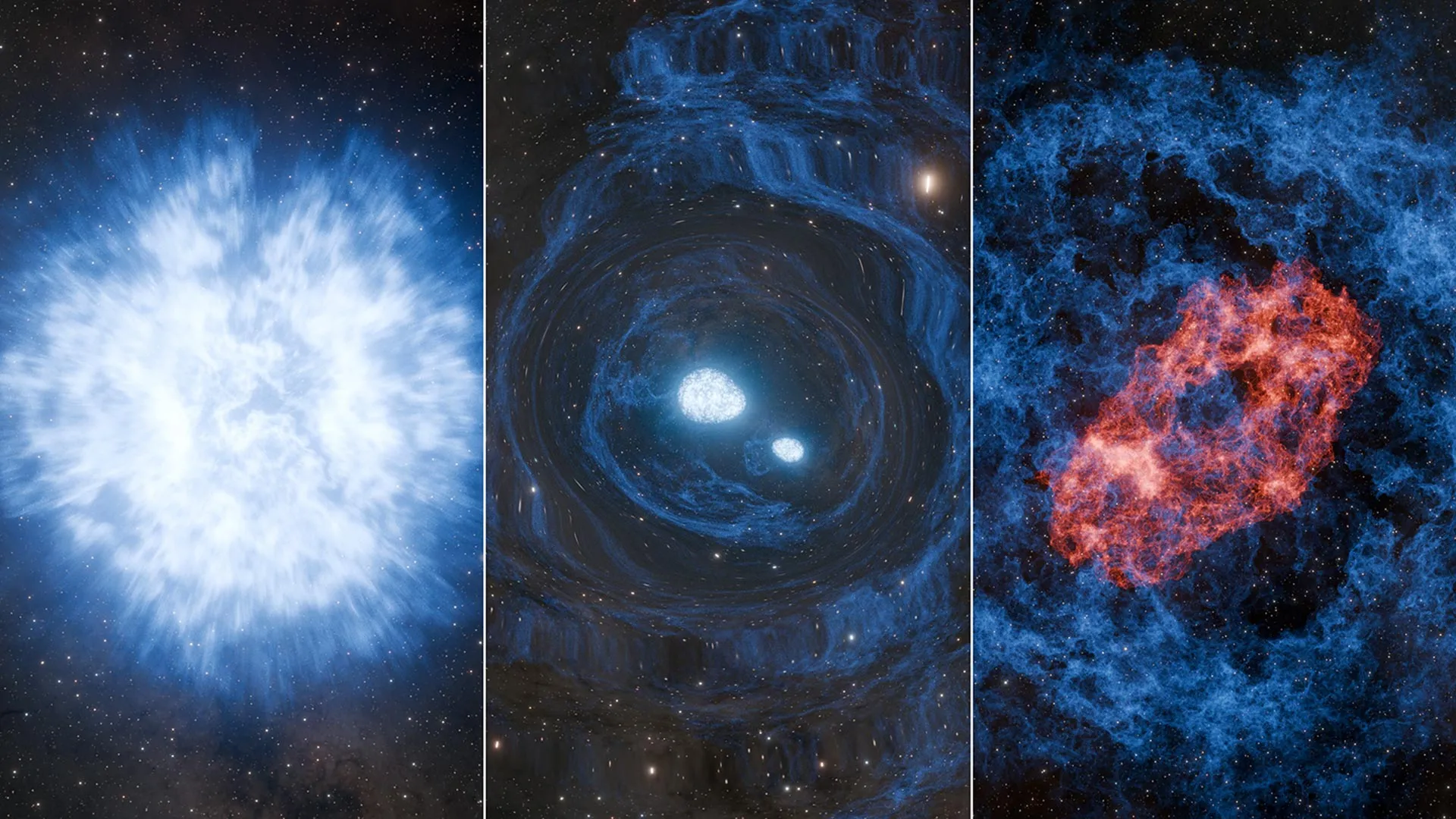
A groundbreaking discovery by an international team of astrophysicists suggests the existence of an entirely new category of cosmic explosion, potentially challenging established paradigms of stellar evolution and compact object mergers. This enigmatic event, provisionally designated AT2025ulz, exhibits characteristics that defy simple classification as either a conventional supernova or a standard kilonova, leading researchers to propose it represents a "superkilonova"—a kilonova triggered and obscured by a preceding supernova. The intricate interplay of gravitational wave signals and complex electromagnetic emissions observed from AT2025ulz points towards a scenario where two unusually low-mass neutron stars, born from a rapidly collapsing stellar core, subsequently merge within the chaotic aftermath of their progenitor’s demise.
For decades, the cosmos has revealed a spectacular array of energetic phenomena, each contributing to the universe’s chemical enrichment and structural evolution. At the most fundamental level, the cataclysmic deaths of colossal stars culminate in supernovae, colossal explosions that scatter newly forged elements like carbon, oxygen, and iron throughout interstellar space, providing the raw materials for subsequent generations of stars and planetary systems. These core-collapse supernovae, marking the end of stars significantly more massive than our Sun, typically leave behind dense remnants: either neutron stars or black holes. A rarer, yet profoundly significant, class of explosion arises from the merger of two neutron stars—the incredibly dense, city-sized cores of dead stars. These mergers, known as kilonovae, are exceptional because they are the primary cosmic factories for synthesizing elements heavier than iron, including precious metals like gold and platinum, as well as radioactive heavy elements such as uranium. These events are crucial for understanding the cosmic origins of the very matter that constitutes our world.
Until recently, observational confirmation of kilonovae remained elusive. The landscape dramatically shifted in 2017 with the detection of GW170817, a landmark event that unequivocally linked a gravitational wave signal to a powerful electromagnetic outburst. This pivotal observation, orchestrated by the Laser Interferometer Gravitational-wave Observatory (LIGO) and its European counterpart Virgo, simultaneously captured gravitational waves—ripples in spacetime caused by the violent merger of two neutron stars—and a broad spectrum of light emissions, from gamma-rays to radio waves. GW170817 not only validated the theoretical predictions for binary neutron star mergers but also inaugurated the era of multi-messenger astronomy, demonstrating the immense power of combining gravitational wave and electromagnetic observations to unravel cosmic mysteries. The event provided the clearest evidence to date for the r-process (rapid neutron capture process) nucleosynthesis, directly confirming that kilonovae are indeed the sites where the universe’s heaviest elements are forged.
The emergence of AT2025ulz, however, presents a significantly more convoluted narrative than GW170817. This candidate event, detected in 2025, initially bore a striking resemblance to the 2017 kilonova, characterized by a rapid fade and a predominantly red light signature. Yet, its subsequent evolution diverged dramatically, manifesting features more consistent with a standard supernova, specifically a stripped-envelope core-collapse supernova, which typically does not produce detectable gravitational waves. This perplexing dual nature—an initial kilonova-like phase followed by a supernova-like resurgence—posed a formidable interpretive challenge for astronomers worldwide. The intricate temporal and spectral evolution observed in AT2025ulz suggested a cosmic ballet far more complex than a simple, isolated explosion.
Dr. Mansi Kasliwal, a professor of astronomy and director of Caltech’s Palomar Observatory, spearheaded the investigation into AT2025ulz. Her team’s persistence in observing and analyzing the event, even as many other astronomers concluded it was merely a routine supernova, proved instrumental. "For approximately three days, the eruption mirrored the initial kilonova observed in 2017," Dr. Kasliwal noted, describing the early, intense observational phase. "Despite widespread interest, when it began exhibiting supernova-like characteristics, some observational efforts diminished. Our team, however, maintained its focus." This unwavering commitment led her team to publish their findings in The Astrophysical Journal Letters, proposing that AT2025ulz represents an entirely novel phenomenon: a superkilonova, a theoretical concept that had previously lacked empirical validation. This hypothesis posits a kilonova event intricately interwoven with, and potentially triggered by, a preceding supernova.
The genesis of this extraordinary event can be traced to August 18, 2025, when the global network of gravitational wave detectors—LIGO facilities in Louisiana and Washington, alongside Virgo in Italy—registered an anomalous gravitational wave signal. This alert, disseminated globally within minutes, indicated a high probability of a merger between two compact objects, at least one of which possessed an unusually small mass. While the confidence level of this particular alert was not as high as some prior detections, its unique characteristics immediately captured the attention of the gravitational wave community. Dr. David Reitze, executive director of LIGO and a research professor at Caltech, highlighted the intrigue: "Though not carrying the highest confidence of our alerts, this event quickly became a focal point due to its potentially profound implications. Our ongoing data analysis consistently points to at least one of the colliding objects being less massive than a typical neutron star."
Following the gravitational wave alert, rapid-response optical telescopes were cued to search the broad sky region identified by the gravitational wave triangulation. Within hours, the Zwicky Transient Facility (ZTF) at Palomar Observatory successfully identified a fading red light source approximately 1.3 billion light-years distant, precisely within the designated sky area. Initially cataloged as ZTF 25abjmnps, the object was later officially designated AT2025ulz. The swift identification of an electromagnetic counterpart to a gravitational wave signal underscored the advanced capabilities of multi-messenger astronomy and the importance of rapid, coordinated observational campaigns.
A global consortium of observatories, including the W. M. Keck Observatory in Hawaiʻi, the Fraunhofer telescope in Germany, and facilities within the GROWTH (Global Relay of Observatories Watching Transients Happen) program, rapidly mobilized to observe AT2025ulz. Early photometric and spectroscopic data revealed an object that faded rapidly and exhibited a pronounced red color, a spectral signature consistent with the 2017 kilonova. This red hue in kilonovae is attributed to the presence of heavy elements like gold and uranium, synthesized during the merger, which effectively absorb blue light and allow red wavelengths to dominate the emitted spectrum. However, the trajectory of AT2025ulz soon deviated from this expected kilonova evolution. Within days, the object inexplicably brightened again, its light shifting towards the bluer end of the spectrum, and its spectroscopic signature began to display prominent hydrogen lines. These features—re-brightening, blue shift, and hydrogen presence—are canonical indicators of a stripped-envelope core-collapse supernova, a type of stellar explosion where the star’s outer hydrogen and helium layers have been shed before collapse. This contradictory behavior led many astronomers to hypothesize that the gravitational wave signal and the optical transient were distinct, unrelated events, with AT2025ulz simply being a serendipitously observed, ordinary supernova.
However, Dr. Kasliwal’s team recognized that AT2025ulz’s characteristics did not fully conform to either a classical kilonova or a typical supernova. The light curve, while showing supernova-like re-brightening, retained unusual elements, and the initial red phase was too pronounced for a common supernova. Crucially, the gravitational wave data persisted in suggesting the merger of at least one compact object with a mass significantly smaller than the Sun. This was a critical piece of evidence, as standard neutron stars, the ultra-dense remnants of massive stellar cores, typically possess masses between 1.2 and 3 times that of our Sun, confined within a sphere roughly the size of a city (around 25 kilometers across). The existence of "sub-solar" mass neutron stars—those with masses less than 1.2 solar masses—is theoretically permitted but has never been directly observed.
The theoretical astrophysics community has proposed two primary mechanisms for the formation of such unusually low-mass neutron stars. One scenario involves the fission of a rapidly spinning, highly massive progenitor star. During its core collapse, if the star is rotating at an extreme velocity, the collapsing core might not form a single neutron star but instead split into two smaller, gravitationally bound neutron stars. The second proposed mechanism, known as fragmentation, suggests that during the violent core-collapse of a massive star, a dense disk of material forms around the collapsing core. Clumps within this disk could then gravitationally condense to form small neutron stars, analogous to how planets form within protoplanetary disks around young stars.
Dr. Brian Metzger of Columbia University, a co-author of the study, elucidated the compelling hypothesis that bridges these observations: "It is plausible that two newly formed neutron stars, products of a single supernova event, could rapidly spiral inward and merge, producing a kilonova that emits gravitational waves." In this intricate sequence, the initial kilonova explosion would emit the characteristic red light due to heavy element synthesis, as observed. Simultaneously, the immense amount of debris ejected by the parent supernova would act as a shroud, partially obscuring the kilonova within its expanding cloud. In essence, a single, highly unusual supernova event would create two newborn neutron stars which then, within a remarkably short timescale, collide to produce a second, embedded explosion—the superkilonova.
"The only theoretical pathways identified for the birth of sub-solar neutron stars involve the catastrophic collapse of exceptionally rapidly spinning stars," Dr. Metzger further explained. "Should these ‘forbidden’ compact objects coalesce through gravitational wave emission, it is highly probable that such a merger would be accompanied by, and potentially obscured by, a supernova, rather than presenting as a ‘bare’ kilonova event." This model provides an elegant, albeit complex, explanation for the conflicting observational signatures of AT2025ulz: the initial kilonova-like redness from the merger of exotic neutron stars, followed by the supernova-like re-brightening and hydrogen lines from the larger, enveloping supernova ejecta.
Despite the compelling nature of this hypothesis, the researchers acknowledge that definitive confirmation of AT2025ulz as a superkilonova requires further evidence. The rarity and unique characteristics of such an event necessitate additional observations of similar cosmic cataclysms. The challenge lies in distinguishing these complex events from more conventional supernovae. "Future kilonovae events may not always present like GW170817 and could easily be misidentified as supernovae," Dr. Kasliwal emphasized. This underscores the critical need for advanced observational strategies and sophisticated data analysis techniques to discern subtle clues hidden within vast astronomical datasets.
The astronomical community is already preparing for the next generation of observational facilities that will be crucial in this endeavor. Telescopes like the Vera C. Rubin Observatory, with its unparalleled wide-field survey capabilities, will be instrumental in identifying transient events across the entire sky. NASA’s Nancy Grace Roman Space Telescope, along with upcoming missions such as NASA’s UVEX (UltraViolet EXplorer), led by Caltech’s Fiona Harrison, will provide vital ultraviolet insights. Ground-based projects, including Caltech’s Deep Synoptic Array-2000 and the Cryoscope in Antarctica, will further enhance our ability to detect and characterize these enigmatic phenomena. The continued synergy between gravitational wave observatories and a diverse array of electromagnetic telescopes is paramount. While the definitive classification of AT2025ulz as a superkilonova remains an open question, its discovery has undeniably opened a new and profound avenue of inquiry into the extreme physics of stellar deaths and the enigmatic origins of the universe’s most exotic elements.
The comprehensive study detailing these findings, titled "ZTF25abjmnps (AT2025ulz) and S250818k: A Candidate Superkilonova from a Sub-threshold Sub-Solar Gravitational Wave Trigger," benefited from substantial funding contributions from organizations including the Gordon and Betty Moore Foundation, the Knut and Alice Wallenberg Foundation, the National Science Foundation (NSF), the Simons Foundation, and the US Department of Energy. Additional support was provided by a McWilliams Postdoctoral Fellowship and the University of Ferrara in Italy. The research team included numerous esteemed collaborators from Caltech and other institutions, highlighting the global effort required to decipher such complex cosmic signals. The Zwicky Transient Facility, a key instrument in this discovery, receives support from the NSF, an international consortium of partners, the Heising-Simons Foundation, and Caltech, with its invaluable data processed and archived by IPAC at Caltech.




 Aura Kasih
 Safa Marwah