Ayu Aulia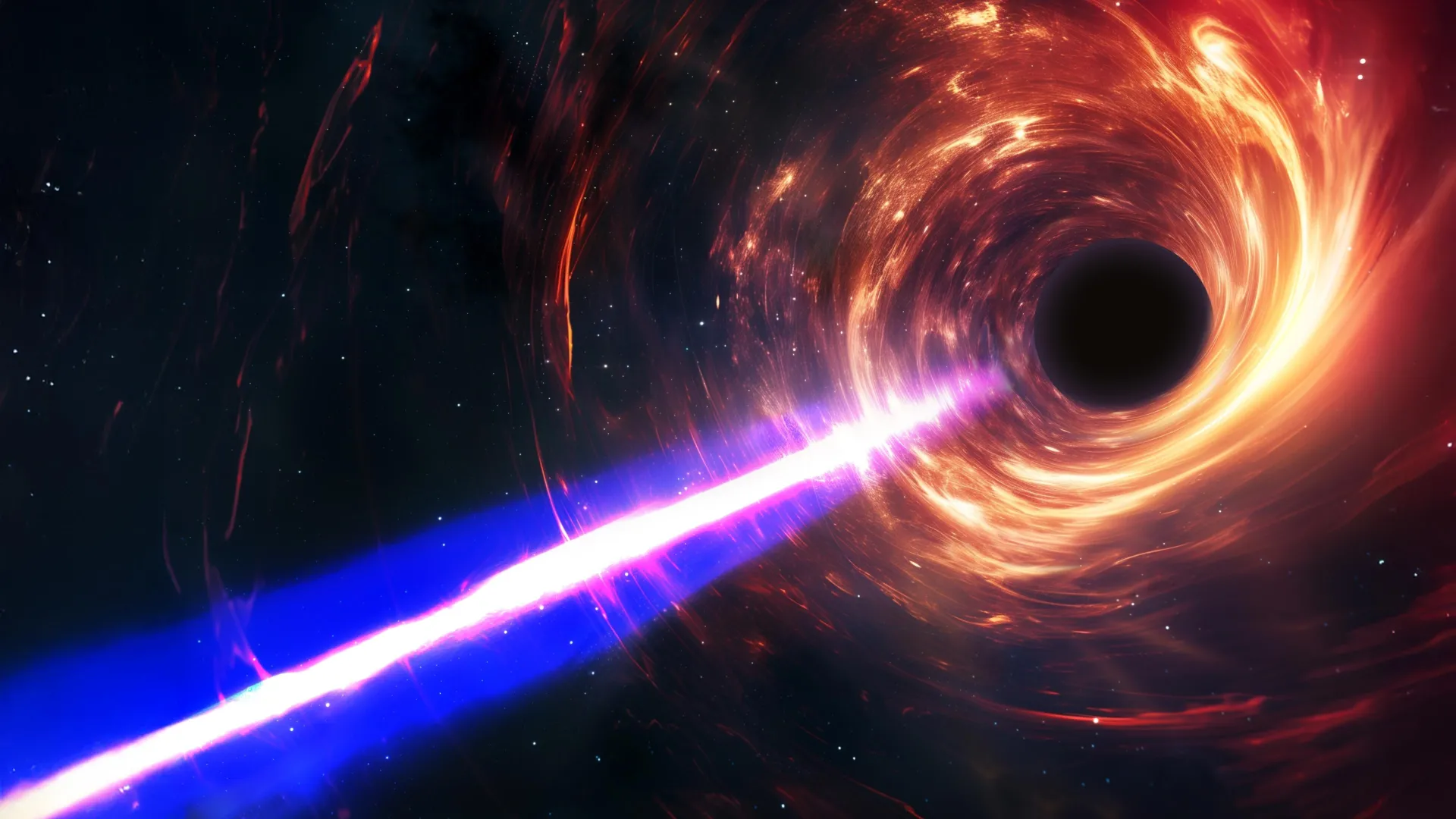
A groundbreaking astrophysical investigation has uncovered a singular, governing principle dictating the powerful energetic outflows from black holes, demonstrating that these cosmic engines ignite their colossal jets at a consistent operational threshold, irrespective of their immense variance in mass.
The cosmos is replete with objects of profound mystery and immense power, none perhaps more enigmatic than black holes. These gravitational behemoths, ranging from stellar-mass entities merely tens of times the Sun’s mass to supermassive varieties millions or even billions of times heavier, have long fascinated scientists. Central to their dynamic behavior is the phenomenon of astrophysical jets: highly collimated beams of plasma ejected at relativistic speeds, capable of shaping galaxies and influencing cosmic evolution over vast scales. For decades, a fundamental question has persisted: do these disparate classes of black holes operate under the same physical laws when it comes to producing these powerful ejections? Recent research, drawing upon an extensive array of astronomical observations, strongly suggests an affirmative answer, identifying a universal critical stage in their feeding cycles when these jets are launched.
This pivotal discovery marks a significant stride towards a unified understanding of black hole physics, bridging the observational gap between the smallest and largest known black holes. The study’s findings indicate that both stellar-mass black holes, typically formed from the collapse of massive stars, and their supermassive counterparts, residing at the hearts of most galaxies, exhibit jet formation at an identical, specific accretion rate relative to their individual capacities. This suggests an underlying, scale-invariant mechanism at play, simplifying our theoretical models of these extreme environments.
The collaborative effort behind this research involved a global consortium of astronomers, harnessing data from cutting-edge observatories across multiple continents and in space. A key figure in this international team is Andrew Mummery, a distinguished member of the School of Natural Sciences at the Institute for Advanced Study, alongside Adelle Goodwin, a prominent Forrest Research Foundation Fellow at Curtin University’s International Centre of Radio Astronomy Research in Western Australia. Their combined expertise and strategic analytical approach were instrumental in synthesizing the diverse observational datasets.
A primary focus of their investigation revolved around tidal disruption events (TDEs). These cataclysmic occurrences transpire when an unfortunate star ventures too close to a supermassive black hole and is subsequently shredded by the immense gravitational forces. The stellar material is then drawn into a swirling accretion disk around the black hole, providing a sudden and substantial influx of matter. TDEs offer astronomers an unparalleled, real-time laboratory to observe the intricate processes of black hole feeding and the subsequent energetic responses. Unlike the gradual, often imperceptible accretion processes that unfold over millennia in quiescent supermassive black holes, TDEs present a compressed timeline of events, allowing for a detailed study of dynamic changes over mere months or years.
The complexity of black hole feeding is often underestimated. While colloquially referred to as cosmic vacuum cleaners, their ingestion process is far from tidy. As a star is torn apart, only a fraction of its material is ultimately consumed by the black hole. A substantial portion is instead violently expelled into the surrounding space, forming the aforementioned powerful outflows or "cosmic burps." These energetic expulsions, carrying immense quantities of matter and energy, play a crucial role in regulating star formation within galaxies and influencing the evolution of their host environments. Understanding the conditions under which these jets are formed is therefore paramount to comprehending galactic ecosystems.
The impetus for this focused inquiry stemmed from a long-standing astrophysical conundrum. As Mummery articulated, "The inconsistency in the timing of radio jet outbursts from supermassive black holes after stellar shredding events has been a significant puzzle. Why do some immediately blast out jets, while others remain dormant for extended periods before suddenly erupting?" This variability hinted at an underlying, yet undiscovered, regulatory mechanism.
The conceptual breakthrough for the study emerged from an informal discussion between Mummery and Goodwin during an astrophysics conference. They realized that a known rule governing jet production in smaller, stellar-mass black holes might also extend to their supermassive counterparts. This ‘eureka’ moment, often a catalyst in scientific discovery, spurred a rigorous empirical investigation to test this hypothesis.
To validate their insight, the researchers systematically analyzed data from twenty well-observed tidal disruption events. This comprehensive dataset encompassed observations across the electromagnetic spectrum, including optical, ultraviolet, X-ray, and radio wavelengths. The multi-wavelength approach was critical, as different emissions reveal distinct physical processes occurring at various distances from the black hole and at different energy levels. For instance, X-rays often probe the innermost regions of the accretion disk, while radio waves are indicative of the synchrotron emission from relativistic jets.
Following a meticulous selection process, the team narrowed their focus to ten high-quality TDEs. These specific events provided sufficiently robust and complete observational data to reliably determine both the black hole’s instantaneous feeding rate (accretion rate) and the precise timing of its radio jet emissions. This rigorous data selection was crucial for drawing statistically significant conclusions.
The detailed analysis of these ten events unveiled a fascinating pattern: two distinct phases during which powerful jets can be launched. The first phase occurs very early in the event, coinciding with the period of extremely high accretion, as the black hole is rapidly consuming the stellar debris. This initial outburst is intuitive, as an abundance of material would naturally fuel energetic processes.
However, the second phase, occurring much later—hundreds to even thousands of days after the initial stellar disruption—proved to be particularly revelatory. During this delayed phase, the black hole’s feeding rate was found to have significantly decreased, settling at approximately two percent of its Eddington limit. The Eddington limit represents the theoretical maximum rate at which a black hole can accrete matter, beyond which the outward pressure of radiation from the infalling material would overcome the inward pull of gravity, effectively blowing away any additional incoming matter.
The identification of this two percent Eddington limit threshold is profoundly significant because it is a value already known to trigger jet formation in much smaller, stellar-mass black holes within our own Milky Way galaxy. The recurrence of this identical critical accretion rate across an enormous spectrum of black hole masses – from tens to millions of solar masses – provides compelling evidence for a universal physical mechanism. It suggests that the fundamental processes governing the conversion of gravitational energy into relativistic jets operate in an intrinsically similar manner, regardless of the black hole’s scale. This represents a significant unification in our understanding of black hole phenomenology.
Beyond its profound theoretical implications for astrophysics, this discovery also holds considerable practical value for the astronomical community. The ability to predict when a black hole is likely to produce a delayed jet offers an unprecedented opportunity for optimizing observational strategies. Armed with this knowledge, astronomers can schedule follow-up observations more efficiently, maximizing their chances of capturing these relatively short-lived yet highly energetic events as they unfold. This predictive capability could lead to a more judicious allocation of precious telescope time, particularly for highly sought-after instruments, reducing the number of ‘blind’ observations when little activity is expected.
This improved efficiency will become especially critical with the advent of next-generation observatories. Projects such as the Square Kilometre Array (SKA) radio telescope, anticipated to commence scientific operations in 2028, will generate vast quantities of data and require highly targeted observation plans to fully exploit their immense capabilities. The predictive power derived from this research will allow astronomers to focus these powerful new instruments on black holes precisely when they are expected to erupt, thereby enhancing the scientific return on these massive investments.
The implications of this work extend beyond merely predicting jet eruptions. By establishing a universal rule, it opens new avenues for theoretical modeling, allowing physicists to develop more robust and comprehensive models that can accurately describe black hole behavior across all mass scales. This unified framework could lead to a deeper understanding of the interplay between black holes and their host galaxies, the generation of gravitational waves, and the fundamental physics of extreme gravity. As Mummery expressed, "We are optimistic that our work will serve as a foundational step, paving the way for even more profound and far-reaching discoveries about the intricate workings of our universe." The revelation of this universal rule represents not an end, but a powerful new beginning in the ongoing quest to unravel the cosmos’s most dramatic secrets.




 Lisa Mariana
 Aura Kasih
 Safa Marwah