Safa Marwah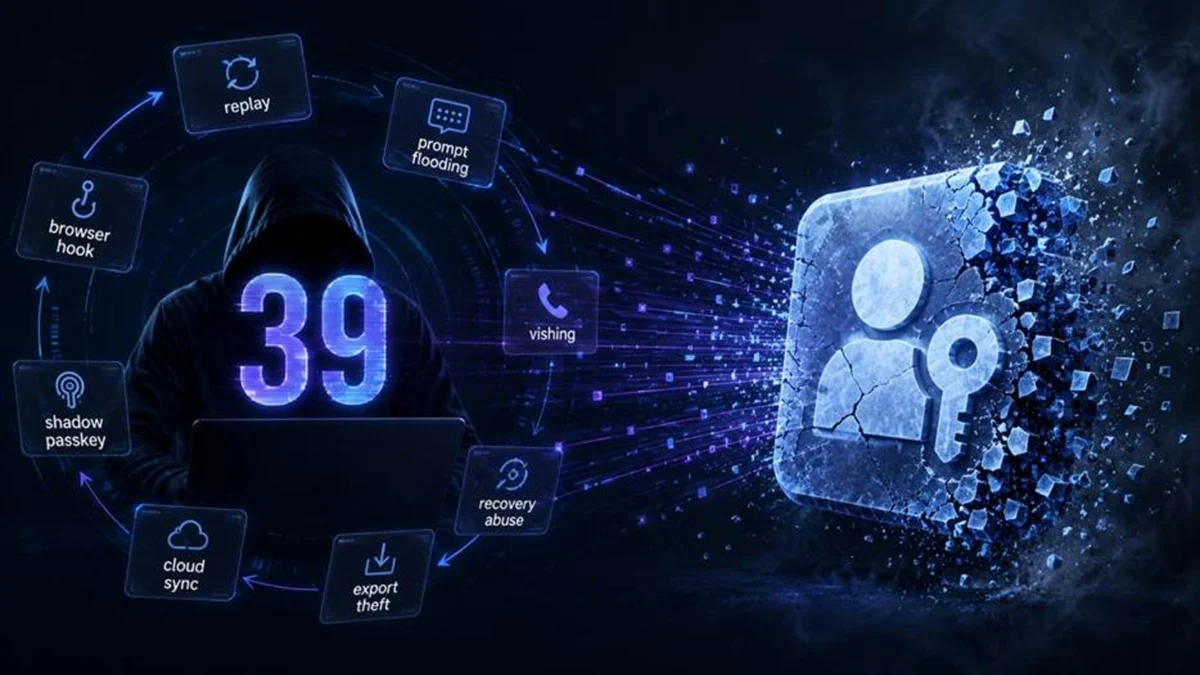
The emergence of passkeys heralded a new era in digital authentication, promising a robust defense against pervasive password-related threats through the power of public-key cryptography. This innovative approach sought to revolutionize security by linking credentials directly to legitimate services, isolating private keys from server-side exposure, and thereby significantly impeding the credential theft and phishing attacks that have long plagued enterprise environments. While the core cryptographic principles underpinning passkeys remain fundamentally sound, a burgeoning body of research now reveals a complex tapestry of at least 39 distinct attack methods, exploitation scenarios, and research techniques that can undermine accounts protected by these advanced credentials.
Initially championed for their inherent resistance to phishing, passkeys leverage the FIDO2 standard to replace susceptible shared secrets with cryptographically strong, unphishable credentials. This architecture binds a user’s device to a specific service, ensuring that even if an attacker intercepts authentication data, it cannot be replayed or used on a different domain. The user’s private key, the true linchpin of their identity, is securely stored on their device—often within a hardware security module (HSM) or a trusted execution environment—and never transmitted over the network. This design paradigm promised a significant leap forward from the vulnerabilities inherent in traditional password-based systems, which are perpetually susceptible to database breaches, brute-force attempts, and sophisticated social engineering tactics.
However, the rapid evolution of the threat landscape has necessitated a re-evaluation of this security posture. What began as a theoretically impregnable cryptographic solution has quickly encountered the pragmatic realities of complex digital ecosystems. The identification of numerous attack vectors, many already supported by working proof-of-concept tools and published academic research, indicates a critical shift. These techniques are not merely theoretical constructs; some have already been observed in real-world malicious campaigns. This proliferation of documented vulnerabilities signifies that the tactical playbook for compromising passkey-protected accounts is being collaboratively constructed and disseminated within the public domain, effectively democratizing advanced attack methodologies for malicious actors. Crucially, this development underscores a fundamental distinction: the cryptographic integrity of the FIDO2 protocol can remain entirely unblemished, yet the user account it purports to protect can still be successfully compromised.
The Expanding Horizon of Attack: Beyond the Cryptographic Core
The traditional focus of authentication security has historically centered on the integrity of the credential itself. With passkeys, this focus has broadened dramatically. A contemporary passkey authentication sequence is not a monolithic event; rather, it traverses an intricate web of trust boundaries and interconnected components. This sprawling architecture encompasses the web application interface, the browser environment, the underlying operating system, integrated password managers, cloud synchronization services, mobile devices, Bluetooth communication protocols, account recovery mechanisms, the initial enrollment procedures, help desk support interactions, and, ultimately, the human element responsible for approving authentication requests. Each of these layers represents a potential point of ingress or manipulation for sophisticated adversaries.
Researchers are systematically probing and exploiting nearly every one of these layers. The catalogue of published techniques now extends far beyond direct cryptographic attacks, encompassing sophisticated methods such as assertion mining, where legitimate authentication assertions are extracted for later use; assertion replay, which involves re-transmitting captured assertions; circuit breaker attacks, designed to disrupt or bypass security controls; and advanced forms of assertion phishing, where users are tricked into generating valid assertions for an attacker-controlled endpoint. Further techniques include browser hooking to intercept authentication flows, assertion capture, challenge injection, detour replay to redirect authentication outcomes, and various manipulations of user verification and user presence mechanisms to bypass essential security checks.
Seminal research, such as SpecterOps’ "Pass the Passkey" study, has vividly illustrated the profound implications of this expanded attack surface. One of its most critical findings demonstrated that malware operating on a compromised system does not necessarily need to extract the sensitive private key from its secure enclave. Instead, a malicious Windows application, executing within the user’s environment, can legitimately invoke the WebAuthn infrastructure to generate a signed assertion. The user, presented with what appears to be a legitimate Windows authentication prompt, completes their verification (e.g., via PIN or biometric). The attacker then intercepts the resulting cryptographically valid assertion. In this scenario, the private key remains secure and untouched within its protected location, and the underlying FIDO2 cryptography is not broken. Yet, the entire authentication process has been successfully subverted, granting unauthorized access. This crucial distinction is paramount to comprehending the evolving threat model associated with passkeys, highlighting that cryptographic strength alone is insufficient if the surrounding ecosystem is vulnerable.
The User Interface as a New Battleground
Even the seemingly innocuous passkey authentication prompt itself has emerged as a significant attack surface. Several of the documented attack techniques specifically target the user interface (UI) components that facilitate authentication interactions. Researchers have meticulously demonstrated methods such as passkey prompt flooding, overwhelming users with repeated legitimate-looking requests; credential interface deception, where fabricated interfaces mimic authentic ones; application metadata spoofing, to mislead users about the origin of a request; and window handle spoofing, to manipulate the context of authentication dialogs. Further, sophisticated tactics like remote desktop passkey phishing and FIDO interface overlay attacks demonstrate how attackers can visually obscure or replace legitimate prompts with malicious counterparts, tricking users into authenticating to an adversary’s advantage.
This phenomenon bears a striking resemblance to the challenges previously encountered with push-based multi-factor authentication (MFA). As users become desensitized to frequent authentication prompts, a cognitive fatigue sets in, making them more susceptible to manipulation. Once authentication becomes a routine, often unthinking visual interaction, attackers can exploit this habituation by manufacturing, repeating, disguising, or strategically timing these interactions. The SpecterOps research, for instance, showcased specialized tooling capable of repeatedly invoking legitimate-looking Windows passkey prompts, effectively creating an environment ripe for user error. Furthermore, techniques were demonstrated that could make malicious authentication activities appear to originate from applications that an employee already trusts implicitly, blurring the lines between legitimate and malicious requests. The critical lesson derived from these observations is clear: while a cryptographic protocol may offer robust phishing resistance at its core, this does not automatically guarantee equivalent deception resistance across the myriad operating system, browser, application, and user interface layers that envelop that protocol. The human factor, often the weakest link, remains a prime target for exploitation, even with advanced authentication mechanisms.
The Perils of Portability: Shareable Passkeys and Architectural Weaknesses
The inherent convenience of passkeys—their ability to be shared, synchronized across devices, exported, restored, or migrated—paradoxically introduces a significant expansion of the attack surface. This portability, while enhancing user experience, fundamentally alters the security boundary. The published inventory of attack methods now includes scenarios such as synced vault compromise, where an attacker gains access to a cloud-synchronized passkey store; Apple or Google account takeover, leading to the compromise of passkeys linked to these ecosystem accounts; cloud recovery takeover, exploiting weaknesses in account recovery processes; and direct exploitation of stolen or compromised phones, mobile malware, or rooted mobile devices. Attacks also extend to hybrid authentication manipulation, the theft of passkeys exported from popular password managers like KeePassXC or Bitwarden, credential exchange theft, malicious browser extensions that intercept or manipulate passkeys, and direct attacks involving CTAP (Client to Authenticator Protocol) and Bluetooth communication.
Fundamentally, these vulnerabilities are not rooted in a cryptographic flaw within FIDO2 itself, but rather in architectural decisions concerning passkey management and distribution. Once a credential is designed to traverse multiple devices, synchronize through a cloud account, be exported from a secure vault, be restored via an alternative identity verification method, or be recovered through an auxiliary process, the security perimeter extends far beyond the confines of the original, hardware-bound authenticator. An attacker, therefore, no longer needs to directly defeat the formidable cryptography of FIDO2. Instead, they can focus on compromising any sufficiently trusted component within the broader ecosystem that manages or enables the passkey’s mobility. A synchronized passkey, despite being underpinned by exceptionally strong cryptography, will inevitably inherit the cumulative weaknesses of the phone, operating system, password manager, cloud account, browser, recovery process, and synchronization system responsible for its lifecycle and management. This distributed trust model inherently creates a larger attack surface, necessitating a holistic security strategy that accounts for every potential point of compromise.
Exploiting the Identity Lifecycle: Enrollment and Recovery as Critical Openings
Perhaps some of the most impactful attack techniques identified do not involve the theft or manipulation of an existing passkey at all. Instead, they focus on the more insidious strategy of simply creating a new one. This category of attacks targets the critical phases of identity lifecycle management: enrollment, replacement, and recovery. Published techniques include the creation of "shadow passkeys," where an attacker registers a new, unauthorized passkey alongside legitimate ones; enrollment vishing, using voice social engineering to trick users into enrolling attacker-controlled devices; direct attacker phone enrollment or attacker-controlled passkey registration; help desk takeover to facilitate unauthorized credential issuance; abuse of temporary credentials; SIM-based recovery attacks; reverse vishing to initiate credential changes; and migration pretext attacks, where users are coerced into migrating credentials to attacker-controlled systems.
Consider a scenario where an attacker successfully gains sufficient control over an employee’s account through a weaker, non-passkey protected channel (e.g., a phishing attack targeting an SMS-based MFA fallback or a compromised help desk). Rather than attempting the arduous task of extracting the employee’s existing, securely stored passkey, the adversary simply initiates a legitimate passkey registration process. The victim’s account, now under partial control, is used to register an entirely new passkey on a device controlled by the attacker. In this instance, no cryptographic mechanism has been cracked, and nothing has been directly stolen from the employee’s existing authenticator. Instead, the legitimate service itself, operating under the assumption of a legitimate request, provisioned a perfectly valid credential for the adversary. This highlights an increasingly important principle in identity security: phishing-resistant authentication, no matter how robust, is fundamentally insufficient if the processes for enrollment, credential replacement, account recovery, and new device registration are not protected to an equivalent, equally stringent standard. The weakest link in the identity lifecycle dictates the overall security posture.
Architectural Resilience: The Role of Dedicated Biometric Hardware
To address the multifaceted vulnerabilities exposed by these attack vectors, dedicated biometric hardware authenticators offer a fundamentally different architectural approach compared to passkeys stored on general-purpose computing devices. A purpose-built biometric authenticator is designed to retain the private cryptographic credential within secure hardware, without relying on cloud synchronization services, offering no export mechanisms, and disassociating from general-purpose password managers for credential movement between devices. This isolation significantly reduces the potential attack surface.
Authentication with such a device typically mandates a live biometric verification (e.g., a fingerprint scan) performed directly on the authenticator itself, often coupled with physical proximity to the endpoint requesting access. Crucially, a dedicated authenticator is intentionally stripped of functionalities found in general-purpose devices. It does not contain a traditional operating system, an application store, a web browser, or even a screen. This minimalist design strategically eliminates vast portions of the attack surface. There are no third-party applications for an attacker to replace with malicious versions, no avenue for rogue applications to be installed, no browser extension ecosystem to compromise, and no screen upon which malware can present a deceptive authentication interface. Furthermore, the absence of a consumer operating system—with its inherent complexities, myriad applications, permissions, background services, and update dependencies—drastically reduces the attack vectors associated with software vulnerabilities and misconfigurations.
This streamlined architecture dramatically alters the economics of attacking such a system. Instead of confronting a sprawling, general-purpose computing environment rife with potential exploits, an attacker is faced with a tightly controlled hardware device specifically engineered to protect cryptographic credentials and verify biometric identity. This design also significantly enhances resistance to employee manipulation. While social engineering can persuade an employee to visit a malicious website, answer a fraudulent telephone call, or follow deceptive instructions from a purported technical support agent, it cannot install a rogue application onto hardware that is incapable of running ordinary applications. It cannot manipulate a screen that does not physically exist, nor can it synchronize a credential through a cloud service that the authenticator is not designed to utilize. In this sense, properly engineered dedicated biometric hardware becomes a powerful bulwark, demonstrating high resistance not only to sophisticated attackers but also to the common human errors and vulnerabilities that often undermine security protocols.
Operationalizing Security: Correct Service Configuration as a Critical Enabler
While dedicated hardware forms a robust foundation, its effectiveness is contingent upon the correct configuration of the relying service. For sensitive enterprise environments, merely possessing advanced hardware is insufficient; the architectural and policy framework surrounding its deployment must actively preserve and reinforce the security model. This necessitates stringent controls at the relying party level. Authentication and enrollment processes should be rigorously restricted to approved authenticator classes, ensuring that only devices meeting specific security profiles can be registered. The relying party must implement robust validation of authenticator identity, rigorously enforce user verification during authentication, and meticulously validate challenges and sessions to prevent replay attacks or session hijacking. Furthermore, the proper application of signature counter protections is essential to detect cloning or unauthorized use, and critical safeguards must be in place to prevent weaker authentication methods from inadvertently becoming fallback paths that undermine the primary security posture.
The enrollment and recovery processes warrant particular attention, as they represent significant attack surfaces, as previously discussed. A secure architecture dictates that the addition of a new authenticator should not merely require proof of control over an account through a weaker recovery channel (e.g., email or SMS). Instead, it should mandate proof of identity from an already authorized and trusted authenticator. This "step-up" authentication for critical identity management tasks ensures that an attacker cannot simply leverage a compromised email account to enroll a new, unauthorized passkey. Configured correctly, this architecture creates a formidable barrier. It prevents an attacker from enrolling an ordinary passkey from a compromised laptop, phone, software vault, or generic security key. Cloud account takeover would not yield the credential, nor would password manager compromise. Mobile malware could not infect the authenticator, and a remote attacker would be unable to manufacture the precise combination of dedicated hardware, biometric verification, physical proximity, and legitimate service interaction required to successfully authenticate. This layered approach, combining secure hardware with stringent policy enforcement, establishes a significantly more resilient identity trust model.
Strategic Imperatives for Enterprise Security
The discovery and publication of 39 distinct attack methods against passkey-protected accounts should not be interpreted as a failure of FIDO2 cryptography. On the contrary, it underscores the inherent strength of the underlying cryptographic protocols. The consistent focus of researchers and malicious actors on software components, synchronization systems, enrollment processes, operating systems, browsers, recovery mechanisms, and the human element strongly suggests that directly defeating properly implemented cryptographic hardware remains a considerably more difficult and resource-intensive endeavor. This critical insight should serve as a clear directive for security leaders, indicating precisely where the next iteration of identity security boundaries needs to be established.
For high-value enterprise identities, the current model of credentials being freely shareable across consumer devices and cloud ecosystems presents an unacceptable level of risk. The future of enterprise identity assurance must pivot towards a model where credentials are inextricably bound: bound to dedicated biometric hardware, to the verified individual, to the legitimate service, and crucially, to an enterprise-controlled and highly secure enrollment and recovery process. Passkeys have undeniably provided a significant solution to the pervasive password problem, offering a substantial upgrade in resistance to widespread phishing and credential theft. However, the comprehensive inventory of 39 published attacks now illuminates the next set of targets for sophisticated adversaries. Implementing dedicated biometric hardware, meticulously configured and correctly integrated across the entire identity lifecycle—from initial enrollment through ongoing authentication and robust recovery—effectively neutralizes virtually all of this surrounding attack surface, proactively denying attackers the opportunities they seek to exploit. This strategic shift represents not just an incremental improvement, but a foundational re-architecture of enterprise identity security.




 Aura Kasih
 Ayu Aulia