
 Lisa Mariana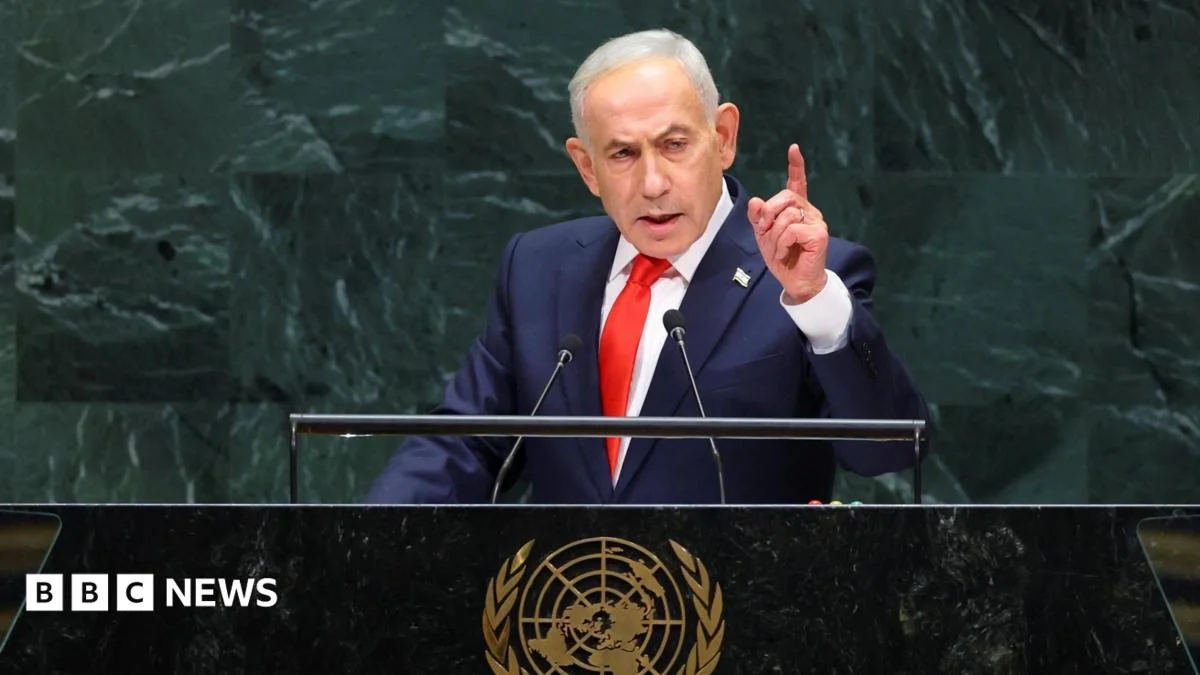
The United Nations General Assembly became the latest stage for an intense diplomatic confrontation as Israeli Prime Minister Benjamin Netanyahu delivered a vehement defense of his nation’s military operations across the Middle East, a speech punctuated by a symbolic walkout from numerous delegations and sharp verbal exchanges. This high-stakes address unfolded against a backdrop of escalating regional instability and persistent international scrutiny, underscoring the deep divisions that characterize the enduring Israeli-Palestinian conflict and broader geopolitical dynamics.
Netanyahu’s appearance at the global forum was immediately met with a conspicuous exodus of delegates, a collective act of protest that underscored the profound international discontent with Israel’s policies, particularly its actions in Gaza and the occupied Palestinian territories. Undeterred by the empty seats, the Israeli premier launched into a forceful declaration, asserting his country’s unyielding resolve to prevail in its ongoing struggles. His defiant stance was encapsulated in a stark assertion: "We’re going to win. We have no other choice." Addressing the departing representatives directly, Netanyahu issued a scathing rebuke, inviting any remaining "moral cowards" to join the exiting delegations, a remark that further intensified the already charged atmosphere within the assembly hall. A significant portion of his discourse was dedicated to vehemently refuting allegations of genocide in Gaza, framing such accusations as baseless and politically motivated.
Hours prior to Netanyahu’s contentious address, Palestinian President Mahmoud Abbas had presented his own powerful narrative to the UN General Assembly via a pre-recorded video message. Abbas utilized his platform to articulate a dire assessment of Israeli policies, particularly highlighting the relentless expansion of illegal Jewish settlements in the occupied West Bank. He contended that these policies, which systematically encroach upon Palestinian land, represent an existential threat to the Palestinian people, jeopardizing their very presence and future on their ancestral homeland. Furthermore, Abbas warned that these actions are systematically dismantling the viability of the internationally endorsed two-state solution, a framework long considered the most pragmatic pathway to a lasting peace between Israelis and Palestinians. The Palestinian leader painted a grim picture of the conditions in Gaza, describing a populace subjected to "killing, destruction, starvation and attempts at displacement, as well as a genocidal war" perpetrated by the Israeli military. His inability to deliver his address in person, owing to a denial of a U.S. entry visa, itself became a point of diplomatic contention, highlighting the intricate layers of political maneuvering and access that often define international relations.
The legal and ethical dimensions of the conflict were implicitly, and sometimes explicitly, woven into the fabric of the speeches. Netanyahu, who is currently subject to an arrest warrant from the International Criminal Court (ICC) for alleged war crimes, a fact that casts a long shadow over his international standing, aggressively challenged the legitimacy and motivations of his detractors. His rhetoric often veered into direct confrontation, particularly when addressing historical grievances and contemporary criticisms. He launched into a detailed critique of accusations labeling Israel as a colonial power, pointing to the historical roles of nations like Britain and France in the actual practice of colonialism, thereby attempting to deflect and invert the narrative. "They accuse Israel, tiny Israel, of colonialism – some colonialism. And who’s accusing us? Among them are people in Britain and in France. For God’s sake, they invented the term," he exclaimed, underscoring a perceived hypocrisy in the international discourse. This particular line of argument sought to reframe Israel’s historical context, positioning it not as an aggressor but as a victim of mischaracterization by nations with their own complex colonial pasts.
Beyond general criticisms, Netanyahu singled out specific leaders and political figures. Turkish President Recep Tayyip Erdogan, a vocal proponent of Palestinian rights, was branded a "tyrant" by the Israeli premier, who further accused him of actively supporting Hamas, the Palestinian armed group. This accusation reflects the deep ideological chasm between the two nations and their leaders, particularly concerning the Gaza conflict and regional power dynamics. Erdogan, in his own address to the UN earlier in the week, had articulated a powerful condemnation of the "injustices faced by those in Gaza and the West Bank," asserting that these conditions "deeply offend the conscience of humanity." This exchange highlights the broader schism within the international community regarding the Israeli-Palestinian issue, with Turkey often emerging as a leading voice in solidarity with Palestinians.
The Israeli leader’s criticisms extended even to local American politics, specifically targeting New York City’s left-wing mayor, Zohran Mamdani. Mamdani had previously made headlines for vowing to arrest Netanyahu upon his arrival in New York, though he later clarified he lacked the legal authority to do so. Netanyahu seized upon this local political controversy, asserting that since Mamdani’s election, many Jewish residents no longer felt secure in the city. This unusual intervention by a foreign head of state into the domestic politics of a host city underscored the intense polarization surrounding the Israeli-Palestinian conflict, even manifesting thousands of miles from the immediate conflict zone. Mamdani’s office responded swiftly, issuing a statement accusing Netanyahu of using his UN platform to "repeat baseless lies meant to sanitize his genocide of Palestinians," thus maintaining the confrontational stance.
In a notable gesture of political alignment, Netanyahu publicly expressed gratitude to former U.S. President Donald Trump, commending his "bold leadership." This commendation specifically referenced the joint U.S.-Israel airstrikes against targets in Tehran in February, an operation that underscored the close strategic partnership between Washington and Jerusalem, particularly concerning regional security threats perceived to emanate from Iran. Netanyahu framed these joint actions not merely as self-defense but as a broader effort to "save civilization," a rhetorical elevation that sought to cast the Israeli-American alliance as a bulwark against global instability. This endorsement serves as a significant signal of Netanyahu’s preferred U.S. foreign policy posture and hints at potential future alignments should Trump return to office.
The gravity of Netanyahu’s visit and the ongoing conflict also spurred significant public demonstrations in New York City. Numerous protestors, voicing their dissent against Israeli policies and the prime minister’s presence, gathered outside the UN headquarters, leading to several arrests. Among those detained were prominent figures from the entertainment industry, including Oscar-winning actress Susan Sarandon and Emmy-winning actress Hannah Einbinder, whose involvement brought a higher profile to the anti-Netanyahu demonstrations. The participation of well-known personalities amplified the public outcry, illustrating the widespread and diverse opposition to Israel’s military actions and its leadership.
Background and Broader Context:
The speeches at the UN General Assembly are not isolated events but rather deeply embedded within decades of unresolved conflict and complex geopolitical maneuvering. The Israeli-Palestinian conflict, at its core, is a dispute over land, self-determination, and security. The establishment of Israel in 1948 led to the displacement of hundreds of thousands of Palestinians, an event known as the Nakba, or catastrophe, in Palestinian collective memory. Subsequent wars and occupations, particularly the 1967 Six-Day War, resulted in Israel’s control over the West Bank, Gaza, East Jerusalem, and the Golan Heights. Gaza, a densely populated strip of land, has been under an Israeli and Egyptian blockade since 2007, following Hamas’s takeover, leading to severe humanitarian conditions. The West Bank, meanwhile, continues to see the expansion of Israeli settlements, which are considered illegal under international law and a major impediment to the two-state solution.
The two-state solution, which envisions an independent Palestinian state alongside Israel, has been the cornerstone of international peace efforts for decades. However, its viability has been steadily eroded by settlement expansion, the fragmentation of Palestinian territories, and a lack of sustained political will from both sides, as well as key international actors. Abbas’s warnings about the "very life and existence of the Palestinian people" and the "genocidal war" in Gaza reflect the acute sense of desperation and existential threat felt by many Palestinians. These terms, while highly emotive and controversial, also echo ongoing legal processes, such as the case brought by South Africa against Israel at the International Court of Justice (ICJ) alleging genocide, highlighting the increasingly fraught legal landscape surrounding the conflict.
The diplomatic walkout during Netanyahu’s speech serves as a potent, if symbolic, indicator of Israel’s diminishing international standing in certain quarters. While Israel maintains strong alliances with the United States and some other nations, particularly in the West, a growing number of countries, especially from the Global South and certain European states, have become increasingly critical of its policies, particularly in light of the high civilian casualties in Gaza and the continued expansion of settlements. Such gestures of protest at a high-profile international forum like the UNGA are designed to exert diplomatic pressure and signal a collective disapproval, even if they do not immediately alter policy.
Implications and Future Outlook:
The fiery exchanges at the UN General Assembly carry significant implications for the future of the Israeli-Palestinian conflict and regional stability. Netanyahu’s defiant stance, coupled with Abbas’s desperate pleas, underscores the profound chasm that currently exists, making any immediate breakthrough towards peace highly improbable.
From an Israeli perspective, Netanyahu’s speech aimed to project an image of strength and unwavering resolve to a domestic audience, particularly given ongoing internal political divisions and legal challenges he faces. Internationally, it sought to solidify support among allies who share Israel’s security concerns, particularly regarding Iran and regional militant groups. His attacks on critics, while alienating some, also served to energize his base and frame Israel’s actions as a necessary defense against a hostile world.
For the Palestinians, Abbas’s address, despite being pre-recorded and delivered remotely, was a crucial effort to keep the plight of his people on the international agenda. His emphasis on the two-state solution, despite its current fragility, reinforces the Palestinian commitment to a political resolution, even as he highlights the obstacles posed by Israeli actions. The denial of his visa, however, further highlights the power imbalances and the challenges faced by Palestinian diplomacy on the world stage.
The broader geopolitical implications are also substantial. The U.S. position, traditionally a strong supporter of Israel, remains pivotal. Netanyahu’s praise for Trump suggests a preference for a U.S. administration that offers robust, unconditional support, potentially signaling a desire for a return to policies that were perceived as highly favorable to Israel, such as the Abraham Accords and the recognition of Jerusalem as Israel’s capital. Such alignments could further complicate efforts by other international actors to mediate a balanced peace process.
The continued use of terms like "genocide" by Palestinian leaders and their supporters, while legally contested, has a powerful rhetorical impact, shaping public opinion and fueling protest movements globally. The involvement of celebrities in protests further amplifies this, ensuring that the conflict remains a prominent topic in public discourse, pressuring governments to respond.
Looking ahead, the path to peace remains fraught with immense challenges. The speeches at the UNGA served to highlight the deep-seated grievances, the lack of trust, and the fundamental disagreements that persist. Any meaningful progress would require a significant shift in political will from both Israeli and Palestinian leaderships, coupled with renewed, robust, and impartial international engagement. The current trajectory suggests continued cycles of conflict, diplomatic stagnation, and an escalating humanitarian crisis, particularly in Gaza, leaving the region in a precarious state of instability with profound implications for global security and human rights. The international community, particularly the UN, will face ongoing pressure to find effective mechanisms to de-escalate tensions, protect civilian populations, and ultimately facilitate a just and lasting resolution to a conflict that has defied generations of peacemaking efforts.




 Aura Kasih
 Safa Marwah
 Ayu Aulia