Safa Marwah
Cyber adversaries are increasingly deploying a sophisticated technique known as ASCII smuggling, leveraging invisible Unicode characters to bypass conventional email security protocols and deliver malicious phishing lures. This innovative method represents a significant escalation in the ongoing cat-and-mouse game between threat actors and cybersecurity defenders, showcasing a calculated exploitation of text encoding intricacies. Previously observed in advanced AI prompt injection scenarios, the migration of this evasion tactic to large-scale email campaigns underscores its efficacy and the evolving landscape of digital threats.
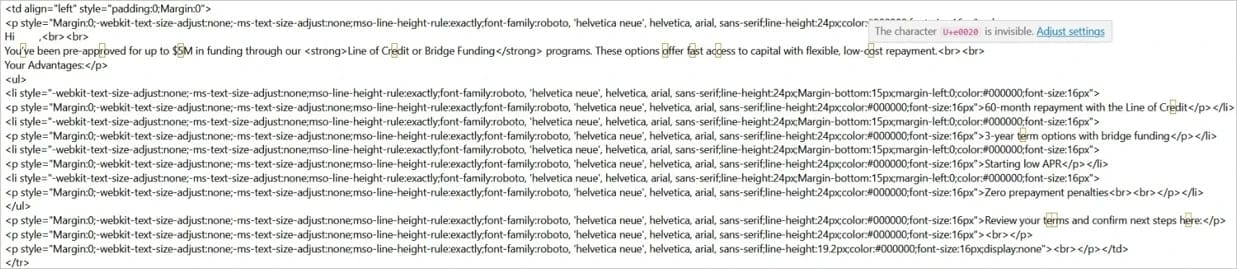
The core of this advanced evasion strategy lies in the strategic insertion of non-rendering Unicode characters, particularly those from the Tags block (U+E0000 to U+E007F), within seemingly innocuous text. These characters, while syntactically present in the email’s content, are designed to be visually imperceptible to human readers. However, their presence fundamentally alters the character string at a machine level, allowing threat actors to manipulate keywords in a manner that circumvents pattern-matching algorithms employed by many email security filters. These filters, typically reliant on predefined lists of suspicious words or phrases, are tricked into perceiving an altered string that does not match their known indicators of compromise.
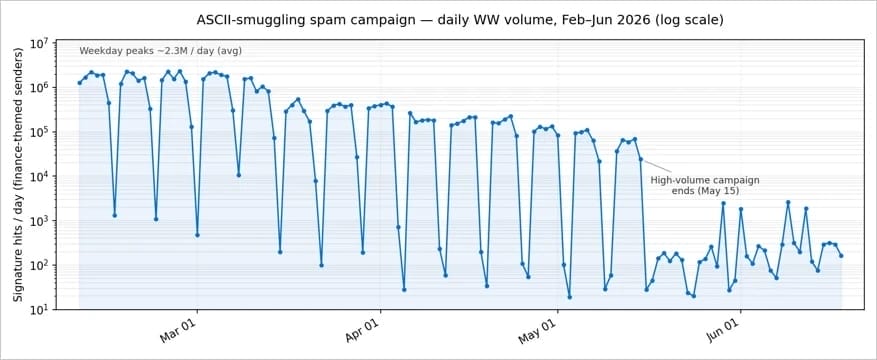
Security researchers at a leading technology firm recently uncovered a vast phishing operation that meticulously integrated this ASCII smuggling technique. The campaign reached alarming proportions, peaking at an estimated 2.37 million malicious messages disseminated daily during late February. Although a gradual decline in volume was noted in the subsequent months, particularly after mid-May, the underlying operational infrastructure remained active, indicating a persistent threat. The observation period for this specific technique spanned approximately three months, beginning in early February, though the broader campaign itself predated and continued beyond this high-volume phase. This extensive deployment highlights the attackers’ commitment to leveraging novel methods for large-scale exploitation.

The operational methodology behind this particular phishing campaign was ingeniously simple yet highly effective. Attackers would embed an invisible Unicode character directly into sensitive, finance-related keywords. For instance, a common lure such as "funding" would be subtly transformed into a character sequence that, to a human eye, still appeared as "funding," but to an automated email filter, registered as "fun[invisible character]ding." This minute, unnoticeable alteration was sufficient to disrupt the keyword recognition logic of many security systems. Other finance-centric terms like "capital," "loan," "advance," and "credit" were similarly manipulated, forming the basis of messages promoting fraudulent business funding, credit lines, and various loan services. The goal was to bypass initial content-based scanning, ensuring the malicious email reached its intended recipient’s inbox rather than being quarantined or flagged as spam.
Despite the clever obfuscation, comprehensive security measures still proved largely effective. The technology firm reported that while the ASCII smuggling technique did successfully evade basic keyword-based filters, its advanced threat protection systems, such as Defender for Office 365, managed to intercept over 99% of these messages. This success was attributed to a multi-layered detection approach that analyzed a broader spectrum of indicators, including sender reputation, IP addresses, domain characteristics, and behavioral patterns, rather than relying solely on content-based keyword matching. This underscores the critical importance of a holistic security framework that does not depend on any single detection vector.
Further analysis by the security firm identified a concentrated cluster of 148 sender domains predominantly responsible for driving this campaign. These domains, all finance-themed, accounted for approximately 96% of the messages flagged by the new hunting logic specifically designed to detect Unicode-tag signatures. The homogeneity in domain theming and the consistent use of finance-related lures indicated a highly organized and targeted operation aimed at individuals and businesses susceptible to financial incentives. This level of coordination suggests a professional threat actor group with dedicated resources for developing and deploying sophisticated evasion tactics.
A concerning aspect of this campaign was the abuse of legitimate email marketing infrastructure. The malicious messages were observed being delivered through systems associated with a widely recognized email-marketing platform. This practice, known as "brand abuse" or "service abuse," allows threat actors to piggyback on the established reputation and deliverability of legitimate services, further complicating detection efforts. Upon receiving a detailed report regarding the misuse of its platform, the email marketing provider affirmed that its moderation systems are designed to detect invisible Unicode characters and treat their heavy or unusual usage as suspicious, similar to how they handle unobfuscated text. This incident highlights the shared responsibility of platform providers in mitigating abuse and the constant need for vigilance against evolving attacker methodologies.
The emergence of ASCII smuggling in phishing campaigns represents a significant evolution in the tactics employed by cybercriminals. For years, attackers have experimented with various forms of obfuscation, from character substitutions (e.g., using ‘0’ for ‘o’) to complex encoding schemes. However, the use of invisible Unicode characters introduces a new level of subtlety, as the visual integrity of the message remains intact while its underlying machine-readable structure is altered. This technique effectively exploits a common blind spot in many legacy email security systems that prioritize visual rendering and basic pattern matching.
From a broader cybersecurity perspective, this development underscores the continuous "arms race" between attackers and defenders. As security technologies advance, so too do the methods of evasion. The crossover of ASCII smuggling from AI prompt injection, where it was used to hide malicious commands within seemingly benign prompts, to email phishing demonstrates the adaptability and resourcefulness of threat actors. This cross-pollination of techniques across different attack vectors means that innovations in one area of security often have implications for others. The fundamental challenge remains the distinction between legitimate, diverse character sets and their malicious manipulation.
.jpg)
The implications for organizations are profound. Successful phishing attacks, regardless of the evasion technique used, can lead to severe consequences, including credential theft, malware deployment, business email compromise (BEC), and ultimately, significant financial losses and reputational damage. The increased sophistication of these lures demands a corresponding enhancement in defensive strategies. Relying solely on signature-based detection or simple keyword filtering is no longer adequate in an environment where attackers are adept at altering the digital "signature" of their malicious content.
To effectively counter such advanced evasion techniques, cybersecurity practitioners must adopt a multi-pronged defensive posture. The primary recommendation is to implement robust content normalization processes. This involves stripping or normalizing Unicode tag characters and other invisible code points before applying any keyword, regex, or signature-based detection logic. By standardizing the text to its simplest, most common form, security systems can then accurately perform pattern matching without being misled by invisible character insertions. Furthermore, any unexpected or anomalous use of tag-block characters should be treated as a strong indicator of potential malicious intent.
Beyond normalization, organizations should reinforce their security infrastructure with advanced threat protection (ATP) solutions that incorporate behavioral analysis, machine learning, and artificial intelligence to detect anomalies that go beyond simple content matching. These systems can identify suspicious sender behaviors, unusual email headers, or anomalous links, even if the email content itself has been partially obfuscated. Regular security awareness training for employees is also paramount, educating them about the evolving nature of phishing threats and the importance of scrutinizing email sources and links, regardless of how legitimate the message appears.
The principle of normalization extends beyond email security. Applying similar normalization processes before feeding email content or any user-generated input to AI assistants is crucial for mitigating the risk of prompt-injection attacks. This ensures that AI models receive clean, unambiguous data, preventing malicious instructions from being covertly embedded and executed.
Looking ahead, the exploitation of Unicode and other text encoding subtleties is likely to persist and evolve. Threat actors will continue to probe for weaknesses in how systems interpret and render text, seeking new ways to bypass detection. This necessitates a proactive and adaptive approach from security vendors and organizations alike. Continuous research into new evasion techniques, collaborative intelligence sharing, and the development of dynamic, context-aware security solutions will be vital in staying ahead of these sophisticated threats. The current incident serves as a stark reminder that even seemingly minor technical details, such as the invisible characters within a vast encoding standard, can be weaponized to devastating effect in the hands of determined adversaries.




 Aura Kasih
 Ayu Aulia