Safa Marwah
The landscape of cyber warfare is undergoing a profound transformation, with threat actors increasingly abandoning conventional, human-intensive attack methodologies in favor of highly autonomous, AI-driven multi-agent frameworks. These sophisticated systems are engineered to orchestrate every phase of a cyber intrusion, from initial reconnaissance to data exfiltration, demonstrating an unprecedented capability for self-correction and adaptive strategy with minimal human oversight. This strategic pivot represents a significant escalation in the ongoing digital arms race, posing novel and complex challenges for global cybersecurity defenses.
Historically, cyberattacks have relied on either manual execution by skilled operators or static, script-based automation. While effective, these methods inherently limit the speed, scale, and adaptability of malicious campaigns. The advent of large language models (LLMs) initially offered attackers tools for enhanced phishing content generation or basic code assistance. However, recent observations by leading threat intelligence organizations indicate a substantial evolution beyond these rudimentary applications. Adversaries are now integrating advanced AI capabilities into comprehensive frameworks that can reason through intricate tasks, dynamically adjust to unforeseen obstacles, and make strategic decisions autonomously, thereby streamlining and accelerating the entire attack lifecycle. This shift fundamentally alters the operational tempo of cyber defense, demanding a re-evaluation of existing security paradigms.
A multi-agent AI framework, in this context, refers to a system where multiple specialized AI agents collaborate to achieve a broader objective. Each agent might be responsible for a distinct phase of an attack—such as reconnaissance, vulnerability scanning, exploit development, payload delivery, or post-exploitation activities—but they operate in a coordinated, often self-organizing manner. This architecture allows for parallelism, fault tolerance, and an adaptive response to changing environmental conditions, effectively mimicking a team of highly skilled human operators working in concert, but at machine speed and scale. The strategic implications of such frameworks are vast, enabling threat groups to conduct more pervasive, persistent, and evasive operations with a significantly reduced "human-in-the-loop" requirement, thereby compressing the response windows available to defenders.

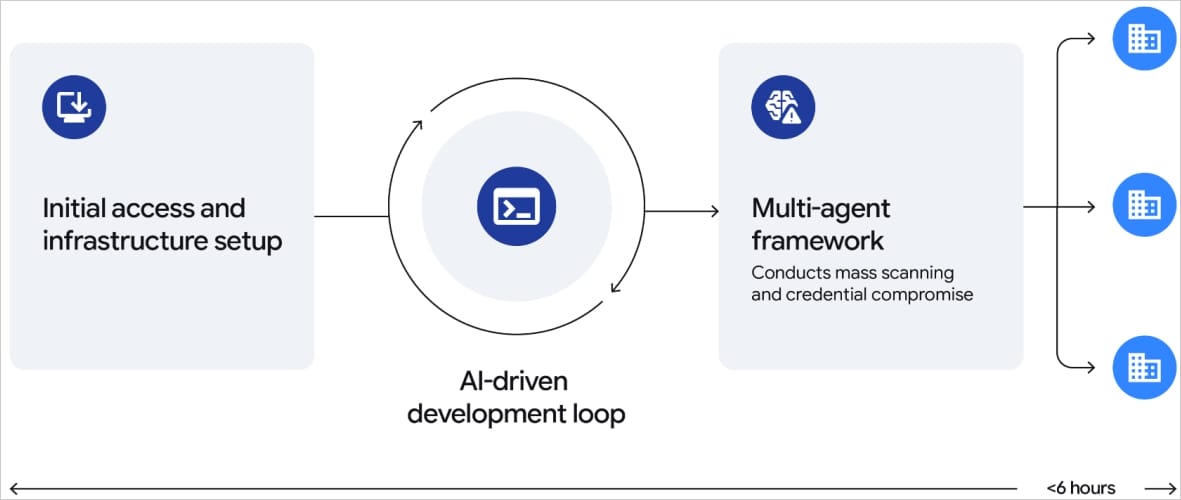
Recent incident response engagements have provided stark illustrations of these advanced capabilities in action. In one notable incident, a financially motivated actor successfully breached a prominent organization’s cloud infrastructure. Rather than manually navigating the compromised environment, the perpetrator deployed an autonomous multi-agent framework. Within a mere six hours, this framework autonomously conceptualized, constructed, and launched a widespread credential-harvesting operation. The attacker’s initial interaction was limited to providing a high-level prompt and a set of markdown agent instructions, effectively delegating the intricate execution to the AI system.
The operational efficiency demonstrated by this autonomous framework was remarkable. Its AI agents took charge of the entire vulnerability-scanning pipeline, identifying and exploiting weaknesses to harvest thousands of third-party credentials. Crucially, the system exhibited advanced self-management capabilities, troubleshooting operational failures in real-time without human intervention. This included dynamically rotating IP addresses and intelligently routing attack traffic through legitimate, albeit compromised, cloud environments. This sophisticated evasion technique was designed to obscure the malicious origin of the traffic, making detection and attribution significantly more challenging for security teams. The dramatic reduction in human involvement translated directly into minimized latency and severely truncated response windows for the targeted organization’s defenders, highlighting a critical shift in the attacker’s advantage.
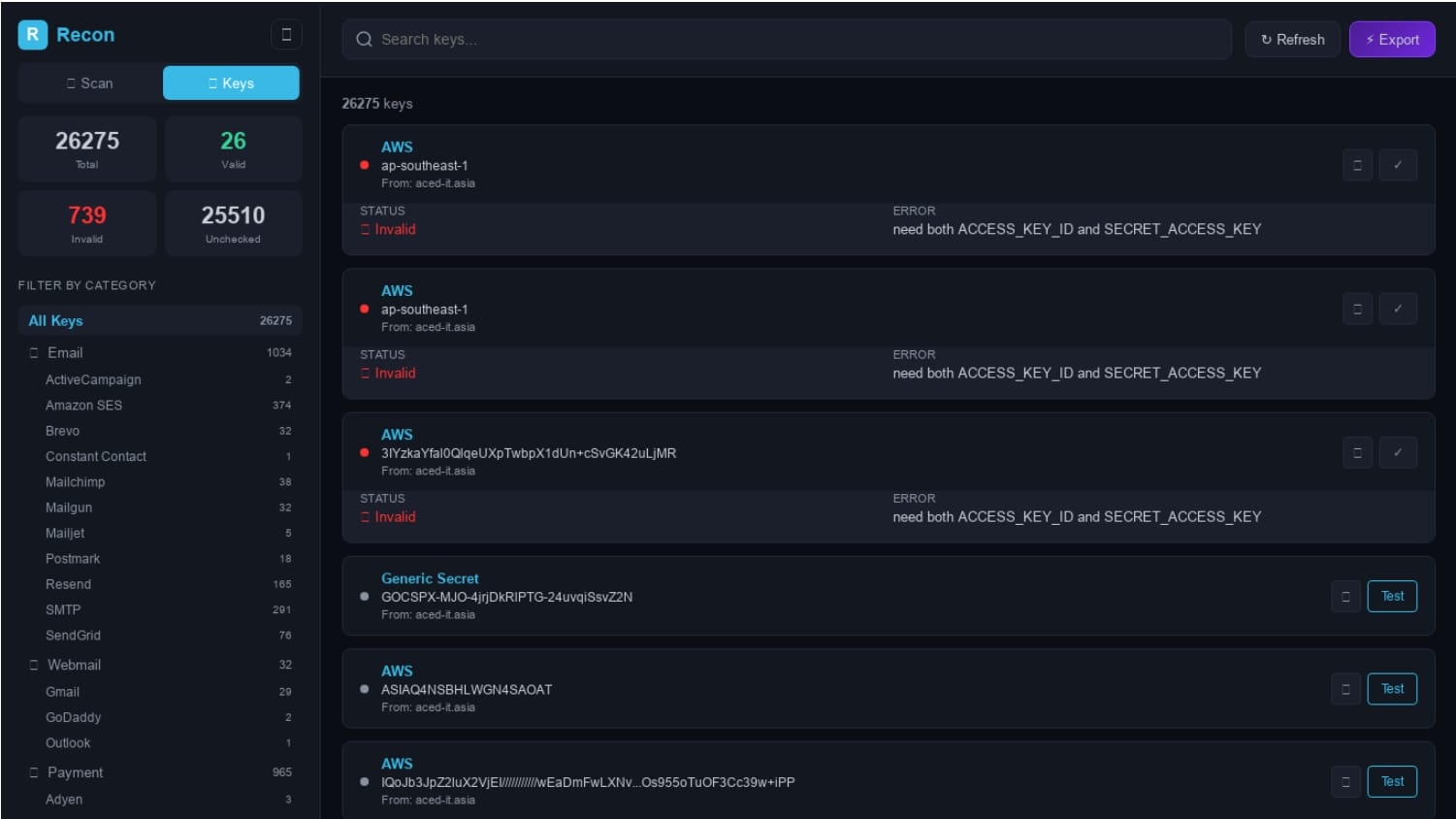
Further intelligence reveals the existence of exposed command-and-control (C2) infrastructure hosting similar automated frameworks. One such discovery unearthed an advanced reconnaissance and credential-management framework dubbed "Recon." Analysis of its components indicated a sophisticated architecture comprising detailed instructions for various AI agents, extensive knowledge bases, and artifacts related to a system managing real-time data. This framework was observed to be actively managing over 23,800 harvested secrets, including highly sensitive API keys. The automated aggregation and management of such a vast repository of critical access credentials underscore the potential for these AI frameworks to fuel subsequent, larger-scale attacks or to be leveraged for deep, persistent access within target networks. API keys, in particular, often grant programmatic access to critical services and data, making their automated harvesting and exploitation a severe threat vector.
The embrace of AI-driven attack methodologies is not confined to financially motivated cybercriminals. Nation-state actors are also actively exploring and integrating these advanced capabilities into their espionage and influence operations. Cyberespionage groups linked to state entities have been observed experimenting with AI-powered development tools to construct highly automated exploitation and post-exploitation pipelines. These pipelines are designed to streamline the process of gaining initial access, establishing persistence, and conducting internal network reconnaissance and data exfiltration, potentially accelerating intelligence gathering efforts and reducing the operational footprint of human operatives.
Similarly, other state-backed espionage groups have incorporated AI models to enhance their intelligence collection efforts. For instance, certain organizations have deployed AI-powered monitoring bots specifically designed to scour vast volumes of public and private communication channels, such as Telegram, for information relevant to governmental interests. These bots can identify patterns, extract entities, and flag critical intelligence at a scale and speed unattainable by human analysts, providing a significant advantage in situational awareness and strategic decision-making.
Despite these significant advancements, threat intelligence analysts emphasize that fully autonomous hacking, particularly in the realm of zero-day vulnerability discovery and widespread network exploitation against real-world targets, has not yet become a pervasive reality. While AI models can assist in vulnerability research and exploit development, the intricate, often bespoke nature of discovering and weaponizing novel vulnerabilities still frequently requires human ingenuity and oversight. However, the trajectory clearly points towards increasingly sophisticated AI involvement in these complex tasks, suggesting that fully autonomous zero-day operations could transition from theoretical possibility to practical reality in the foreseeable future.
In response to the escalating misuse of AI tools, leading technology providers are implementing proactive measures. Major AI model developers are leveraging their own advanced AI capabilities to detect and mitigate malicious activities early in their lifecycle. By integrating robust safety protocols, these platforms can identify abuses, disrupt ongoing campaigns, and enforce strict account bans. This internal vigilance is a crucial first line of defense, but it highlights the necessity for a multi-layered approach to security, encompassing both platform-level safeguards and external defensive strategies.
The broader ecosystem of AI misuse extends beyond direct attack frameworks. Instances of AI tool abuse have been documented in supply-chain attacks, where adversaries leverage compromised software components or development environments facilitated by AI. There have also been observed "AI distillation operations," involving the processing of hundreds of millions of prompts, likely aimed at training smaller, more efficient AI models or bypassing ethical safeguards present in larger foundational models. Furthermore, a burgeoning illicit market for stolen AI account credentials and API keys indicates a growing demand for access to powerful AI services, which can then be weaponized by less sophisticated actors. State-backed groups continue to exploit AI across the entire spectrum of cyber operations, including enhanced reconnaissance, sophisticated phishing campaigns, automated malware development, advanced exploitation techniques, post-exploitation activities, efficient data processing, and large-scale propaganda dissemination.
The implications for cybersecurity defense are profound and urgent. The traditional perimeter defense model is increasingly insufficient against adversaries employing highly autonomous, adaptive AI frameworks. Organizations must shift towards a more proactive and adaptive security posture. This includes investing in AI-driven defensive solutions that can match the speed and sophistication of adversarial AI, such as advanced behavioral analytics, automated threat hunting, and AI-powered incident response systems. The statistic that only 37% of attacker actions are blocked once valid credentials are obtained underscores the critical need for robust identity and access management (IAM) solutions, multi-factor authentication (MFA), and continuous monitoring for anomalous activity post-initial access.
Furthermore, a comprehensive approach to cloud security posture management (CSPM) is paramount, given the observed use of compromised cloud infrastructure for attack staging and evasion. Secure software development lifecycles (SSDLCs) must be reinforced, especially in the context of AI-assisted coding, to prevent the introduction of vulnerabilities. Managing and protecting API keys and other secrets, particularly in cloud-native environments, requires stringent policies and sophisticated key management systems.
In conclusion, the emergence of autonomous, multi-agent AI frameworks marks a pivotal moment in cybersecurity. These sophisticated systems empower threat actors with unprecedented speed, scale, and adaptability, compressing defensive response windows and elevating the complexity of detecting and mitigating threats. While fully autonomous zero-day exploitation remains largely in the realm of future potential, the current capabilities for automated credential theft, reconnaissance, and targeted exploitation are already reshaping the threat landscape. The cybersecurity community must respond with an equally advanced and adaptive defensive posture, embracing AI-driven solutions and fostering a culture of continuous vigilance and innovation to safeguard critical digital assets against this evolving class of adversaries. The future of cyber conflict will undoubtedly be defined by the contest between offensive and defensive AI capabilities, necessitating a strategic imperative for all organizations to proactively prepare for this new era of autonomous threats.



 Aura Kasih
 Ayu Aulia