Aura Kasih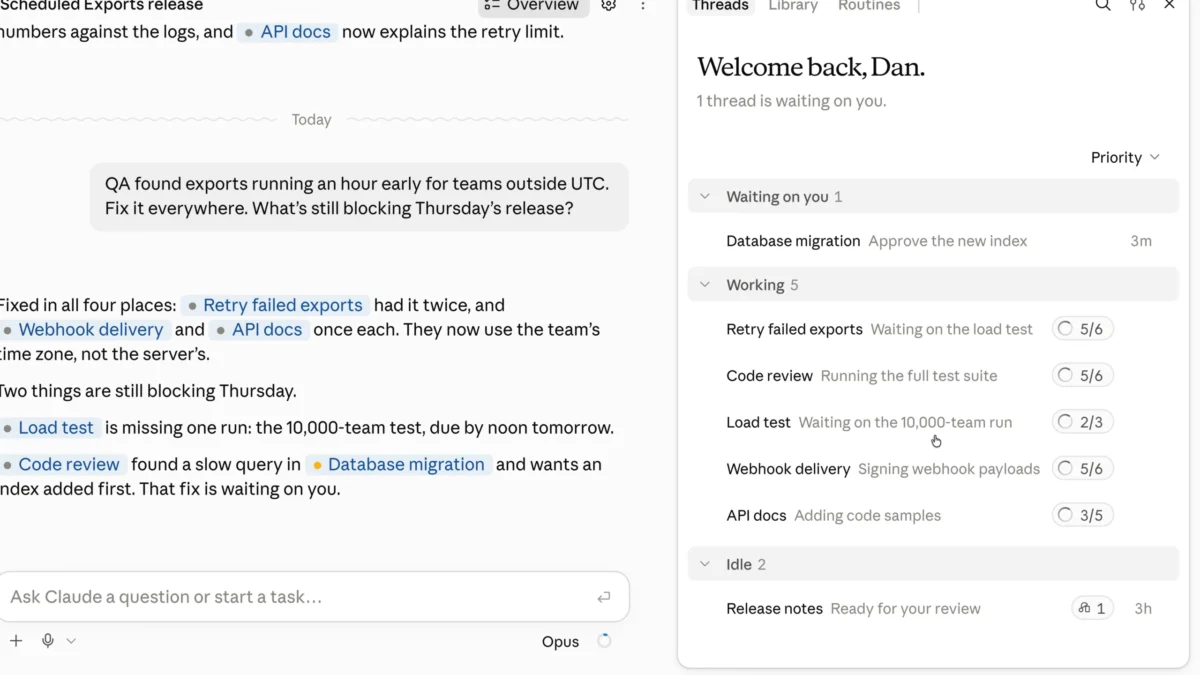
Anthropic, a leading artificial intelligence research company, has significantly enhanced its Claude Code platform with a re-envisioned "Projects" feature. This substantial upgrade empowers users to orchestrate and manage multiple AI agents concurrently within a unified cloud-based environment, fostering a more integrated and efficient approach to complex AI-driven tasks. The new system introduces a shared memory, overarching goals, and a centralized repository for files and artifacts, fundamentally altering how developers and researchers can leverage AI for ambitious undertakings.
The evolution of AI development has been marked by an increasing demand for tools that can manage the complexities of sophisticated projects. As AI models become more capable, the need for them to collaborate, share information, and work towards common objectives becomes paramount. Traditional single-agent AI interactions, while powerful for specific tasks, often fall short when addressing multifaceted problems that require parallel processing, iterative refinement, and diverse skill sets. This is where the concept of multi-agent systems, and platforms designed to manage them, gains critical importance.
Claude Code’s revamped Projects feature directly addresses this burgeoning need. At its core, the system operates on a "thread" architecture, where each thread represents a distinct AI agent, or a group of agents, diligently working on a specific aspect of a larger project. These threads function autonomously, each operating within its own dedicated Claude Code cloud session and managing its own copy of the project’s codebase, akin to independent branches in a version control system. This parallel execution capability is crucial for accelerating development cycles and tackling computationally intensive tasks that would be prohibitive for a single agent.
The operational framework of these threads is overseen by a sophisticated "coordinator" agent. This central orchestrator is responsible for maintaining order and coherence across all active threads. It ensures that tasks are appropriately delegated, progress is tracked, and that potential conflicts arising from multiple agents working on the same code are managed effectively. When such overlaps occur, the system intelligently resolves them as merge conflicts, mirroring the established practices in software development workflows. This integration of standard development paradigms into AI project management signifies a maturation of the field, bridging the gap between AI development and traditional software engineering.
Furthermore, the Projects feature is designed for granular control and scalability. Each individual thread, empowered by the coordinator, can further subdivict its assigned work into smaller, more manageable components. This is achieved through the utilization of sub-agents, iterative loops, and predefined workflows. This hierarchical delegation of tasks ensures that even the most expansive and intricate assignments can be broken down into digestible steps, allowing for faster completion and more efficient resource allocation. The ability for agents to spawn and manage sub-agents introduces a dynamic and adaptable structure, capable of responding to evolving project requirements.
The implications of this architectural shift are far-reaching. For software developers, it represents a powerful new tool for automating complex coding tasks, debugging, and even entire application development lifecycles. Imagine an AI agent tasked with building a new web application. With the enhanced Projects feature, this agent could spawn multiple sub-agents: one for front-end development, another for back-end logic, a third for database integration, and a fourth for testing and quality assurance. These agents would operate in parallel, communicating and coordinating through the central coordinator, significantly reducing development time and the potential for human error.

Beyond software development, the potential applications extend to scientific research, data analysis, and creative endeavors. Researchers could employ multi-agent systems to sift through vast datasets, identify patterns, and generate hypotheses at an unprecedented scale. For instance, in drug discovery, AI agents could collaborate to simulate molecular interactions, analyze genomic data, and propose potential therapeutic candidates, accelerating the pace of medical innovation. In the creative arts, AI agents could work together to generate music, write scripts, or even design visual art, pushing the boundaries of human-AI collaboration in creative fields.
The introduction of shared memory and a unified repository for files and artifacts is another critical component of this upgrade. This shared context ensures that all agents within a project have access to the same information, preventing inconsistencies and facilitating seamless knowledge transfer. This is particularly important in complex projects where different agents may possess specialized knowledge or perform distinct functions. By having a common ground of information, agents can build upon each other’s work, leading to more cohesive and robust outcomes. The artifact library serves as a central hub for all outputs, logs, and intermediate results, providing a comprehensive audit trail and enabling easy access to project history.
The cloud-based nature of the initial implementation offers immediate accessibility and scalability. Users can leverage the power of Anthropic’s infrastructure without the need for significant local hardware investments. However, the company’s commitment to supporting local tools and code "very soon" indicates a strategic vision to provide users with the flexibility to integrate their existing development environments and workflows. This hybrid approach acknowledges the diverse needs of users and aims to create a versatile platform that caters to both cloud-native and on-premises development preferences.
The phased rollout of this feature, beginning with select Claude Pro and Max subscribers and gradually expanding to all subscription tiers, including Team and Enterprise users, as well as Cowork and regular Claude chats, suggests a deliberate strategy to gather user feedback and refine the system based on real-world usage. This iterative approach is characteristic of leading technology companies aiming to ensure the stability and usability of their advanced offerings before a wider public release. The inclusion of Cowork and regular Claude chats indicates an ambition to democratize access to multi-agent AI capabilities, making them available to a broader spectrum of users beyond specialized developers.
The competitive landscape of AI development tools is rapidly evolving, with numerous companies exploring multi-agent architectures. Features similar to Claude Code’s Projects have been observed in other platforms, such as Grok Bot, highlighting a convergent trend towards enabling collaborative AI. However, Anthropic’s approach, with its emphasis on robust project management, shared memory, and seamless integration with development workflows, appears to position Claude Code as a frontrunner in this emerging domain. The ability to resolve merge conflicts, for instance, directly addresses a key challenge in collaborative AI development and demonstrates a deep understanding of the practical needs of its users.
Looking ahead, the continued development of such platforms will likely focus on several key areas. Enhanced natural language understanding and generation capabilities will be crucial for enabling more intuitive interactions between users and AI agents, as well as among the agents themselves. The development of standardized protocols for inter-agent communication and data exchange could further streamline collaboration and foster interoperability between different AI systems. Moreover, advancements in AI safety and ethical alignment will be paramount, ensuring that these powerful multi-agent systems are developed and deployed responsibly.
The advent of advanced AI project management tools like Anthropic’s revamped Projects feature marks a significant milestone in the journey towards more sophisticated and collaborative artificial intelligence. By providing a structured and efficient environment for multiple AI agents to work in concert, these platforms are poised to unlock new levels of productivity, innovation, and problem-solving capability across a wide range of industries and disciplines. The ability to manage complex AI workflows with the precision and adaptability of traditional software development methodologies signals a maturation of AI as a development tool, paving the way for truly transformative applications in the near future. The ongoing evolution of these systems promises to further blur the lines between human and artificial intelligence, ushering in an era where AI acts not just as a tool, but as a trusted collaborator in tackling humanity’s greatest challenges.




 Safa Marwah
 Ayu Aulia