Aura Kasih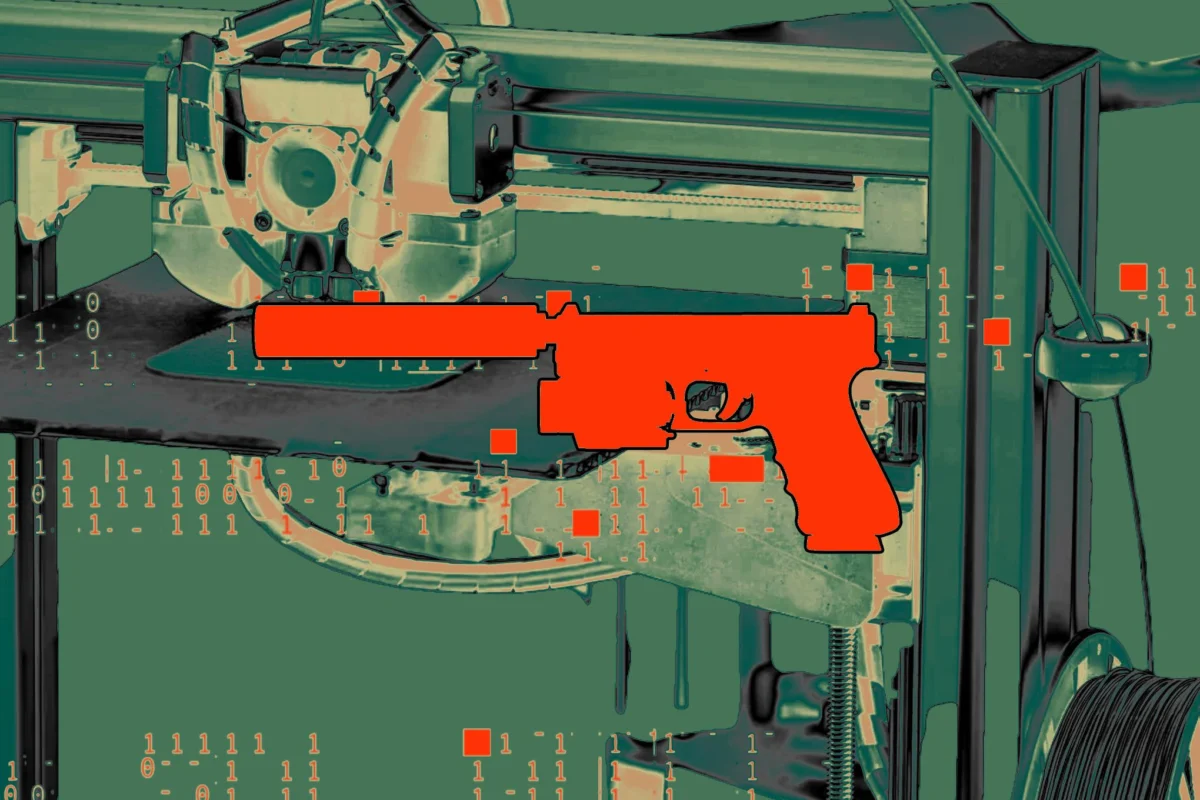
A contentious battleground has emerged in the digital realm, as innovators and regulators clash over the proliferation of 3D-printable firearm designs, commonly known as "ghost guns." At the heart of this escalating conflict is a new development that challenges government efforts to control the creation of these untraceable weapons, signaling a significant escalation in the ongoing technological and legal struggle.
The creator of the world’s first fully 3D-printed firearm has unveiled a sophisticated method designed to circumvent government-mandated software intended to identify and block the digital blueprints for firearms. This development represents a direct countermeasure against legislative attempts to curb the spread of ghost guns, which are firearms assembled from parts that are not serialized, making them difficult to trace by law enforcement. This technological maneuver has ignited what is rapidly becoming an evolving confrontation between authorities seeking to regulate the digital dissemination of weapon designs and individuals committed to circumventing these controls.
Cody Wilson, the individual credited with developing this detection-defying tool, has provocatively dubbed his innovation "Hochulization," a pointed reference to New York Governor Kathy Hochul. Governor Hochul was instrumental in championing the nation’s first law that mandates gun file detection software on newly manufactured 3D printers. Wilson, operating from Austin, Texas, stated that New York’s initiative represents an attempt to "reach into the internet and police how open-source 3D printing is done," framing his own development as a "self-defense measure" against what he perceives as governmental overreach into digital creation and dissemination.
Wilson’s technological solution targets a fundamental aspect of the proposed 3D-printed gun bans: the reliance on identifying unique digital signatures of firearm files. His organization, Defense Distributed, operates DEFCAD, reportedly the world’s largest repository of 3D gun files, hosting an extensive collection of designs for firearms and accessories like suppressors. The standard approach to detecting these files involves a cryptographic hashing technique. Each digital file is processed through a specific algorithm to generate a unique alphanumeric string, known as a hash. Government-mandated software would then theoretically scan incoming files, compare their hashes against a database of known firearm design hashes, flag any matches, and prevent the printing process from commencing.
The "Hochulization" tool disrupts this mechanism by systematically altering these hashes. It achieves this by inserting a small, imperceptible series of data bytes into each file. This alteration changes the file’s hash without impacting the functionality of the resulting 3D-printed object. Consequently, a firearm or suppressor produced from such a modified file would theoretically remain fully operational. Wilson characterizes "Hochulization" as a "de minimis policy to change the hash of every file that gets created and downloaded to where there is never going to be a complete library of hashes."
Wilson has expressed his intention to apply this "Hochulization" process to all files hosted on DEFCAD by default. He views this as a necessary form of "self-defense" against what he describes as increasingly invasive digital surveillance aimed at restricting 3D printing. While he plans to make the tool available to DEFCAD users, he also intends to release it as open-source software. This would empower individual users to apply the "Hochulization" process to any gun file they possess, thereby scrambling its hash and potentially evading detection systems.
This strategic move by Wilson highlights the burgeoning resistance to technologies designed to block the creation of 3D-printed firearms. While the current impetus stems from Second Amendment advocates, the broader implications of such detection software are a cause for concern across various communities. Proponents of digital rights, maker communities, and even segments of the entertainment industry have voiced apprehension, arguing that mandating file scanning on 3D printers introduces a new layer of digital surveillance that could stifle legitimate creative expression for all users, not just those seeking to print firearms.
The prevalence of 3D-printed firearms, while still a fraction of conventional gun ownership, has seen a notable increase. Law enforcement data from New York City, for instance, shows a significant jump in confiscated 3D-printed guns, from a single incident in 2021 to over a hundred by 2024. Similar upticks have been observed in other major cities, according to research from gun policy organizations. Despite this rise, 3D-printed firearms remain a comparatively small segment of the total firearms recovered by law enforcement nationally. However, the rapid advancement in 3D printing technology has dramatically improved the capabilities of these homemade weapons.
The evolution of 3D-printed firearm technology since Wilson’s initial "Liberator" pistol in 2013 is striking. Modern designs, such as the FGC-9, are capable of firing multiple high-velocity rounds without structural failure. These advanced weapons have unfortunately been discovered in the possession of extremist groups, including neo-Nazi cells in Europe and rebel factions in conflict zones. Furthermore, the ability to print critical firearm components, such as switches that convert semi-automatic weapons to fully automatic fire or suppressors that aid in concealment, presents a particularly concerning threat. These components, often heavily regulated or illegal to acquire through conventional means, are readily produced via 3D printing, circumventing existing legal frameworks. The case of Luigi Mangione, who allegedly used a partially 3D-printed pistol frame and a 3D-printed suppressor in a high-profile murder, underscores the potential real-world consequences of this technology.
From a policy perspective, gun control advocates and law enforcement officials argue that these developments expose a critical vulnerability in the existing legal system. Individuals legally prohibited from owning firearms can potentially acquire them through 3D printing. While many jurisdictions have enacted regulations on the creation and sale of "ghost guns," enforcement of these laws has proven exceptionally challenging. The new legislative approach, which mandates that 3D printers incorporate file-blocking software, aims to preemptively address this issue by preventing the printing of prohibited items before they can be created. The technical feasibility and effectiveness of such widespread print-blocking at scale, however, remain subjects of ongoing debate among industry experts.

Governor Hochul’s office, which spearheaded the inclusion of print-blocking software requirements in New York’s budget, asserts that such measures are essential to combat what she terms a "plastic pipeline" of illicit firearms. Her administration declined to comment on Wilson’s "Hochulization" workaround.
New York is not an isolated case. California is also advancing similar legislation, with Assembly Bill 2047 poised for a Senate vote. This bill mirrors New York’s proposal, requiring new printers sold or manufactured in the state to be equipped with print-blocking capabilities. The California Department of Justice would maintain a roster of compliant models, and non-compliant printers would face a sales ban starting in late 2029. A spokesperson for the bill’s author declined to comment on Wilson’s project.
Crucially, the precise technical specifications for this print-blocking software are not explicitly defined in these legislative proposals. This leaves considerable latitude for industry experts in fields such as manufacturing technology, artificial intelligence, and firearms regulation to develop effective solutions. While a simple hash-matching system might minimize false positives by accurately identifying known gun files, Wilson’s demonstration reveals its susceptibility to circumvention. More sophisticated approaches, employing artificial intelligence to analyze the geometric properties of a design and predict its function as a firearm, could potentially offer greater efficacy in preventing unauthorized prints. However, these advanced systems may also be prone to a higher rate of false positives, potentially flagging legitimate designs as problematic.
Wilson’s intention is to influence these crucial working group discussions by showcasing the ease with which a basic hash-matching system can be undermined. By doing so, he aims to compel policymakers to confront the limitations of such approaches and consider more robust, albeit potentially more complex, solutions or accept the status quo. He contends that relying solely on a database of known files and hash comparisons is insufficient due to its inherent vulnerability to defeat.
Solomon Diamond, an associate professor of engineering at Dartmouth College, acknowledged that Wilson’s "Hochulization" technique would likely succeed in bypassing a hash-based detection model on a technical level. However, Diamond also noted that this technical bypass does not render the policy itself entirely ineffective. He suggested that not all 3D printer users would necessarily undertake the extra steps required to alter file hashes. Furthermore, the process of obtaining firearm files from repositories like DEFCAD often involves account creation and email registration, presenting additional barriers to entry for less committed individuals. Therefore, a hash-based system, while imperfect, could still deter casual or less technologically adept users.
Beyond hash manipulation, Wilson claims his team has explored other methods to circumvent more advanced detection systems, employing techniques such as "adversarial noise." This involves subtly altering digital files in ways that are imperceptible to humans but confuse AI detection models. His team developed their own AI model for classifying firearms and parts, trained on a dataset that included both public and proprietary files from DEFCAD. This internal model was informed by the approaches of companies like Print&Go, which is reportedly collaborating with lawmakers in New York and California.
Wilson reported successfully bypassing their own AI detection system through methods such as resaving a gun part with a slightly modified mesh structure or incorporating extraneous, non-functional geometric elements. He noted that even their well-trained gun detection system exhibited a significant 30 percent false positive rate, suggesting inherent challenges with prediction-based detection systems.
Wilson, a self-proclaimed crypto-anarchist and ardent Second Amendment advocate, frames the debate over print-scanning as a matter of fundamental rights. He has been a prominent proponent of the argument that gun files constitute constitutionally protected speech under the First Amendment. His past endeavors, including the creation of Hatreon as an alternative to Patreon to circumvent content moderation policies, attracted individuals and groups associated with extremist ideologies.
However, concerns regarding the implications of mandated print-blocking software extend beyond gun enthusiasts. Many makers and hobbyists have expressed apprehension that such systems could erroneously flag non-firearm objects as weapons, thereby infringing upon their freedom of expression. There are also concerns that a technology initially intended to address firearm proliferation could be expanded by corporations to enforce intellectual property and copyright protections on all 3D printed content.
Wilson’s engagement with legal challenges surrounding 3D-printed firearms is not new. Following the initial release of the Liberator files, the U.S. State Department ordered their removal and threatened legal action for alleged violations of export control regulations. Wilson and Defense Distributed responded with a lawsuit, asserting that the government’s actions constituted an infringement on his First Amendment rights by attempting to suppress computer code. This legal battle initiated a complex series of court proceedings concerning the classification of gun file code as protected speech, an issue that continues to be debated in the judicial system.
The emergence of "Hochulization" and similar countermeasures underscores the dynamic nature of this technological arms race. As regulatory bodies endeavor to implement controls, innovators are poised to develop workarounds, creating a perpetual cycle of challenge and response. The efficacy of future legislative efforts will likely hinge on their ability to adapt to rapidly evolving technologies and to balance public safety concerns with the protection of digital freedoms and the rights of responsible makers. The ongoing debate highlights the complex interplay between technological innovation, individual liberties, and the persistent societal challenge of regulating potentially dangerous tools in the digital age.




 Lisa Mariana
 Safa Marwah
 Ayu Aulia