Safa Marwah
A significant cybersecurity incident has led to the public exposure of extensive internal analytics data belonging to Rockstar Games, the renowned video game developer. This breach is intrinsically linked to a wider campaign orchestrated by the notorious ShinyHunters extortion collective, which exploited vulnerabilities stemming from a recent security compromise at Anodot, a data anomaly detection firm. The leaked datasets, reportedly comprising over 78.6 million records, underscore the escalating risks associated with complex digital supply chains and third-party cloud integrations, particularly within enterprise data warehousing environments like Snowflake.
Rockstar Games, a subsidiary of Take-Two Interactive and the creative force behind global phenomena such as the Grand Theft Auto and Red Dead Redemption series, found itself embroiled in this breach through an indirect vector. The ShinyHunters group asserts that their access to Rockstar’s Snowflake instances was achieved by leveraging authentication tokens pilfered during the Anodot security incident. Anodot, a provider of AI-powered anomaly detection services, integrates deeply with a multitude of Software-as-a-Service (SaaS) cloud platforms, making it a critical choke point in the digital supply chain. The compromise of such a third-party integrator can, as this incident demonstrates, grant threat actors lateral movement capabilities across a vast network of client data hosted on connected cloud infrastructure.
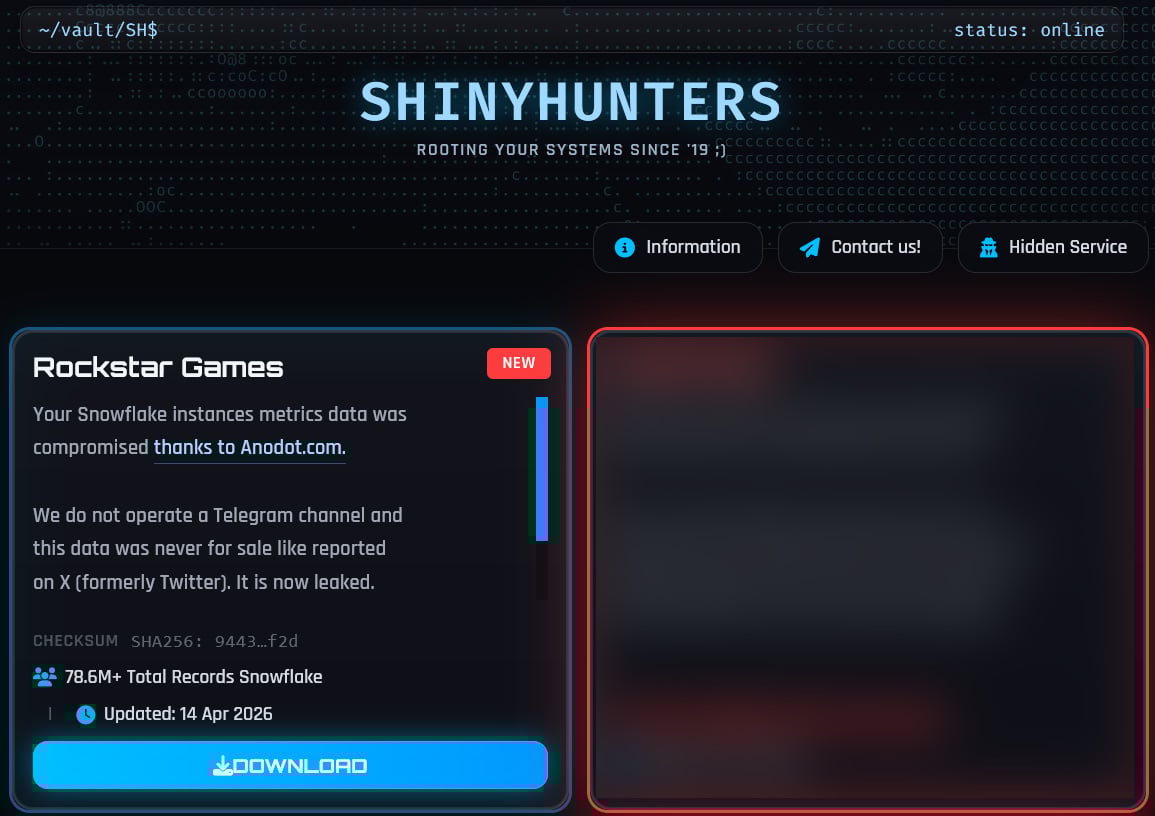
The revelation of this breach came via the ShinyHunters’ dedicated data leak site, where the group prominently listed Rockstar Games among its victims. The listing explicitly pointed to Anodot.com as the initial point of failure, stating, "Your Snowflake instances metrics data was compromised thanks to Anodot.com." This public declaration served as the initial notification of the extent of the compromise. Snowflake, a prominent cloud-based data warehousing company, subsequently acknowledged detecting unusual activity affecting a limited number of customer accounts that utilized a specific third-party integration, later confirming Anodot as the source of the initial compromise. The incident highlights the intricate web of dependencies within modern enterprise IT architecture and the inherent vulnerabilities that arise when critical data processing and storage are distributed across multiple vendors and platforms.

While Rockstar Games initially maintained a reserved public posture, the company later confirmed the incident, albeit downplaying its severity. In a statement shared with media outlets, Rockstar acknowledged that "a limited amount of non-material company information was accessed in connection with a third-party data breach." The company further asserted that "This incident has no impact on our organization or our players." This characterization, however, warrants closer scrutiny given the nature of the data claimed by the ShinyHunters group.
According to the threat actors, the leaked information primarily encompasses internal analytics data vital for monitoring Rockstar’s extensive online services and customer support operations. This includes granular metrics related to in-game revenue generation and purchase patterns, comprehensive player behavior tracking, and intricate game economy data specifically for its highly successful online multiplayer titles, Grand Theft Auto Online and Red Dead Online. Furthermore, the datasets reportedly contain customer support analytics derived from the company’s Zendesk support instance. The granular nature of this data, extending to references to fraud detection systems and anti-cheat model testing within the disclosed file lists, suggests a much deeper insight into the operational backbone of Rockstar’s online ecosystem than what might be typically considered "non-material."
The implications of such a comprehensive leak of internal analytics extend far beyond simple inconvenience. For a company like Rockstar Games, which operates some of the most lucrative and enduring online gaming platforms, this data represents proprietary business intelligence. Competitors could potentially gain insights into successful monetization strategies, player engagement drivers, and even vulnerabilities in game economies. Understanding player behavior patterns at such a detailed level could inform future game design, marketing campaigns, or even targeted exploitation attempts by malicious actors. The presence of fraud detection and anti-cheat system data could, in theory, be leveraged by sophisticated cheaters or exploit developers to bypass existing security measures, thereby impacting the integrity and fairness of the gaming experience for the broader player base.

This incident serves as a stark reminder of the evolving landscape of cyber threats, particularly the increasing prevalence of supply chain attacks. Rather than directly targeting the primary organization, threat actors are increasingly exploiting vulnerabilities in third-party vendors, whose security postures may be less robust or whose integrations provide a broader attack surface. The compromise of Anodot’s authentication tokens, which then facilitated access to Snowflake environments, exemplifies this strategy. It underscores the critical need for organizations to not only fortify their own defenses but also to rigorously vet and continuously monitor the security practices of every vendor in their digital supply chain, especially those with privileged access to sensitive data or critical infrastructure.
The ShinyHunters group itself is not new to the cybercrime scene, having been implicated in numerous high-profile data breaches and extortion campaigns over several years. Their modus operandi often involves exfiltrating large volumes of data and then attempting to extort organizations for payment, threatening public leaks if demands are not met. Their ability to consistently penetrate corporate networks and leverage stolen credentials highlights a persistent and adaptable threat. The fact that they successfully exploited a vulnerability in a data anomaly detection company—a service designed to enhance security—adds a layer of irony and concern regarding the potential for such tools to become vectors for attack if not properly secured themselves.
This is not the first time Rockstar Games has faced a significant cybersecurity challenge. In 2022, the company suffered a highly publicized breach where a hacker, reportedly linked to the Lapsus$ extortion group, leaked extensive Grand Theft Auto 6 gameplay videos and source code. While the nature of the data stolen in the 2022 incident differed (focusing on pre-release game assets), both events highlight recurring security vulnerabilities within the organization’s extended digital footprint. The cumulative effect of such incidents can erode trust, attract further malicious attention, and necessitate substantial investments in enhancing cybersecurity infrastructure and protocols.
Looking ahead, the fallout from this breach will likely prompt Rockstar Games to conduct an exhaustive internal review of its security architecture, particularly concerning third-party integrations and cloud data warehousing practices. The incident will also undoubtedly intensify scrutiny on Snowflake and other cloud service providers to ensure robust security measures are in place to protect customer data, even when accessed via third-party applications. For the broader industry, this event reinforces the imperative for comprehensive third-party risk management frameworks, including regular security audits, strict access controls, and multi-factor authentication for all integrated services. The concept of "zero trust" security, where no entity inside or outside the network is automatically trusted, will gain further traction as organizations grapple with the complexities of securing increasingly distributed and interconnected digital ecosystems.
The exposure of such extensive analytics data, even if categorized as "non-material" by the affected entity, represents a valuable asset for threat actors and a potential strategic disadvantage for the victim. It underscores a fundamental shift in the value of data beyond direct personal identifiable information, extending to operational intelligence, competitive insights, and systemic vulnerabilities. As cyber extortion gangs continue to evolve their tactics, organizations must proactively strengthen their defenses, understand their entire digital attack surface, and prepare for a future where the integrity of the supply chain is as critical as the security of their own internal networks.



 Lisa Mariana
 Aura Kasih
 Ayu Aulia