Ayu Aulia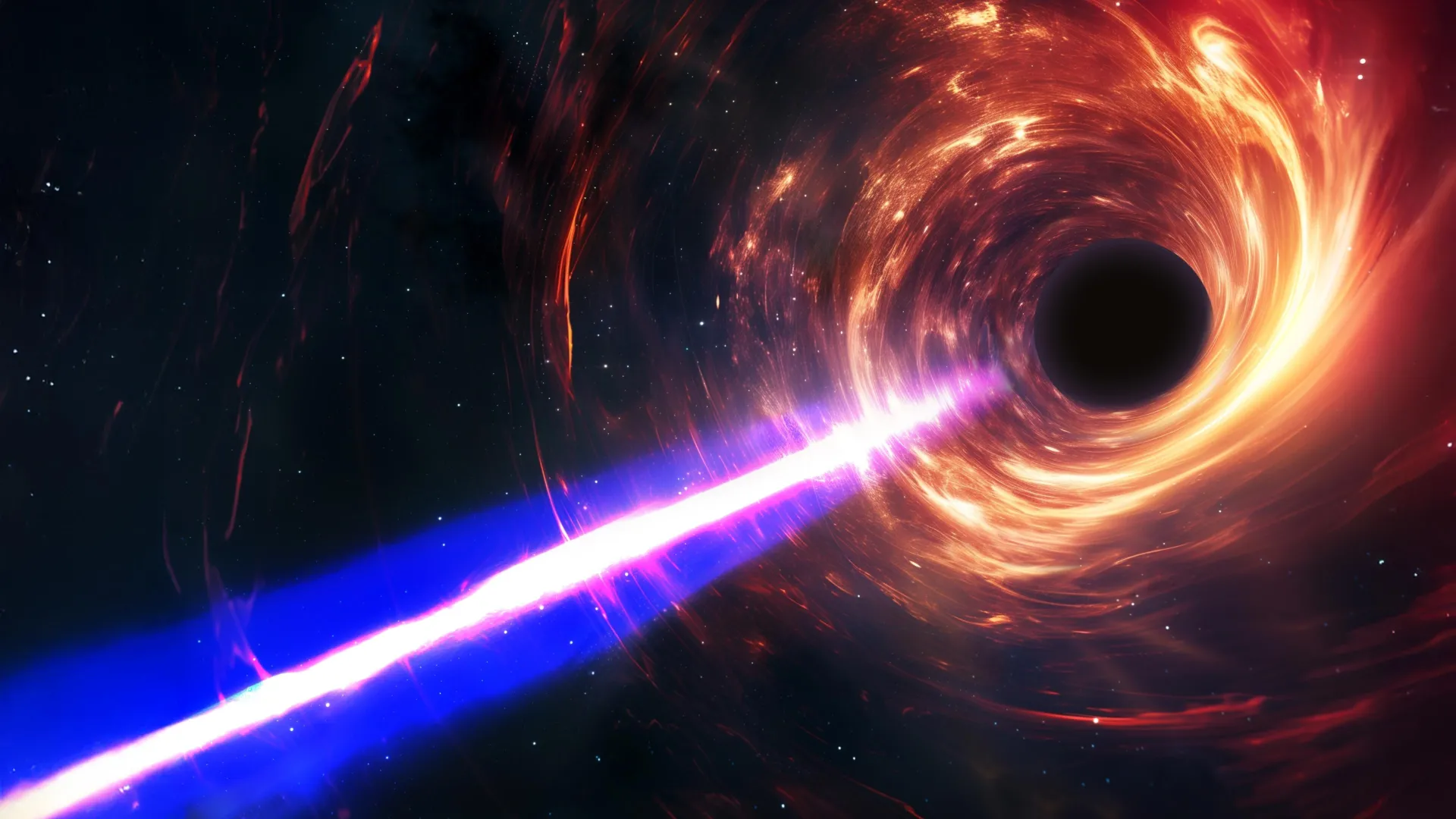
A monumental achievement in astrophysics has for the first time directly quantified the immense energy output of black hole jets, revealing these relativistic outflows to be cosmic engines capable of rivaling the power of 10,000 suns. This groundbreaking research, leveraging an advanced global network of radio telescopes, offers unprecedented insight into how these enigmatic phenomena exert profound influence across the cosmos, fundamentally reshaping galaxies and validating long-held theoretical frameworks regarding their operational mechanics.
The Enigma of Relativistic Jets
Black holes, objects of such extreme gravity that nothing, not even light, can escape their grasp, are paradoxically among the most luminous and energetic entities in the universe when actively accreting matter. As gas, dust, and even entire stars spiral into a black hole’s accretion disk, friction heats this material to extraordinary temperatures, emitting intense radiation across the electromagnetic spectrum. A fraction of this infalling matter, however, instead of disappearing beyond the event horizon, is somehow collimated and ejected outwards at speeds approaching that of light, forming powerful, narrow beams known as relativistic jets. The precise mechanisms by which these jets are launched and accelerated remain one of the most compelling mysteries in astrophysics, believed to involve complex interplay between the black hole’s spin, the accretion disk’s magnetic fields, and general relativistic effects. These jets are not merely astrophysical curiosities; they are recognized as critical components in the grand narrative of cosmic evolution, playing a pivotal role in regulating star formation, distributing heavy elements, and influencing the growth of galaxies. Until now, direct, instantaneous measurements of their raw power have remained elusive, forcing scientists to rely on estimations derived from long-term observations or theoretical modeling.
Cygnus X-1: A Proximity Laboratory
The focus of this transformative study was Cygnus X-1, a binary X-ray system located approximately 6,070 light-years from Earth in the constellation Cygnus. Discovered in 1964, Cygnus X-1 holds a special place in astronomical history as the first unequivocally confirmed stellar-mass black hole. It consists of a black hole, estimated to be about 21 times the mass of our Sun, locked in a tight orbital dance with a massive blue supergiant star, HDE 226868. This supergiant companion is approximately 40 times the mass of the Sun and nearly 20 times its radius. The black hole siphons material from its stellar partner through a process known as Roche lobe overflow, forming a vibrant accretion disk that fuels its powerful X-ray emissions and, crucially for this study, its relativistic jets. The relative proximity of Cygnus X-1 and the distinct characteristics of its binary system, particularly the robust stellar wind emanating from the supergiant, rendered it an ideal natural laboratory for scrutinizing the dynamics of black hole jets with unprecedented detail. Its status as a well-studied, persistent source of X-rays and radio emission further contributed to its suitability for a pioneering measurement campaign.
Innovative Methodology: Reading the Cosmic Wind
To achieve their breakthrough, the international research team employed a sophisticated technique known as Very Long Baseline Interferometry (VLBI). This method involves linking multiple radio telescopes spread across continents, effectively creating a virtual telescope dish thousands of kilometers in diameter. This vast baseline provides unparalleled angular resolution, allowing astronomers to resolve incredibly fine details in distant cosmic objects. In the case of Cygnus X-1, this resolution was crucial for observing the subtle interactions between the black hole’s jets and its environment.
The key innovation of this study lay in exploiting the powerful stellar winds generated by the supergiant companion star. These winds, composed of ionized gas streaming away from the star at high velocities, act as a natural probe, physically interacting with and subtly deflecting the black hole’s jets as the black hole traverses its orbit around the supergiant. Analogous to observing how a strong gust of wind bends a stream of water from a garden hose, the researchers meticulously tracked the minute shifts and distortions in the jet’s trajectory over time. By accurately modeling the strength and velocity of the supergiant’s stellar wind – a parameter that can be determined through various spectroscopic observations – and precisely measuring the degree to which the jets were deflected, scientists could then infer the exact kinetic power carried by the jets at specific moments. This represents a significant departure from previous methods, which typically relied on averaged luminosity measurements over extended periods, often thousands or even millions of years, thus obscuring the instantaneous energetic output and its variability. The ability to measure the "instantaneous" power provides a much more direct and accurate window into the underlying physics governing jet formation and energetics. Furthermore, this meticulous tracking allowed the team to precisely determine the jets’ velocity, a notoriously challenging parameter to pin down. Their findings indicated that the jets travel at approximately half the speed of light, translating to an astonishing 150,000 kilometers per second.
Quantifying Cosmic Power: 10,000 Suns and 10% Efficiency
The direct measurements revealed that the jets streaming from Cygnus X-1 possess an astounding energy output equivalent to approximately 10,000 times the total power radiated by our Sun. To put this into perspective, the Sun’s total power output is about 3.8 x 10^26 watts, primarily in the form of electromagnetic radiation. These jets, however, carry their energy predominantly as kinetic energy in the form of relativistic particles. This colossal energy expenditure underscores the extraordinary efficiency of black holes in converting gravitational energy into outflows that can dramatically influence their cosmic surroundings.
Perhaps one of the most profound revelations from this study pertains to the efficiency of energy transfer. The research determined that roughly 10 percent of the energy released as matter spirals into the black hole is subsequently channeled into these powerful jets. This particular fraction holds immense significance because it directly corroborates a long-standing assumption in theoretical astrophysics and large-scale cosmological simulations. For decades, modelers of galaxy evolution and cosmic structure formation have often incorporated a 10% efficiency factor for black hole feedback, positing that this proportion of accretion energy is carried away by jets, thereby regulating the growth of galaxies by heating and expelling gas, thus preventing runaway star formation. The observational confirmation of this crucial parameter provides a robust empirical anchor for these complex models, substantially enhancing their predictive power and reliability.
Broader Implications for Galactic Evolution and Universal Scaling
This breakthrough extends far beyond the confines of Cygnus X-1. The ability to precisely measure the instantaneous power of a black hole’s jets has profound implications for our understanding of black hole physics across the vast spectrum of masses, from stellar-mass black holes like Cygnus X-1 to the supermassive black holes residing at the centers of galaxies, which can be millions or even billions of times the Sun’s mass. The fundamental physics governing accretion and jet launching is widely believed to scale with black hole mass, meaning that insights gleaned from a stellar-mass system can be extrapolated to its supermassive counterparts. This research provides a crucial "anchor point," a direct, well-calibrated measurement that can be used to refine and validate theoretical models applied to black holes of all scales.
The energetic feedback from black hole jets is now firmly established as a dominant force in galaxy evolution. By injecting vast amounts of energy into the interstellar and intergalactic medium, these jets can heat and displace cold gas clouds, which are the raw material for star formation. This "quenching" mechanism prevents galaxies from forming stars too rapidly, effectively regulating their growth and morphological development. Without this feedback, galaxies would likely be much larger and more chaotic than observed. This study’s confirmation of the 10% energy transfer efficiency directly strengthens our understanding of this feedback loop, allowing for more accurate modeling of how galaxies form, evolve, and interact within the cosmic web. It provides empirical validation for the mechanisms that sculpt the universe on its grandest scales.
The Future: Calibrating the Cosmic Landscape
The findings of this research also illuminate the path forward for future astronomical endeavors. As next-generation radio observatories, such as the Square Kilometre Array Observatory (SKA) currently under construction in Western Australia and South Africa, come online, they will usher in an era of unprecedented sensitivity and survey capabilities. The SKA is expected to detect jets from millions of distant galaxies, many of which harbor supermassive black holes. The precise calibration provided by this direct measurement of jet power in Cygnus X-1 will be invaluable for interpreting these future observations. It will serve as a crucial benchmark, enabling astronomers to accurately infer the energy output of jets from black holes across the universe, even those too distant or faint for direct, detailed analysis.
This ability to calibrate the overall power output of black hole jets on a universal scale is essential for addressing some of the most pressing questions in astrophysics. It will allow scientists to map the distribution of black hole feedback throughout cosmic history, understand its impact on the intergalactic medium, and ultimately piece together a more complete picture of how the universe has evolved from its early stages to its present complex structure. The "dancing jets" of Cygnus X-1 have not only revealed their own prodigious power but have also illuminated a critical pathway for deciphering the pervasive influence of black holes on the cosmic tapestry, solidifying their role as indispensable architects of the universe.




 Lisa Mariana
 Aura Kasih
 Safa Marwah