
 Safa Marwah

A sophisticated digital skimming campaign has reportedly infiltrated the critical infrastructure of Convertr, a prominent Brazilian e-commerce platform, leading to the illicit acquisition of sensitive payment card information from numerous online shoppers. This incident highlights the growing threat of supply chain attacks, where a compromise in a third-party service provider can cascade across an entire ecosystem of connected businesses, exposing sensitive consumer data. The perpetrators, a Brazilian cybercrime syndicate active since at least July 2024, are known for targeting popular e-commerce platforms such as Magento, OpenCart, and WooCommerce, indicating a calculated and persistent focus on online retail vulnerabilities.
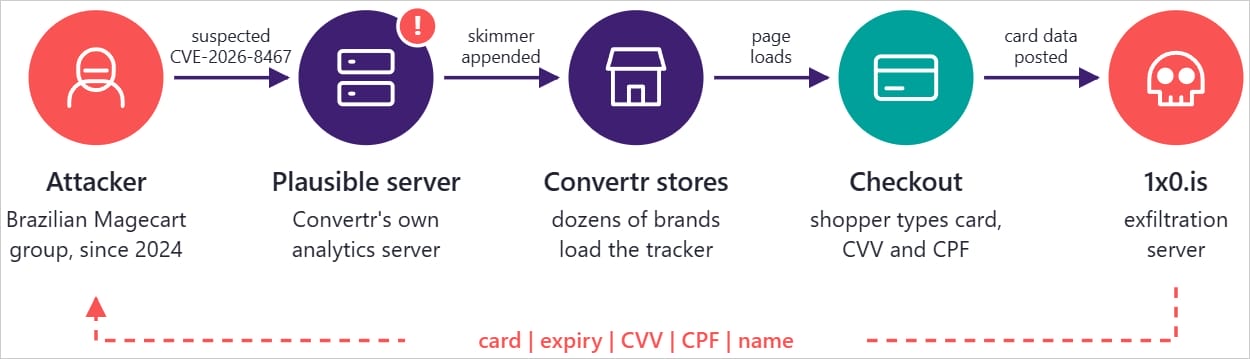
The core of the compromise involved the clandestine modification of a shared analytics script, specifically a Plausible tracker file, hosted on a self-managed server operated by Convertr. Plausible, an open-source alternative to Google Analytics, became the unwitting conduit for data exfiltration due to a suspected vulnerability in Convertr’s specific installation. This attack vector allowed the criminals to deploy malicious code that activated on the checkout pages of all merchants utilizing the Convertr platform, seamlessly harvesting payment details as customers completed their purchases. The widespread impact is significant, given that Convertr powers online stores for dozens of major fashion brands across Brazil, facilitating an estimated R$2 billion (approximately $370 million USD) in annual sales.
The Anatomy of a Supply Chain Attack: Exploiting Trust and Infrastructure
At its heart, this incident exemplifies a supply chain attack, a type of cyberattack that targets less secure elements in an organization’s supply chain to gain access to the main target. In this scenario, Convertr’s self-hosted Plausible analytics system served as the vulnerable link. Rather than directly breaching each individual online store powered by Convertr, the attackers strategically targeted a single point of failure that propagated their malicious code across the entire network of client websites. This approach is highly efficient for attackers, maximizing potential data theft with minimal effort compared to individual site compromises.
Security researchers from a leading e-commerce cybersecurity firm identified the campaign on October 24, tracing its origins to a Brazilian criminal group. This syndicate’s prior activities suggest a specialized expertise in compromising e-commerce environments, indicating a deliberate and targeted approach to this lucrative sector. The group’s methodology, involving the injection of skimmers into widely used analytics scripts, mirrors the tactics of well-known Magecart groups, which have plagued online retailers globally for years. These groups specialize in "carding," the automated theft of payment card data from compromised websites, often by manipulating JavaScript files loaded during the checkout process.
The Plausible Vulnerability: A Gateway for Data Theft
The specific point of entry for the attackers is suspected to be CVE-2026-8467, an unauthenticated command-execution vulnerability affecting Convertr’s outdated Plausible Community Edition installation. While this remains unconfirmed by official sources, the exploitation of such a vulnerability would grant attackers initial access to the server, enabling them to modify or inject malicious scripts. Unauthenticated command execution flaws are particularly dangerous as they allow unauthorized individuals to execute arbitrary code on a server without needing any credentials, essentially bypassing authentication mechanisms entirely. If exploited, this would have provided the necessary foothold for the attackers to manipulate the legitimate Plausible analytics tracker.

Once initial access was secured, the attackers injected their malicious JavaScript skimmer into the Plausible analytics tracker file. This file, being a standard component loaded on the checkout pages of all Convertr-powered merchants, became the perfect vehicle for widespread data collection. The beauty, from an attacker’s perspective, lies in the stealth: the malicious code piggybacks on a legitimate and expected resource, making it difficult for standard website monitoring tools to flag it as anomalous. The skimmer would then lie dormant until a user navigated to a checkout page, at which point it would activate, silently siphoning off critical payment details.
Evolving Sophistication: From Generic to Targeted Skimming
Initially, the deployed skimmer utilized generic patterns to identify and extract payment card data. This approach typically involves looking for common field names associated with credit card numbers, expiration dates, and CVV codes across various payment gateways. However, by October 26, the attackers demonstrated an increased level of sophistication. They pushed an updated version of the skimmer specifically engineered to target Convertr’s exact payment API field names. This refinement indicates a deeper understanding of Convertr’s underlying payment processing architecture and a deliberate effort to maximize the efficiency and accuracy of data exfiltration.
Targeting specific API field names makes the skimmer more robust and less prone to errors or detection. Generic patterns can sometimes miss data if a merchant uses slightly unconventional field names or layouts. By tailoring the skimmer to Convertr’s precise payment API, the attackers ensured a higher success rate in capturing complete and accurate payment card details. The injected skimmer was meticulously configured to steal a comprehensive array of data types from checkout pages, including but not limited to: full payment card numbers, cardholder names, expiration dates, security codes (CVV/CVC), billing addresses, and potentially other personal identifiable information (PII) like email addresses and phone numbers. This breadth of stolen data significantly increases the potential for financial fraud and identity theft against affected consumers.
Implications for E-commerce and Consumer Trust
The implications of such a widespread compromise are far-reaching. For the dozens of major fashion brands utilizing Convertr, the incident poses significant reputational damage, potential financial liabilities from fraud claims, and a loss of consumer trust. Rebuilding this trust can be a lengthy and costly process. Furthermore, the incident underscores the inherent risks associated with relying on third-party services and the critical need for rigorous security vetting and continuous monitoring of all external dependencies.
For consumers, the immediate threat is financial fraud. Individuals who made purchases using a credit or debit card on a Brazilian online store displaying the ‘checkout.convertr’ string in the checkout page address since October 24 are advised to contact their bank or card issuer immediately. Freezing or blocking the compromised card and monitoring bank statements for any suspicious activity are crucial first steps. The potential for identity theft also looms large, given the variety of personal data that may have been harvested.
Detection, Remediation, and Lingering Threats
In response to the incident, Convertr has reportedly taken swift action. Security researchers confirmed that the company "removed the skimmer and upgraded Plausible to a patched version," indicating a commitment to addressing the immediate threat and fortifying its infrastructure. Convertr also announced its intention to notify affected merchants and payment providers, a critical step in coordinating broader remediation efforts and informing potentially impacted consumers.
However, the nature of browser caching presents a lingering challenge. Even after the malicious script has been removed from Convertr’s servers, customers who previously visited compromised sites might still have cached versions of the malicious script stored in their web browsers. This means the skimmer could potentially remain active on their local machines for up to 24 hours or even longer, depending on cache settings. Therefore, security experts strongly recommend that customers clear their browser cache and cookies before placing any new orders, even after official confirmation that the threat has been neutralized. This proactive measure ensures that only the clean, updated script is loaded.
Protecting Against Evolving Digital Skimming Threats
This incident serves as a stark reminder of the persistent and evolving threat landscape facing the e-commerce sector. Digital skimming, often referred to as Magecart, continues to be a highly effective method for cybercriminals to steal payment data. To mitigate these risks, a multi-faceted approach is essential:
- Enhanced Supply Chain Security: E-commerce platforms and merchants must implement rigorous security audits and continuous monitoring for all third-party scripts, plugins, and services. This includes regular vulnerability assessments of self-hosted components and ensuring timely patching.
- Regular Patching and Updates: Outdated software, as potentially highlighted by the CVE-2026-8467 vulnerability, provides an easy entry point for attackers. Strict patching policies and automated update mechanisms are paramount.
- Content Security Policy (CSP): Implementing a robust CSP can significantly restrict which scripts are allowed to execute on a website and where they can send data, making it harder for skimmers to operate and exfiltrate information.
- Subresource Integrity (SRI): For critical third-party scripts, SRI ensures that the files loaded by a browser have not been tampered with. If the script’s hash doesn’t match the expected value, the browser will refuse to execute it.
- Behavioral Analytics and Anomaly Detection: Advanced security solutions that monitor website behavior for unusual script activity or data exfiltration patterns can help detect skimmers more rapidly.
- Consumer Education: Educating consumers on best practices, such as regularly monitoring bank statements, using strong and unique passwords, and being cautious of unsolicited communications, is vital.
- Virtual Payment Cards: A highly effective protection measure for online shoppers is the use of disposable virtual cards. These cards generate unique, temporary numbers for each transaction or can be set with specific spending limits and expiry dates, significantly limiting potential fraud if the primary card details are compromised.
The Convertr incident underscores that no part of the digital supply chain is immune to attack. As e-commerce continues to grow, so too will the sophistication and persistence of cybercriminals targeting its vulnerabilities. A proactive, layered security strategy, coupled with rapid incident response and clear communication, remains the most effective defense against these pervasive threats.




 Lisa Mariana

 Aura Kasih



 Ayu Aulia
