Safa Marwah
A significant security vulnerability affecting specific Calix residential router models, widely deployed by major U.S. broadband providers, allows unauthorized remote actors to establish persistent port-forwarding rules, thereby exposing internal network devices and sensitive content directly to the public internet. This unauthenticated flaw circumvents fundamental network address translation (NAT) and firewall protections, creating a direct conduit into otherwise private home networks.
Designated as CVE-2026-75501, the vulnerability stems from a critical lapse in authentication controls within devices running EXOS/6.6.47 firmware, specifically the Calix GS7 XGS (GS5239XG) residential gateway. This oversight permits external attackers to manipulate router configurations without requiring any prior authentication or user interaction. The discovery was made by security researcher Brian Khan Quintana, who, following unsuccessful attempts to engage the vendor, coordinated a public disclosure through the Carnegie Mellon CERT Coordination Center (CERT/CC) after exhausting responsible notification avenues. The absence of an official patch leaves a substantial number of end-users susceptible to potential exploitation.
Technical Underpinnings of the Exposure
The core of CVE-2026-75501 lies in the router’s inadvertent exposure of its Universal Plug and Play (UPnP) WANIPConnection SOAP service on the public-facing Wide Area Network (WAN) interface via TCP port 5000. UPnP is a set of networking protocols designed to enable devices to discover each other and establish functional network services, often used for automatic port forwarding in applications like gaming or video conferencing. While intended for convenience within a local network, exposing this control endpoint directly to the internet without any access restrictions represents a severe security misconfiguration.
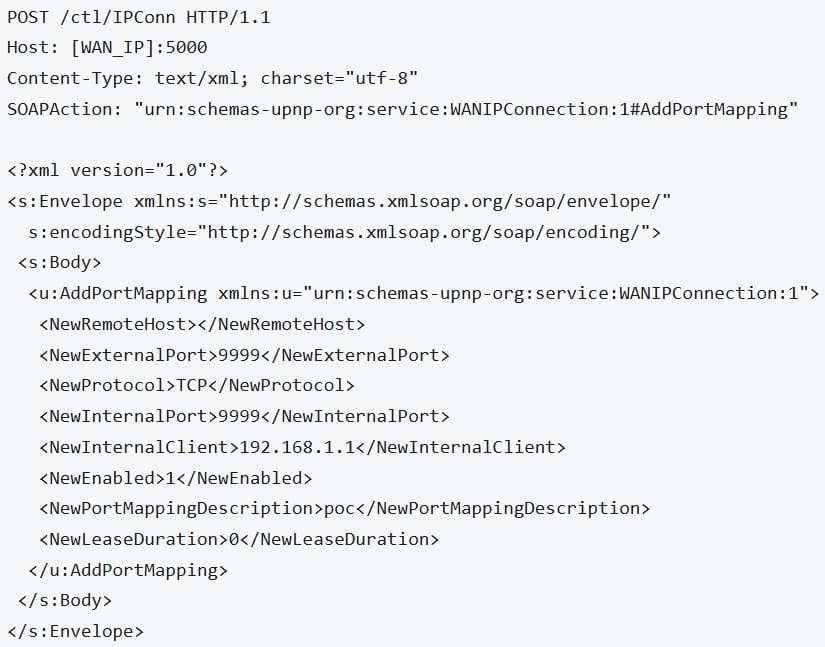
Attackers can leverage this exposed service by sending unauthenticated Simple Object Access Protocol (SOAP) requests to the device. These requests, crafted externally from anywhere on the internet, can instruct the router to perform various actions, including:
- Adding Port Mappings: Creating new rules that forward traffic from a specified public port on the router to a specific port and IP address of an internal device.
- Deleting Port Mappings: Removing existing port-forwarding rules, potentially disrupting legitimate services or clearing traces of malicious activity.
- Enumerating Port Mappings: Discovering currently active port-forwarding rules, providing intelligence about the internal network’s configuration and exposed services.
- Querying External IP Address: Retrieving the router’s public IP address, a foundational step for targeted attacks.
Crucially, the vulnerability allows for the creation of port-forwarding rules that lack an expiration, meaning they persist even after the router is rebooted or power-cycled. This permanence ensures that once an attacker establishes a malicious rule, it remains active indefinitely unless manually removed by the user or an ISP. This persistent access bypasses the fundamental security role of Network Address Translation (NAT), which normally shields internal IP addresses and services from direct exposure to the internet, and effectively neutralizes the router’s built-in firewall for the specified ports and devices.
Profound Implications for Network Security and User Privacy
The ability for an unauthenticated remote attacker to dictate port-forwarding rules has far-reaching and severe consequences for affected users. By creating these unauthorized pathways, attackers can directly access devices within the home network that were previously protected by the router’s NAT and firewall. This transforms a seemingly secure private network into an open target for a multitude of malicious activities.

Specific internal devices that become vulnerable include:
- Network-Attached Storage (NAS) Devices: Often contain vast amounts of personal data, family photos, financial documents, and backups. Exposure can lead to data theft, ransomware deployment, or data manipulation.
- IP Cameras and Surveillance Systems: Direct access can enable unauthorized live viewing, recording, and retrieval of historical footage, leading to profound privacy breaches and potential for home invasion planning.
- Smart Home (IoT) Devices: Thermostats, smart locks, lighting systems, and other connected appliances could be remotely controlled or monitored, compromising physical security and privacy.
- Administrative Interfaces: Management portals for other network devices, printers, or even the router itself (if internal access is less restricted) could become accessible, providing further avenues for lateral movement and deeper compromise.
- Personal Computers and Servers: While less common in typical home setups, any internal server or device running specific services could be directly targeted for exploitation.
The ease of exploitation is particularly alarming. As highlighted by the researcher, "one unauthenticated request from anywhere in the world is enough to open a permanent hole through the router’s firewall to any device inside the house. No password. No prompt. Nothing on screen. The rule survives a reboot." This stark reality underscores the critical nature of the flaw, presenting an extremely low barrier for entry for malicious actors. Potential attack scenarios range from data exfiltration and unauthorized surveillance to the recruitment of devices into botnets for distributed denial-of-service (DDoS) attacks, or even serving as an initial foothold for more sophisticated targeted attacks against individuals or their employers.
Vendor Response and the Coordinated Disclosure Process
The vulnerability’s disclosure trajectory highlights a critical aspect of cybersecurity: the delicate balance between responsible notification and public safety. Brian Khan Quintana initiated contact with Calix on June 7, seeking to report the flaw privately and allow time for a patch development. However, after repeated attempts yielded no response from the vendor, the researcher escalated the matter to the Carnegie Mellon CERT Coordination Center. CERT/CC plays a crucial role in such situations, acting as an impartial third party to facilitate communication between researchers and vendors, coordinate vulnerability disclosures, and issue public alerts when necessary to protect the wider internet community.
The decision by CERT/CC to proceed with a public disclosure, followed by Quintana’s publication of technical details, indicates a determination that the public interest in awareness outweighed the potential risks of early exposure, primarily due to the vendor’s unresponsiveness. A lack of timely vendor engagement in addressing critical vulnerabilities can exacerbate risks, leaving a vulnerable population exposed for extended periods. It also places a burden on end-users and internet service providers (ISPs) to implement workarounds in the absence of an official fix. As of the time of this analysis, Calix has not publicly acknowledged the flaw, nor has it provided a timeline for a patch or commented on the scope of affected devices beyond the initially identified model.
Market Reach and Scope of Potential Impact
Calix holds a significant position within the U.S. broadband provider market, supplying networking equipment to a broad spectrum of entities. Its clientele includes major telecommunications companies and regional providers such as Cox Communications, Brightspeed, ALLO, CityFibre, and Conexon. This extensive deployment footprint implies that a substantial number of households could be relying on vulnerable Calix hardware.
The specific affected model, the GS5239XG, is also marketed under the branding "GigaSpire 7u10txg." This device is presented as a premium, cutting-edge gateway, combining advanced Wi-Fi 7 capabilities with an integrated XGS-PON fiber terminal. Its status as a newer, high-performance offering suggests that it is likely to be deployed in new installations or as an upgrade for existing customers seeking the latest in connectivity technology. The prevalence of such advanced gateways in home networks means that a wide cross-section of internet users, including those with sophisticated smart home setups or demanding online activities, could be inadvertently exposed. The sheer volume of these devices in active service underscores the urgency of addressing this vulnerability.

Mitigation Strategies and Long-Term Remediation
Given the absence of an official patch, immediate action falls to end-users and their internet service providers to mitigate the risk posed by CVE-2026-75501. The primary recommended workaround involves disabling the Universal Plug and Play (UPnP) functionality through the router’s administrative interface. This setting is typically found under sections like "Advanced," "Security," or "NAT Forwarding." Disabling UPnP will prevent unauthorized external requests from creating new port-forwarding rules, effectively closing the vulnerable port 5000 on the WAN interface.
However, disabling UPnP is not without its considerations. Many common applications, particularly online games, some streaming services, and certain peer-to-peer applications, rely on UPnP for automatic port opening to function optimally. Users who disable UPnP might experience connectivity issues with these services. In such cases, the alternative is to configure specific port-forwarding rules manually for necessary applications. While more cumbersome, manual port forwarding offers a controlled and secure method of exposing only the required services, rather than leaving the UPnP daemon open to unauthenticated requests.
Furthermore, CERT/CC notes that in some instances, ISPs may have locked down certain administrative settings on customer-provided routers, including the ability to disable UPnP. In such scenarios, users are advised to contact their internet service provider directly and request that UPnP be deactivated on their gateway device. ISPs bear a significant responsibility in this situation, not only for deploying potentially vulnerable hardware but also for assisting customers in securing their networks and, ultimately, for pushing out firmware updates once they become available from Calix.
The long-term and definitive solution for this vulnerability rests squarely with Calix: the development and release of a firmware patch that addresses the missing authentication controls and ensures the UPnP WANIPConnection SOAP service is not exposed on the WAN interface without proper access restrictions. Until such a patch is widely deployed, the risk to affected users remains elevated.
Broader Context: The Perils of UPnP and Router Security
This Calix vulnerability serves as a potent reminder of the inherent security risks associated with UPnP, particularly when improperly implemented or configured. While designed for convenience, UPnP has a long history of being a security weak point in consumer-grade networking equipment. Its "plug and play" nature often prioritizes ease of use over robust security, leading to default configurations that are overly permissive. Historical vulnerabilities in UPnP implementations have frequently allowed attackers to bypass firewalls, gain access to internal devices, and even compromise the routers themselves. Many security experts advocate for disabling UPnP by default on all routers due to these persistent risks.
The incident also highlights the broader challenges in securing the modern connected home. As homes become increasingly filled with smart devices, cameras, and networked appliances, the router acts as the primary gatekeeper, becoming a critical attack surface. The security posture of these gateway devices is paramount, yet they are often overlooked by consumers and, at times, by manufacturers. This vulnerability underscores the need for:
- Secure-by-Design Principles: Hardware and software vendors must integrate security considerations from the earliest stages of product development.
- Robust Vulnerability Management: Vendors need clear, accessible channels for security researchers to report flaws and a commitment to rapid patch development and deployment.
- ISP Responsibility: Internet service providers must prioritize the security of the equipment they deploy in customer homes, including regular firmware updates and proactive communication about vulnerabilities.
- User Awareness: End-users need to be educated about basic network security practices, such as disabling unnecessary services, understanding router settings, and keeping firmware updated.
Future Outlook and Recommendations
Given the public availability of technical details and proof-of-concept information, it is highly probable that malicious actors will attempt to exploit CVE-2026-75501. The ease of exploitation and the potential for significant privacy and data compromise make this an attractive target. Therefore, immediate action from affected users and ISPs is crucial.
For users of Calix GS7 XGS (GS5239XG) / GigaSpire 7u10txg routers, the strongest recommendation is to immediately disable UPnP through the administrative interface. If this option is unavailable, contact your ISP without delay to request its deactivation. Regularly check for firmware updates from your ISP or Calix, and maintain strong, unique passwords for your router’s administrative access. Consider network segmentation for critical devices if technically feasible.
For Internet Service Providers utilizing these Calix devices, proactive measures are imperative. This includes urgent communication with affected customers, providing clear instructions on how to disable UPnP, and facilitating this process where settings are locked. Furthermore, ISPs must actively pressure Calix for a prompt firmware patch and establish mechanisms for its rapid deployment to customer devices.
For Calix, a swift and transparent response is essential to restore trust and mitigate the widespread risk. This includes acknowledging the vulnerability, providing a definitive timeline for a firmware patch, and clarifying the full scope of affected products. A robust and accessible vulnerability disclosure program is also critical for future security.
The unpatched Calix flaw serves as a stark reminder that the security of our digital lives begins at the network perimeter. As our homes become increasingly connected, the integrity and security of the devices that facilitate these connections must remain a top priority for manufacturers, service providers, and end-users alike.



 Aura Kasih
 Lisa Mariana