Aura Kasih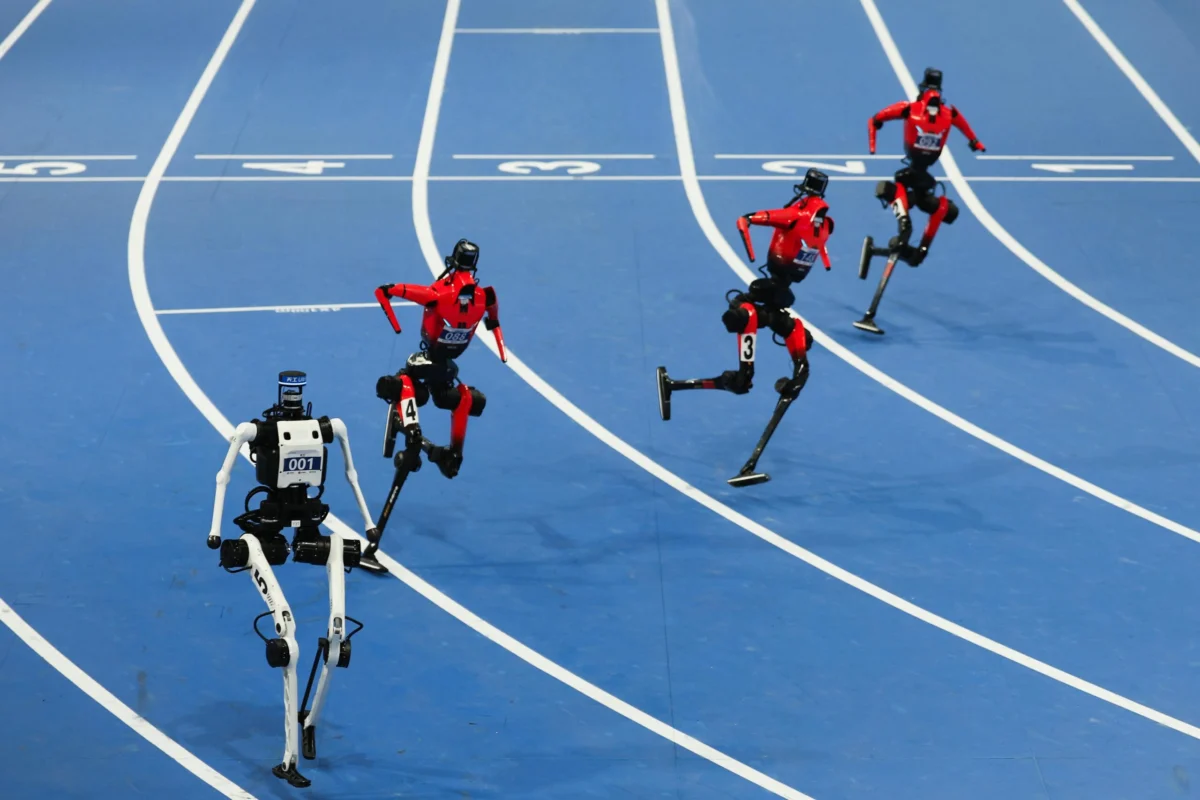
A new era in athletic performance has dawned as advanced humanoid robots have shattered established human speed records, most notably Usain Bolt’s iconic 100-meter dash time, signaling a profound shift in what is achievable in both technology and physical exertion.
The global stage of the World Humanoid Robot Games, held in Beijing, has become the crucible for unprecedented robotic athletic feats. In a remarkable display of engineering prowess, the "Tiangong Ultra," developed by the Beijing Humanoid Robot Innovation Center, blazed through the 100-meter sprint in a mere 9.39 seconds during a preliminary heat. This astonishing performance eclipses the previous world record of 9.58 seconds, a benchmark that had stood as a testament to human peak physical capability since Usain Bolt’s legendary run in 2009. Hot on Tiangong Ultra’s heels was the "Lightning" robot, engineered by Honor, which clocked an equally impressive 9.47 seconds, demonstrating a rapidly intensifying competitive landscape among leading robotics developers.
These groundbreaking achievements are not isolated incidents but rather highlights from an increasingly sophisticated international competition, often likened to an "Olympics for robots." Launched in 2025, the World Humanoid Robot Games has rapidly evolved into a premier platform for showcasing advancements in bipedal robotics. This year’s iteration has drawn an impressive contingent of 2,056 robots representing 16 nations, all vying for supremacy across a diverse array of disciplines. Beyond the sprint, the games feature events designed to test the agility, power, and strategic capabilities of these artificial athletes, including jumping competitions, simulated football matches, and even boxing bouts. The sheer scale and scope of the event underscore the global commitment to pushing the boundaries of humanoid robotics.
The implications of Tiangong Ultra’s performance extend beyond the 100-meter dash. The same robot demonstrated exceptional endurance and speed by completing the 400-meter race in an astonishing 38.16 seconds. This time significantly outperforms the existing human world record of 43.03 seconds, set by Wayde van Niekerk in 2016. The dual record-breaking performances by Tiangong Ultra highlight the multifaceted advancements in locomotion, energy efficiency, and control systems being achieved in humanoid robotics. This suggests that the development trajectory is not merely focused on raw speed but also on sustained performance across various distances and challenges.
The spectacle of these robotic athletes in motion offers a unique, albeit sometimes disquieting, glimpse into the future of automation. While human athletes train with dedication and artistry, the robotic competitors present a different paradigm. Their locomotion, optimized for speed and efficiency, can appear jarring and unnatural to human observers. Videos circulating from the event often capture these machines colliding with padded barriers at high velocities, requiring immediate retrieval by specialized equipment, sometimes resembling a medical transport. This stark contrast between the precision of their recorded times and the often-ungainly nature of their physical execution underscores the fundamental differences in their design and operational principles compared to biological organisms. The controlled chaos of their landings and subsequent recovery processes serves as a visual reminder of the engineering challenges inherent in creating robots that can navigate and perform in dynamic, physical environments.
The development of humanoid robots capable of exceeding human athletic benchmarks is a direct consequence of decades of intensive research and development across multiple scientific and engineering disciplines. The pursuit of artificial general intelligence (AGI) has spurred innovations in areas such as advanced sensor technology, sophisticated artificial intelligence algorithms for motion planning and adaptation, novel materials science for lighter and stronger chassis, and breakthroughs in power generation and energy management. The complex interplay of these fields has enabled the creation of robots that can not only mimic human movement but, in specific contexts, surpass human physical limitations.

The progress observed at the World Humanoid Robot Games represents a critical inflection point. For years, humanoid robots have been primarily conceptualized for tasks in controlled environments, such as manufacturing or logistics. However, the increasing ability of these machines to perform in dynamic and unpredictable settings, as evidenced by their athletic prowess, signifies a broader potential for their deployment in a wider range of applications. This includes disaster response, exploration of hazardous environments, personal assistance for individuals with mobility challenges, and even entertainment and sports.
The competitive nature of the World Humanoid Robot Games serves as a powerful catalyst for innovation. By establishing clear benchmarks and fostering a spirit of inter-national competition, the event encourages researchers and developers to accelerate their efforts. The investment by corporations and governments in this field is substantial, driven by the anticipation of future commercial and societal benefits. The data generated from these competitions—performance metrics, failure analysis, and optimization strategies—provides invaluable feedback for refining designs and algorithms. This iterative process of development, testing, and refinement is crucial for overcoming the remaining hurdles in humanoid robotics.
One of the most significant ongoing challenges in humanoid robotics is achieving a level of agility and adaptability comparable to humans. While robots can be programmed to execute specific movements with remarkable precision, replicating the nuanced adaptability of human locomotion—the ability to adjust balance on uneven terrain, react to unexpected obstacles, or perform complex acrobatic maneuvers—remains a formidable task. The development of advanced proprioception (the sense of the relative position of one’s own parts of the body and strength of effort being employed in movement) and exteroception (the ability to sense external stimuli such as touch, temperature, and pain) is paramount. Furthermore, the integration of sophisticated machine learning models that allow robots to learn from experience and adapt their movements in real-time is essential for true bipedal mastery.
The energy requirements for such dynamic movements also present a considerable engineering challenge. Human athletes draw upon highly efficient biological energy systems. Replicating this efficiency in artificial systems, particularly for robots engaged in high-intensity activities, requires breakthroughs in battery technology, energy harvesting, and power management. The current reliance on relatively heavy and short-lived battery packs limits the duration and intensity of robotic performances. Future advancements in solid-state batteries, wireless power transfer, and more efficient motor designs will be critical for enabling robots to operate for extended periods without frequent recharging.
The ethical and societal implications of robots surpassing human athletic records are profound and warrant careful consideration. As robots become increasingly capable in physical domains, questions arise regarding the future of human employment in physically demanding sectors, the potential for new forms of competition and entertainment, and the very definition of athletic achievement. The development of humanoid robots that can perform complex physical tasks also raises concerns about safety and accountability, particularly in scenarios where human interaction is involved. Establishing robust regulatory frameworks and ethical guidelines will be crucial to ensure that these technological advancements are harnessed for the benefit of society.
Looking ahead, the trajectory of humanoid robotics suggests a future where these machines will play an increasingly integral role in various aspects of human life. The athletic achievements witnessed at the World Humanoid Robot Games are not merely technological curiosities but indicators of a broader paradigm shift. As robots become more adept at navigating and interacting with the physical world, their potential applications will expand exponentially. The insights gained from these competitions will undoubtedly translate into more capable, efficient, and versatile robots, poised to redefine industries, assist humanity in unprecedented ways, and challenge our very understanding of what it means to be capable. The pursuit of robotic excellence in athletic endeavors is, in essence, a quest to unlock new frontiers of artificial intelligence and mechanical engineering, with far-reaching consequences for the future of civilization.




 Lisa Mariana
 Safa Marwah
 Ayu Aulia