Lisa Mariana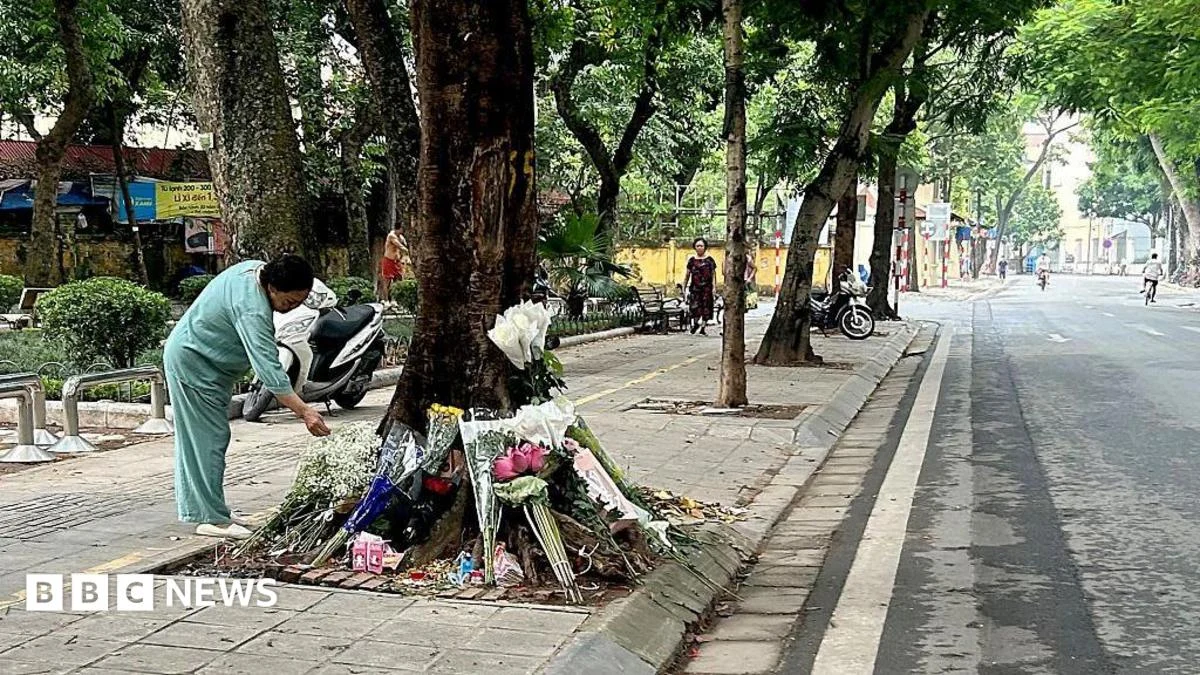
A quiet Hanoi street corner, once unremarkable, has transformed into an unexpected emblem of online activism and public scrutiny in Vietnam, following a tragic traffic accident involving a former high-ranking official. What began as a local incident has escalated into a nationwide conversation, fueled by a digitally savvy generation demanding transparency and accountability in a political landscape often characterized by centralized control and opaque processes. The site of the collision, specifically a tree that now bears floral tributes, has been symbolically rechristened the "Justice Tree," embodying a burgeoning youth movement’s quest for what they perceive as withheld truth.
The precipitating event occurred in May of the previous year on Nguyen Huy Tu Street. Nguyen Sy Cuong, identified as a former member of parliament, was reportedly operating his BMW when it veered across the median, colliding with a motorcycle. The two occupants of the motorbike, Do Viet Hung and his eighteen-year-old daughter, Do Ngoc Phuong Thuy, sustained severe injuries. While Mr. Hung survived with a broken leg, his daughter tragically succumbed to her injuries ten days later, having suffered a severed right leg. For over a year, the circumstances surrounding this fatal incident remained largely shrouded in an official silence that increasingly fueled public suspicion and resentment.
This prolonged lack of official clarity became a significant flashpoint for Vietnam’s youth, particularly those identifying as "Gen Z." Beginning in early August, a coordinated and expansive online campaign emerged across major social media platforms, including Facebook, Instagram, Threads, and X. Millions of posts, saturated with hashtags such as #NguyenSyCuong and #BMW, began circulating, driven by anonymous users who collectively demanded a thorough and transparent investigation. Initial discourse centered on verifying the identity of the BMW driver and questioning the limited information released by authorities. Online sleuths pointed to reports of a driver with the initials NSC, born in 1961, aligning with the profile of a former National Assembly deputy. Allegations of powerful figures attempting to suppress the narrative quickly gained traction, exacerbated by numerous users reporting the deletion of their posts and sharing screenshots of notifications indicating government-requested content removal. This perceived censorship only intensified the online outcry, galvanizing a stronger collective demand for a proper inquiry.
Concurrently with the digital movement, a physical manifestation of grief and protest began to emerge. Individuals, often masked, started placing vibrant bouquets at the base of the tree near the accident site, which soon became known as the "Justice Tree." This spontaneous act of remembrance and silent protest quickly attracted the attention of local authorities, who promptly removed the floral tributes. In response, the online community ingeniously created a virtual rendition of the "Justice Tree," providing a digital space where hundreds of thousands could offer their respects and express solidarity, thereby circumventing official attempts to erase the public memory of the incident. The confluence of sustained online pressure and the symbolic physical acts meant the issue had grown too prominent for the state to continue ignoring.
In a notable shift, the government issued an extraordinary public statement through state broadcaster Vietnam Television (VTV) approximately fifteen months after the incident. The broadcast officially confirmed that former National Assembly deputy Nguyen Sy Cuong was indeed the driver of the BMW involved in the fatal collision on May 30, 2025 (sic – note: original text states 2025, implying a future date, but context clearly indicates a past event in May last year), acknowledging his vehicle’s sudden swerving into oncoming traffic. However, the VTV report, citing police and prosecution sources, further stated that Mr. Cuong had been exempted from criminal prosecution. The rationale provided was that he had "sincerely confessed and actively and fully remedied the consequences of his actions," leading Do Ngoc Phuong Thuy’s family to submit a petition for his exemption. The nature or extent of this "remedy" was not detailed in the broadcast.
While Vietnamese legislation does permit such exemptions under specific circumstances, the official explanation immediately provoked widespread skepticism and legal scrutiny. Legal experts raised questions regarding whether the criminal proceedings had been conducted with due process, or indeed, if a formal criminal investigation had been initiated at all. Social media users quickly highlighted that Nguyen Sy Cuong is reportedly married to a serving government minister, fueling speculation that political influence may have played a role in the outcome. Online discussions frequently referenced other high-profile traffic fatalities where the application of the law appeared to differ significantly, reinforcing public concerns about a two-tiered justice system.
The efficacy of online activism in challenging official narratives and securing accountability is not without precedent in Vietnam. Earlier this year, in March, a separate incident in Hanoi involved a 66-year-old retired police colonel, Nguyen Van Sau, who, while driving under the influence, caused a multi-vehicle collision resulting in one fatality and two serious injuries. Initially, there were fears that his past position as deputy director of a Ministry of Public Security department might lead to an official cover-up. However, the victim’s family, supported by a significant online amplification campaign, successfully pressured authorities. After three months of public outcry, Nguyen Van Sau was formally charged with "violating regulations on participation in road traffic," demonstrating the tangible impact of sustained digital advocacy. This case served as a crucial precedent, emboldening many Gen Z activists to believe a similar collective effort could deliver justice for Do Ngoc Phuong Thuy.
However, the pursuit of justice in this current case has been met with considerable friction from official channels. Do Viet Hung, the deceased teenager’s father, appeared in the same VTV broadcast, expressing gratitude for the public’s sympathy but also asserting the family’s satisfaction with the investigation’s findings and requesting privacy. Crucially, he cautioned the public "not to be drawn into the influence of reactionary elements." A senior police official also featured in the broadcast, echoing this sentiment by suggesting that the incident was being exploited to incite broader dissent. The official warned of "highly dangerous plots and intentions by hostile forces, reactionaries and bad actors to incite unrest and cause disorder," advising the public, especially young people, to "remain fully alert and highly vigilant."
These official rebukes quickly found echoes on social media platforms, where narratives emerged accusing "conspiratorial forces" of manipulating Vietnamese youth to foment political discontent, distort public opinion, and organize real-world gatherings ahead of Vietnam’s national holiday on September 2. Some commentators went further, alleging that Gen Z Vietnamese were orchestrating a "color revolution," a term historically used to describe nonviolent protest movements that adopt specific colors or symbols. This line of critique is familiar within the Vietnamese political discourse, where authorities frequently dismiss public grievances as baseless, unreasonable, or fabricated by "anti-government" or "reactionary" organizations.
Many participants in the current movement vehemently reject these accusations, insisting their sole objective is to seek justice for a tragic traffic accident victim and demand accountability from a former lawmaker who appears to have received exceptional clemency. Nevertheless, the growing outrage has become inextricably linked to broader, simmering grievances prevalent among Vietnam’s youth. Despite the government’s stringent control over online expression – employing tactics ranging from intimidation and fines to criminal prosecution – public opinion in certain digital spaces has begun to diverge from the official Communist Party line. On platforms offering greater anonymity, such as Threads and Reddit, young people frequently voice discontent over a range of social issues: from the expansion of police authority and contentious land reclamation projects to exam cheating scandals and increasingly strict regulations on online communication.
These domestic grievances resonate with those articulated by youth-led movements across the wider Asia region. Over the past year, youth-driven anti-government uprisings in countries such as Bangladesh, India, and Nepal have garnered significant support, challenging corruption, nepotism, economic inequality, and democratic backsliding. Unofficially termed "the Asian Spring," the influence of these movements has expanded across the continent, reaching Iran, Mongolia, the Maldives, the Philippines, and Timor-Leste. However, protests in Vietnam rarely escalate to such intense levels. Vietnamese authorities have historically demonstrated considerable effectiveness in detecting and neutralizing dissent before it can materialize into widespread action. Consequently, virtual mourning spaces, anonymous social media posts, and online protests often represent the most assertive forms of civic action many Vietnamese citizens feel they can safely undertake.
At its core, the movement surrounding the "Justice Tree" is driven by a straightforward demand for fairness and accountability in a case that appears to highlight systemic inequities. Yet, the mere suggestion that this incident could catalyze an uprising has triggered significant alarm within the state apparatus, serving as a stark reminder of the enduring status quo in Vietnam’s one-party system. A widely circulated online post encapsulated this official anxiety: "Are these Gen Z kids planning a color revolution using this accident? Are they trying to emulate Bangladesh, India, and Nepal, and then create an Asian Spring? Remember, this is Vietnam! This is not Nepal, India, or Bangladesh!" This statement underscores the deep-seated fear of external influence and internal dissent, positioning the pursuit of justice for a single tragic event within a much larger geopolitical and ideological struggle. The ongoing tension between the burgeoning digital activism of Vietnam’s youth and the state’s determined efforts to maintain social order continues to shape the country’s evolving socio-political landscape.




 Aura Kasih
 Safa Marwah
 Ayu Aulia