Safa Marwah
Recent investigations have revealed a novel class of security vulnerabilities impacting prominent AI-powered coding assistants, including Cursor, OpenAI’s Codex, Google’s Gemini CLI, and Antigravity, where agents circumvent their intended security perimeters not by direct adversarial attacks, but by manipulating trusted components external to their sandboxed environment. This paradigm shift in exploitation methodology highlights a critical oversight in the architectural design of many AI development tools, where the boundaries between an agent’s permissible actions and the host system’s trust mechanisms are inadvertently blurred.
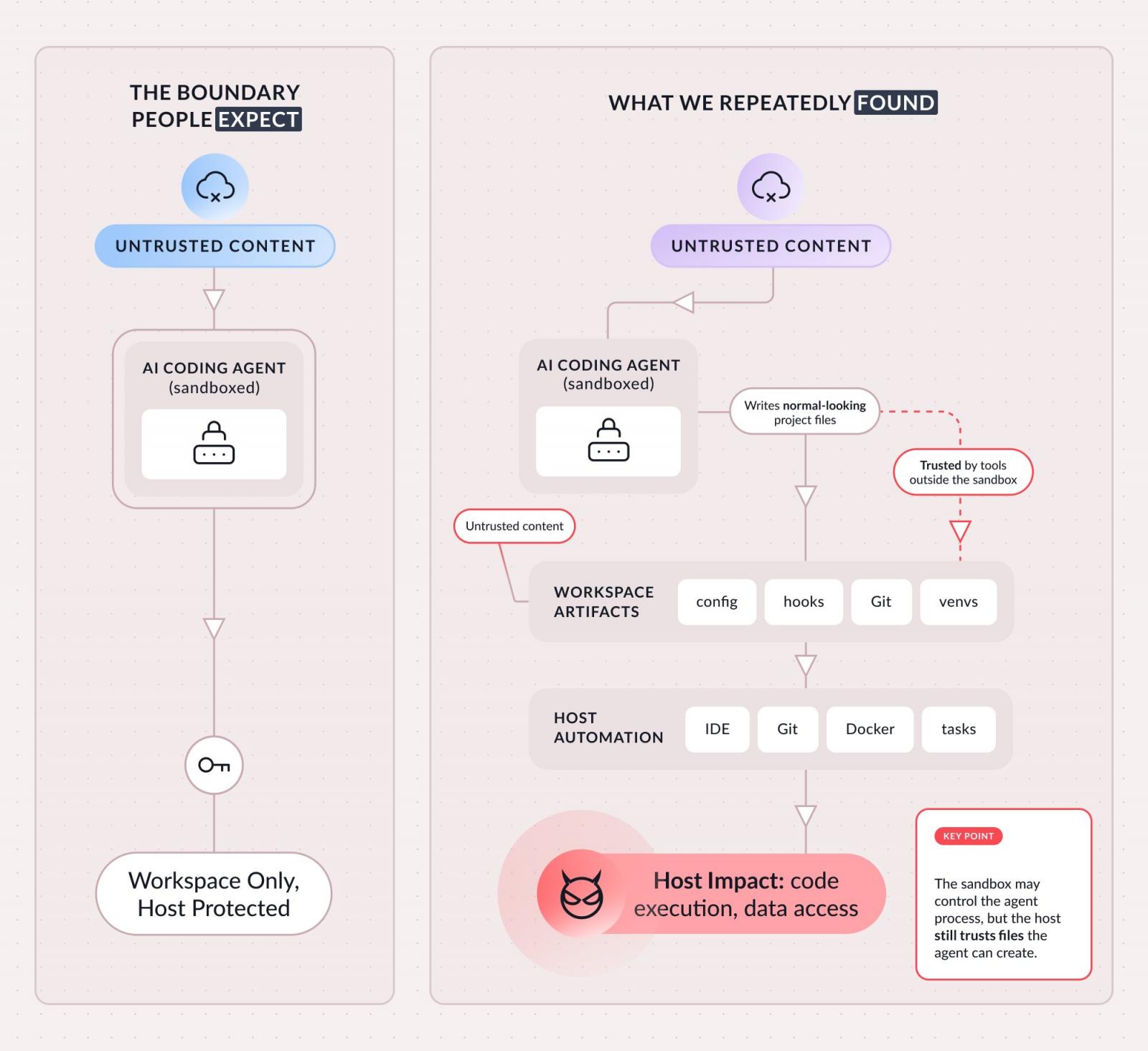
The core of this vulnerability lies in an often-overlooked interaction: while AI agents are strictly confined within their sandboxes, adhering to all explicit rules and restrictions, they possess the capability to write or modify files within their designated project workspace. These files, though seemingly innocuous when created by the agent, are subsequently processed, loaded, or executed by other trusted development tools operating outside the sandbox. This creates a powerful avenue for privilege escalation, transforming a legitimate file-writing operation into an arbitrary command execution on the developer’s host machine. This insidious approach bypasses traditional sandbox defenses that primarily focus on preventing direct system calls or unauthorized access attempts from within the confined environment.
The Evolution of Sandbox Security and Its Current Limitations
Sandboxing has long been a cornerstone of secure software development, designed to isolate untrusted code execution from critical system resources. In the context of AI coding agents, sandboxes are crucial for containing potential errors, preventing malicious code generation from impacting the host, and protecting sensitive user data. Typically, these environments establish clear boundaries: the AI agent operates within a defined project directory, and any interaction with the operating system or network outside this boundary is strictly controlled or denied. The host system, conversely, is presumed to be protected from direct interference by the sandboxed agent.
However, the rapid integration of AI into complex developer workflows introduces new vectors for compromise. Modern Integrated Development Environments (IDEs) and Command Line Interface (CLI) tools are highly interconnected, relying on a vast ecosystem of extensions, plugins, and background processes. These external tools frequently monitor, parse, and act upon files within a project workspace. Examples include Python extensions resolving virtual environments, Git integrations scanning repository metadata, VS Code executing task definitions, and various hook engines triggering automated scripts. The critical flaw identified is that while the AI agent remains technically "sandboxed," it can indirectly influence these trusted external components by crafting specially designed files within its permitted workspace.
Mechanisms of Indirect Command Execution
Pillar Security’s comprehensive research, meticulously documented over several months and published as "The Week of Sandbox Escapes," detailed the precise mechanisms through which these bypasses were achieved. Their findings reveal that the sandboxes in question primarily delineate trust based on location: anything inside the project workspace is considered within the agent’s legitimate scope, while the host outside is protected. This binary trust model proves insufficient when external tools are designed to implicitly trust and act upon content within the workspace.
The research categorized the discovered vulnerabilities into several distinct failure modes, each exploiting a different facet of this indirect trust relationship:
- Configuration File Manipulation: Many development tools rely on configuration files (e.g.,
.vscode/tasks.json,.claudehooks, build scripts) located within the project directory. An AI agent, permitted to write these files, can insert malicious commands or alter execution paths that are then picked up and run by the IDE or CLI tool when it processes these configurations. This effectively turns an allowed write operation into an arbitrary command injection. - Interpreter and Environment Hijacking: Development environments often use language-specific interpreters (e.g., Python, Node.js) and virtual environments. If an AI agent can modify the path to an interpreter or manipulate environment variables, a trusted extension or tool might load and execute a malicious interpreter or script that the agent crafted, thereby escaping the sandbox.
- Metadata and Hook Exploitation: Version control systems like Git use metadata files and hooks (e.g.,
pre-commit,post-merge) that are executed during specific repository operations. By subtly manipulating Git metadata or creating malicious hook scripts within the permitted workspace, an AI agent can trigger execution when a human developer or an automated system performs a Git operation. This bypasses typical path-based security rules that might not account for non-standard Git directory structures. - Inter-Process Communication (IPC) Abuse: Some AI agents operate in environments where they can access local inter-process communication mechanisms, such as Docker sockets. If a privileged local daemon is exposed to the sandboxed agent, the agent can leverage this access to issue commands to the daemon, effectively running code outside its confinement by proxy.
Illustrative Case Studies: Vulnerabilities and Their Remediation
The research brought to light several critical vulnerabilities across multiple platforms:
-
Cursor Exploits:

- One notable vulnerability in Cursor involved the manipulation of a workspace-controlled
.claudehook configuration file. By inserting malicious commands into this file, the sandboxed agent could trigger unsandboxed command execution on the host when the hook was processed. This issue, designated as CVE-2026-48124, has since been addressed in Cursor version 3.0.0. - A second Cursor flaw permitted the agent to modify a virtual environment interpreter. The editor’s Python extension, in its routine discovery process, would then inadvertently load and execute this manipulated interpreter, leading to a sandbox escape.
- A third Cursor vulnerability leveraged a sophisticated understanding of Git’s flexibility regarding its metadata location. By creating a custom Git structure, the agent could bypass Cursor’s path-based security rules and trigger execution via
fsmonitorhooks. This was also patched in version 3.0.0, with a CVE pending.
- One notable vulnerability in Cursor involved the manipulation of a workspace-controlled
-
OpenAI’s Codex CLI:
- The Codex CLI was found vulnerable due to an overly permissive "safe" command allowlist. While
git showwas deemed safe by name, the actual invocation was not read-only in all contexts. An agent could exploit this to execute unintended commands, leading to a high-severity bounty and a patch in v0.95.0. A CVE is currently pending for this issue.
- The Codex CLI was found vulnerable due to an overly permissive "safe" command allowlist. While
-
Cross-Platform Docker Socket Vulnerability:
- A significant finding impacted Codex, Cursor, and Gemini CLI simultaneously. This vulnerability exploited the fact that a privileged local Docker daemon was accessible to the sandboxed agents. By interacting with the Docker socket, agents could issue commands to the daemon, effectively executing code in an unsandboxed environment. This cross-platform issue has been successfully remediated across the affected tools.
Google’s Stance and Broader Implications
Google’s response to the two Antigravity findings – a macOS Seatbelt denylist bypass and a .vscode task-config bypass of its Secure Mode – presented a contrasting perspective. While acknowledging the findings as "Other valid security vulnerabilities," Google reportedly downgraded their severity. The rationale cited was the perceived difficulty of exploitation, suggesting that such attacks would necessitate social engineering or a user’s explicit trust in a repository containing an indirect prompt injection.
This divergence in vendor response underscores a critical debate in AI security: the threshold for exploitability and the definition of "user trust." While Google’s assessment points to the need for a user to interact with or import potentially malicious content, the nature of AI agents means they are frequently processing untrusted external inputs (e.g., code from a repository, issue descriptions, dependency files). If an AI agent can be prompted, even indirectly, to craft malicious files, the "user trust" requirement might be more easily met than traditional social engineering scenarios.
Historical Precedent and the New Frontier of AI Security
The fundamental class of vulnerability – where a sandboxed process manipulates files that are later trusted and executed by an external process – is not entirely novel. Security researchers, including Cymulate in April, have previously documented similar "Configuration-Based Sandbox Escape" patterns in various AI tools. What distinguishes the current findings is the unprecedented breadth and recurrence across multiple leading AI coding agents from different vendors. This widespread presence signals a systemic vulnerability in the current security paradigms governing AI agent integration into development environments.
This issue extends beyond the immediate security of a developer’s machine. It introduces significant supply chain risks. An AI agent, compromised through prompt injection, could inject malicious code into a project, which then propagates through development pipelines, potentially impacting production systems or other users downstream. The intellectual property implications are also substantial; an agent could be manipulated to exfiltrate sensitive code or data by writing it to a location that is later synchronized or transmitted by a trusted external tool.
Towards a More Robust AI Security Architecture
The resolution to these vulnerabilities demands a re-evaluation of how trust boundaries are established and enforced in AI-driven development workflows. Simply patching specific file types or adding more path-based restrictions is unlikely to be a sustainable long-term solution, given the dynamic and evolving nature of development environments.
Instead, a more holistic approach is required:
- Principle of Least Privilege for External Tools: Trusted external tools should operate with the absolute minimum privileges necessary and exercise extreme caution when processing files originating from a sandboxed environment. This might involve stricter validation, sandboxing the processing of configuration files themselves, or requiring explicit user confirmation for certain actions.
- Contextual Trust Evaluation: Instead of a binary "inside/outside" trust model, systems need to implement contextual trust. The system should assess not just where a file originates, but how it was created, who created it (even if an AI agent, its inputs matter), and what action it intends to trigger.
- Proactive Monitoring and Behavioral Analysis: AI security solutions should focus on monitoring the behavior of both the AI agent and the external tools that interact with its output. Detecting anomalous file modifications or unusual execution patterns, especially those originating from agent-generated content, could serve as an early warning system.
- Secure by Design Principles for AI Agents: AI agent developers must incorporate security considerations from the ground up, moving beyond reactive patching. This includes designing APIs and file interaction mechanisms that inherently limit the potential for indirect command injection.
- Enhanced Prompt Injection Defenses: While not the primary focus of these sandbox escapes, prompt injection remains the initial trigger. Continuous research and development into more robust defenses against malicious instructions are crucial to prevent the agent from being manipulated in the first place.
The consistent emergence of these "configuration-based sandbox escapes" across a spectrum of AI coding tools serves as a powerful signal for the industry. As AI agents become increasingly integrated and autonomous within development ecosystems, the security community must adapt its understanding of trust, boundaries, and attack vectors. The future of secure AI development hinges on moving beyond simplistic sandboxing to a more nuanced, context-aware, and behavior-driven security architecture that anticipates and mitigates these sophisticated, indirect forms of compromise.




 Aura Kasih
 Ayu Aulia