Ayu Aulia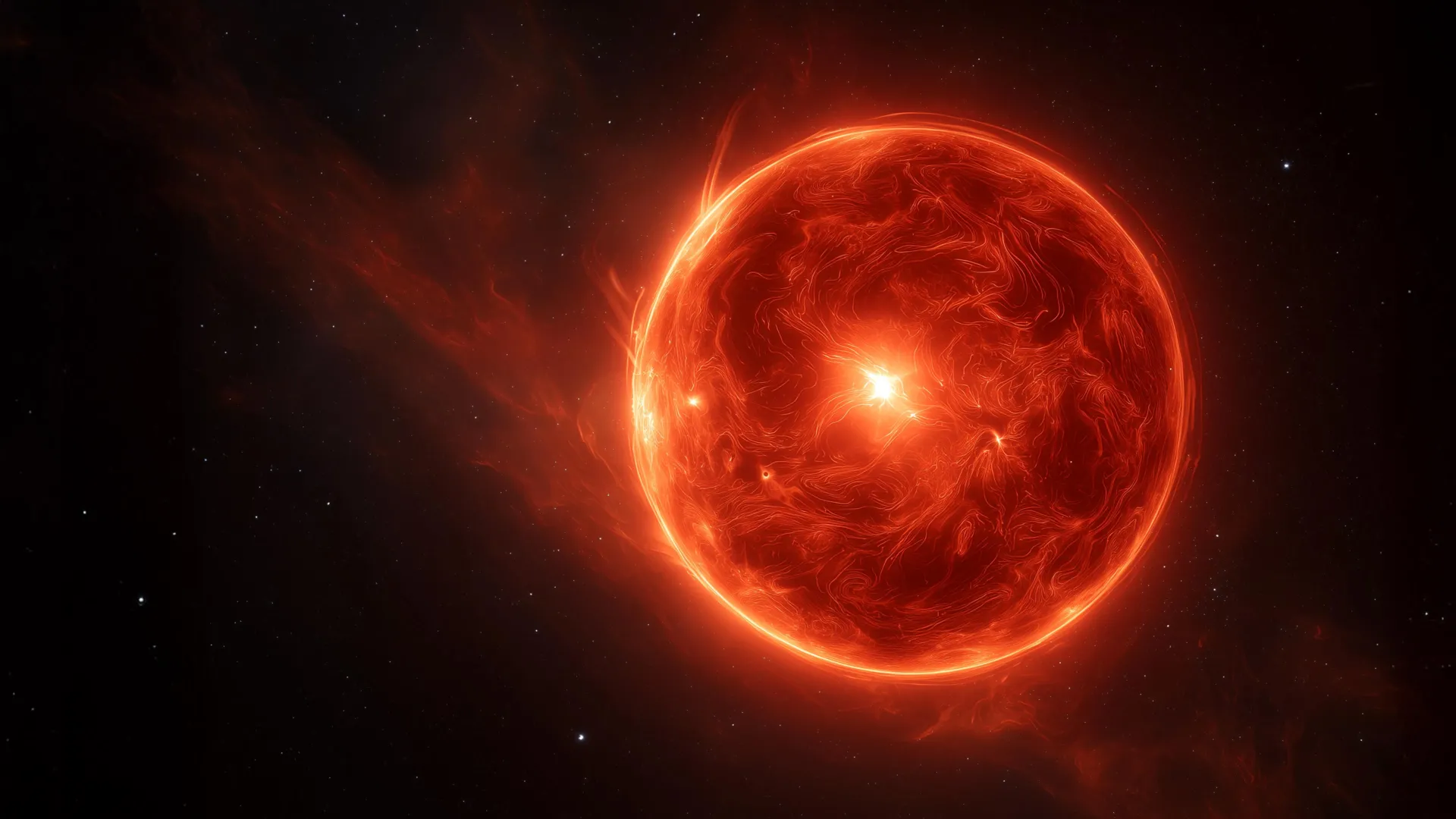
Astronomers have, for decades, grappled with a profound puzzle concerning the chemical evolution of red giant stars, a mystery now definitively resolved through the pioneering application of advanced supercomputing. Researchers have successfully illuminated the long-elusive mechanism responsible for the observed alterations in the surface composition of these colossal celestial bodies as they traverse their evolutionary paths.
The enduring challenge in astrophysics has been to reconcile the intense nuclear transformations occurring deep within a red giant’s core with the distinct chemical fingerprints detected at its visible surface. Within these stars, a dynamically stable layer acts as a formidable barrier, theoretically isolating the inner regions, where elements are forged and transmuted, from the outer convective envelope. The precise mechanism by which material manages to surmount this internal divide and influence the star’s atmospheric chemistry has remained a subject of intense speculation and unconfirmed hypotheses for over fifty years. This critical gap in understanding has significantly impeded the construction of comprehensive stellar evolution models.
A groundbreaking investigation, recently published in the prestigious journal Nature Astronomy, now provides a definitive answer. A collaborative team of scientists from the University of Victoria’s Astronomy Research Centre (ARC) and the University of Minnesota has pinpointed stellar rotation as the previously underestimated, yet crucial, driver of this internal mixing process.
The Fifty-Year Stellar Conundrum: A Deep Dive into Red Giant Evolution
To appreciate the magnitude of this discovery, one must first understand the life cycle of stars like our Sun. After billions of years burning hydrogen in their cores, these stars exhaust their primary fuel supply. This depletion triggers a dramatic expansion, transforming them into red giants—stellar behemoths that can swell to hundreds of times their original diameter. During this red giant phase, the internal structure of the star undergoes profound changes. The core contracts and heats up, initiating helium fusion, while the outer layers cool and expand.
Observations dating back to the 1970s consistently revealed perplexing anomalies in the surface chemistry of these evolved stars. Spectroscopic analyses, which decode the light emitted by stars to determine their elemental composition, showed significant shifts in isotopic ratios, particularly the carbon-12 to carbon-13 ratio. Carbon-12 is the most common isotope of carbon, while carbon-13 is less abundant and is primarily produced through specific nuclear reactions, such as the CNO (carbon-nitrogen-oxygen) cycle, which operates in the hotter, denser interiors of stars. The unexpected increase in carbon-13 at the surface of red giants strongly suggested that material processed in the deep interior was somehow being dredged up to the exterior. However, the standard models of stellar convection, which describe how heat and material are transported through fluid motions, could not adequately explain how this transport bypassed the stable radiative zone separating the core from the outer convective envelope. This stable layer acts like a thermal and chemical insulator, preventing direct mixing. The persistent discrepancy between theoretical predictions and observational evidence formed the crux of the half-century-old mystery.
Stellar Rotation: The Unseen Architect of Elemental Mixing
The pivotal insight uncovered by the research team centers on the role of stellar rotation. While the influence of rotation on stellar dynamics has long been acknowledged, its specific impact on the internal mixing of red giants had not been quantitatively verified until now.
"Leveraging sophisticated, high-resolution 3D simulations, our team successfully isolated and quantified the profound impact of stellar rotation on the ability of elements to traverse the critical barrier between the interior and the surface," stated Simon Blouin, the lead researcher and a postdoctoral fellow at the University of Victoria. "Stellar rotation emerges not merely as a contributing factor, but as the crucial, fundamental mechanism providing a natural and robust explanation for the observed chemical signatures across a wide spectrum of typical red giants. This breakthrough represents a significant leap forward in our comprehensive understanding of how stars evolve and sculpt the chemical landscape of the universe."
Previous theoretical models and simulations, primarily limited to one or two dimensions, struggled to adequately capture the complex, multi-scale interactions necessary to resolve this mixing problem. These earlier efforts often focused on internal gravity waves, which are oscillations generated by the churning motions within the convective envelope. While these waves were known to penetrate the stable barrier, their efficacy in transporting substantial amounts of material was deemed negligible. The innovative aspect of the new study lies in demonstrating that stellar rotation dramatically amplifies the transport capacity of these internal waves. The intricate interplay between the waves and the Coriolis forces generated by rotation creates instabilities and turbulence that effectively breach the stable layer, allowing chemically altered material to ascend.
Blouin further elaborated, "We recognized that internal waves, originating from the vigorous churning within the convective envelope, possessed the capability to propagate through this otherwise stable barrier. However, earlier simulations indicated that these waves alone transported only a minuscule amount of material. Our research definitively demonstrates that the star’s rotation profoundly enhances the effectiveness with which these waves can facilitate material mixing across the barrier, achieving a degree of transport that precisely corresponds with the magnitude of observed changes in surface composition." This amplification is not incremental; the team’s findings reveal that rotation can boost mixing rates by more than a hundredfold compared to non-rotating stellar models. Furthermore, the efficiency of this mixing process is directly correlated with the star’s rotational speed: faster rotation leads to even more vigorous internal transport. Given that our own Sun is destined to become a red giant in roughly five billion years, these findings offer unprecedented insights into its eventual chemical and structural evolution.
The Indispensable Power of Advanced Supercomputing
The unraveling of this complex stellar process was made possible only through an unprecedented application of computational power. The research team utilized hydrodynamical simulations, which meticulously model the three-dimensional flow of material within stars. These simulations are extraordinarily complex, requiring the simultaneous solution of fundamental equations of fluid dynamics, thermodynamics, and radiative transfer across vast scales, from the stellar core to its surface. Such computational demands place them at the absolute forefront of scientific computing, rendering the discovery unattainable without recent, exponential advancements in supercomputing technology.
"For decades, while stellar rotation was theoretically hypothesized to be a key component in resolving this astrophysical conundrum, the limitations of available computing capabilities prevented us from quantitatively testing and verifying this hypothesis," explained Falk Herwig, the principal investigator and director of ARC. "These cutting-edge simulations now empower us to meticulously resolve even minute effects, allowing us to definitively ascertain the actual physical processes at play and, crucially, to align our theoretical understanding with the wealth of observational data."
To execute these monumental simulations, the researchers leveraged some of the most powerful computing resources globally. These included systems at the Texas Advanced Computing Centre (TACC) at the University of Texas at Austin, renowned for its petascale and exascale capabilities, and the Trillium supercomputing cluster at SciNet, hosted at the University of Toronto. Trillium, a recently deployed system (its full capabilities becoming operational around the time of this research), stands among Canada’s most powerful platforms for large-scale academic simulations, forming a critical component of the Digital Research Alliance of Canada. Its significantly enhanced processing power, memory bandwidth, and parallel processing capabilities were absolutely instrumental in enabling the execution and analysis of these intricate models.
"The discovery of this novel stellar mixing process was directly attributable to the immense computational power offered by the new Trillium machine," Herwig emphasized. "These simulations represent the most computationally intensive stellar convection and internal gravity wave simulations ever performed to date, pushing the boundaries of what is possible in astrophysics." The ability of these supercomputers to model intricate, non-linear fluid dynamics in three dimensions, accounting for rotation and wave propagation simultaneously, provided the critical lens through which the long-standing mystery was finally brought into focus.
Far-Reaching Implications and Future Directions
The profound implications of this research extend far beyond the realm of astrophysics. The sophisticated computational methodologies and numerical algorithms developed and refined in this study are fundamentally applicable to a broad spectrum of scientific disciplines concerned with fluid motion. The same underlying principles and computational approaches used to model stellar interiors can offer unprecedented insights into diverse phenomena, including the complex dynamics of ocean currents, the intricate patterns of atmospheric circulation that govern weather and climate, and even the nuances of blood flow within biological systems. Recognizing this interdisciplinary potential, Herwig is actively engaged in collaborations with researchers across these varied fields, fostering the development of shared computational tools and robust infrastructure for conducting large-scale simulations that transcend traditional disciplinary boundaries.
For Blouin, the immediate future involves continuing to explore the multifaceted ways in which stellar rotation influences various classes of stars. Future investigations will delve into the effects of differing rotation patterns, such as differential rotation where different parts of a star rotate at different speeds, on mixing efficiency. The team also plans to examine whether similar rotational-driven mixing processes manifest in other critical stages of stellar evolution, potentially impacting our understanding of phenomena like binary star evolution, stellar flares, or even the formation of planetary systems. This research promises to refine existing stellar models, enhance our predictive capabilities regarding stellar lifetimes and nucleosynthesis, and ultimately deepen humanity’s cosmic understanding.
This pioneering research was made possible through the generous support of key scientific funding bodies, including the Natural Sciences and Engineering Research Council (NSERC) of Canada, the National Science Foundation (NSF), and the U.S. Department of Energy.



 Lisa Mariana
 Aura Kasih
 Safa Marwah