Ayu Aulia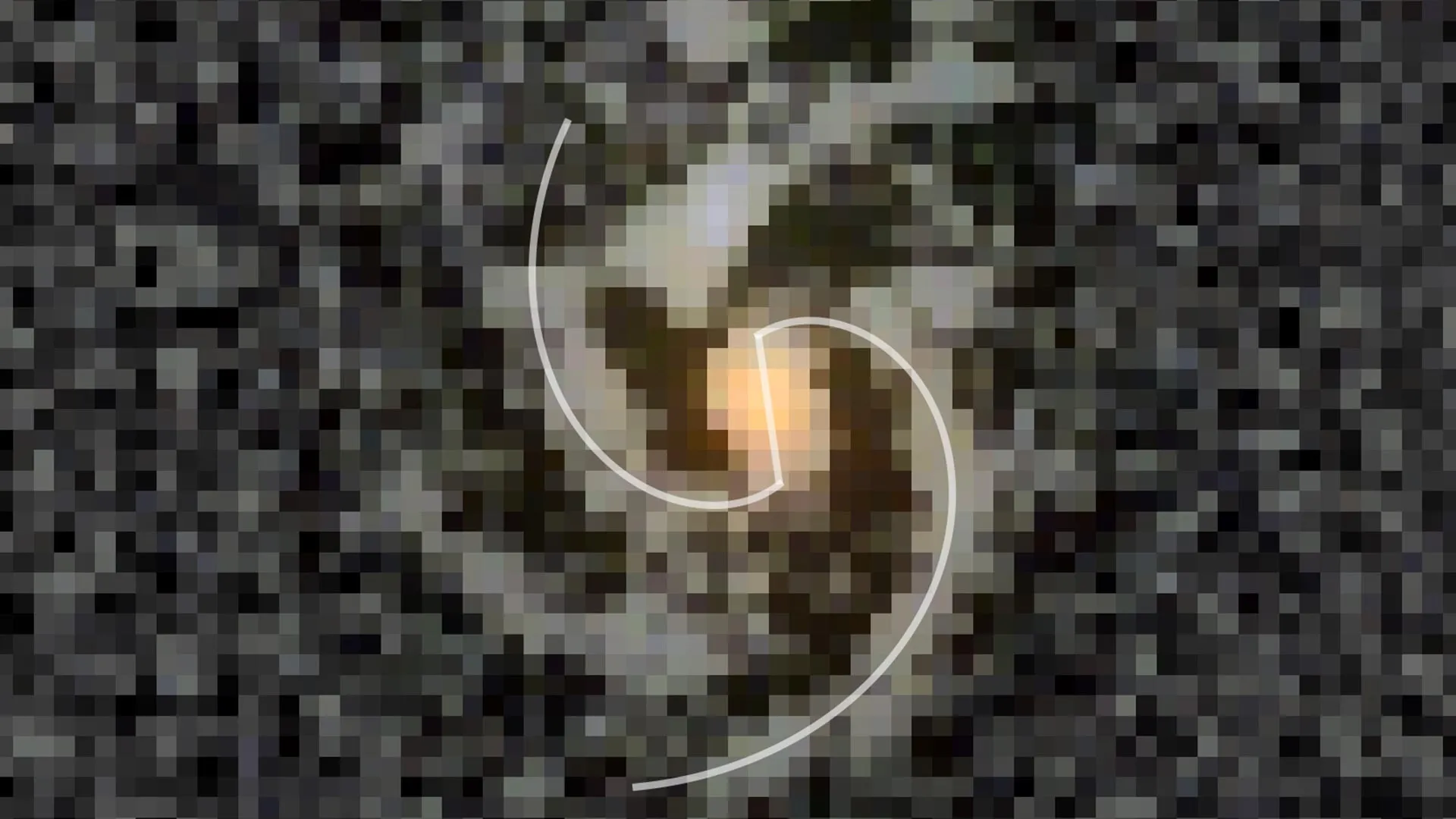
A groundbreaking astronomical discovery, leveraging the unparalleled capabilities of the James Webb Space Telescope (JWST), has identified a robust candidate for one of the earliest known spiral galaxies exhibiting a prominent stellar bar, a complex galactic feature whose prevalence at such an early epoch challenges prevailing astrophysical models of galaxy formation and evolution.
The galaxy, officially designated COSMOS-74706, has been precisely dated to approximately 11.5 billion years ago, placing its existence a mere 2 billion years after the Big Bang. This observation pushes the established timeline for the emergence of sophisticated galactic morphologies, suggesting that the intricate gravitational dynamics required to form such structures were already at play much earlier than previously confirmed with high certainty. The findings, presented by a research team at the 247th meeting of the American Astronomical Society, underscore the transformative power of JWST in redefining our understanding of the universe’s formative stages.
The Significance of a Stellar Bar in Early Galaxies
Stellar bars are dense, elongated structures of stars and gas that traverse the central regions of many spiral galaxies, including our own Milky Way. Far from being mere aesthetic features, these bars play a crucial and dynamic role in shaping the long-term evolution and internal dynamics of their host galaxies. Their presence acts as a cosmic funnel, effectively channeling vast quantities of gas from the outer galactic disk inward towards the central bulge. This inward flow has profound implications for galactic development.
Firstly, the concentrated gas can fuel intense bursts of star formation in the galaxy’s central region, leading to the rapid birth of new stellar populations. Secondly, this gas can also feed the supermassive black hole residing at the galaxy’s core, potentially igniting or sustaining an Active Galactic Nucleus (AGN) — a phase of extreme luminosity where the black hole actively accretes matter. Conversely, the presence of a strong bar can also stabilize the outer disk, potentially suppressing star formation in those regions by redistributing gas and altering gravitational potentials. Understanding when these powerful agents of galactic change first emerged is critical for piecing together the full narrative of cosmic evolution. The detection of COSMOS-74706 with a clearly defined stellar bar provides a vital constraint on the theoretical timescales for these complex structures to coalesce.
Unveiling COSMOS-74706: A High-Fidelity Observation
The identification of COSMOS-74706 as an early barred spiral galaxy stands apart due to the rigorous methodology employed in its characterization. Previous studies have hinted at the existence of barred spirals at even earlier cosmic epochs, but these observations often relied on less precise techniques, such as photometric redshift measurements. Photometric redshifts estimate distance based on a galaxy’s overall color across different filters, which can be less accurate than spectroscopic methods, particularly for very distant objects.
In contrast, COSMOS-74706’s distance and age were confirmed using spectroscopy. This technique involves dispersing a galaxy’s light into its constituent wavelengths, allowing astronomers to identify specific spectral lines. The "redshift" of these lines – their shift towards longer, redder wavelengths due to the universe’s expansion – provides a highly reliable and precise measurement of the galaxy’s velocity away from us, and thus its distance and age. This spectroscopic confirmation elevates the confidence level in COSMOS-74706’s age and morphology significantly.
Furthermore, a critical aspect of this discovery is that the galaxy is "unlensed." Gravitational lensing occurs when the light from a distant galaxy is bent and magnified by the gravitational field of an intervening massive object, such as a galaxy cluster. While lensing can make faint, distant objects visible, it also distorts their appearance, making it challenging to accurately determine their intrinsic morphology. The unlensed nature of COSMOS-74706 ensures that the observed barred structure is an intrinsic property of the galaxy itself, free from gravitational distortions, thereby providing a pristine view of its ancient architecture. Lead researcher Daniel Ivanov emphasized this distinction, stating, "It’s the highest redshift, spectroscopically confirmed, unlensed barred spiral galaxy." This combination of high redshift, spectroscopic confirmation, and freedom from lensing makes COSMOS-74706 a singularly important discovery in the field of galaxy evolution.
Theoretical Predictions Versus Observational Reality
The existence of a well-formed stellar bar in a galaxy as ancient as COSMOS-74706 presents a fascinating interplay between theoretical predictions and observational evidence. Computer simulations of galaxy formation and evolution have indeed suggested that stellar bars could begin to form relatively early in cosmic history, potentially as early as redshift 5, corresponding to approximately 12.5 billion years ago. These simulations model the complex gravitational interactions between dark matter halos, gas, and stars that drive galactic structure formation.
However, while simulations might allow for early bar formation, they generally do not predict them to be common at such nascent stages of the universe. The conditions for bar formation — a sufficiently massive and dynamically "cold" (thin and rotationally supported) stellar disk – were thought to be less prevalent in the chaotic, merger-rich environment of the early universe. Early galaxies were often characterized by turbulent, clumpy disks, frequently undergoing mergers, which would typically disrupt the stable conditions necessary for a bar to develop and persist. The discovery of COSMOS-74706 thus provides empirical evidence that such stable conditions, conducive to bar formation, were indeed achievable for at least some galaxies in the early universe, even if they were expected to be rare. This finding serves as a critical data point for refining and validating these sophisticated cosmological simulations.
The Unprecedented Power of the James Webb Space Telescope
This landmark discovery would not have been possible without the extraordinary capabilities of the NASA/ESA/CSA James Webb Space Telescope. JWST is designed to observe the universe primarily in infrared light, a capability that is absolutely crucial for studying extremely distant objects like COSMOS-74706. As light from these ancient galaxies travels across billions of light-years, the expansion of the universe stretches its wavelength, shifting what was originally ultraviolet or visible light into the infrared spectrum – a phenomenon known as cosmological redshift. Ground-based telescopes and the Hubble Space Telescope, while powerful, have limitations in observing at these longer infrared wavelengths, which are often absorbed by Earth’s atmosphere or obscured by thermal emission from the telescopes themselves.
JWST, positioned at the Earth-Sun L2 Lagrange point, operates in the cold vacuum of space, allowing its instruments to detect these faint infrared signals with unprecedented sensitivity and resolution. Its Near-Infrared Camera (NIRCam) and Near-Infrared Spectrograph (NIRSpec) were likely instrumental in both imaging the detailed morphology of COSMOS-74706 and performing the crucial spectroscopic analysis to confirm its redshift. The telescope’s ability to peer through cosmic dust and gas, coupled with its sheer light-gathering power and sharp vision, allows astronomers to resolve intricate structures in galaxies that are billions of light-years away, revealing details that were previously inaccessible. This discovery is a testament to JWST’s design and its promise to revolutionize our understanding of the universe’s earliest epochs. The research received support from the Brinson Foundation, acknowledging the collaborative effort behind such advanced astronomical endeavors.
Implications for Galaxy Evolution Models and Future Research
The detection of a confirmed barred spiral galaxy 11.5 billion years ago carries significant implications for our models of galaxy evolution. It suggests that the processes leading to the morphological maturity of galaxies were more efficient or occurred more rapidly in some cases than previously assumed. This challenges models that predict a longer period of chaotic, irregular morphology before the emergence of stable spiral and barred spiral structures.
This discovery provides a direct observational constraint on the "timescales of bar formation," as noted by Ivanov. It indicates that the conditions necessary for gravitational instabilities to develop into a stellar bar – a relatively settled, rotating disk with sufficient mass and low velocity dispersion – were already present in at least a subset of galaxies at an early cosmic age. This might imply either that some early galaxies formed their disks more quickly and stably, or that mechanisms for bar formation are more robust in turbulent early environments than current simulations fully capture.
Future research will undoubtedly focus on identifying more such early barred spirals using JWST, aiming to build a statistical sample. A larger sample will allow astronomers to determine the true prevalence of bars at different cosmic epochs, providing a more comprehensive picture of their formation and evolution. This data will be invaluable for refining theoretical simulations of galaxy formation, potentially leading to new insights into the interplay between dark matter halos, baryonic matter, and the internal dynamics that shape galactic architecture. Furthermore, studying the properties of these early barred galaxies – their star formation rates, gas content, and central black hole activity – will shed light on how bars influenced the overall evolution of galaxies in the early universe, connecting the ancient cosmos to the more mature galaxies we observe today. The continued exploration with JWST is poised to unlock further secrets of galactic infancy and the grand cosmic tapestry.



 Lisa Mariana
 Aura Kasih
 Safa Marwah