Aura Kasih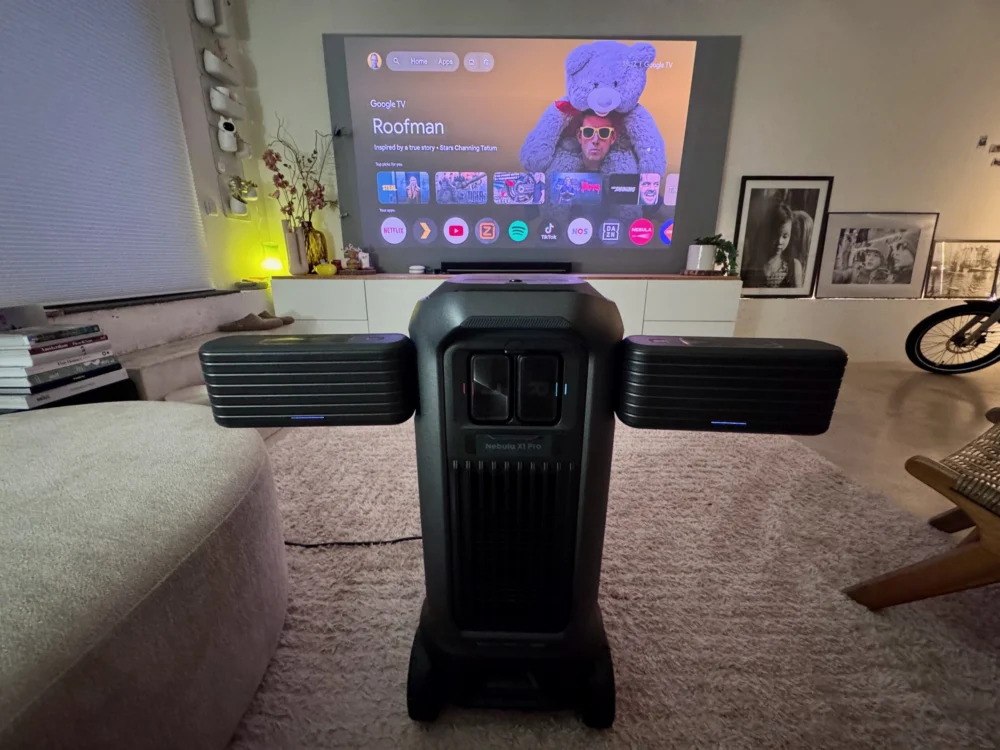
Anker’s Soundcore Nebula X1 Pro represents a bold, some might say audacious, leap into the realm of portable entertainment, merging an exceptional 4K projector with a formidable multi-channel audio system into a single, mobile unit. This device, which eschews conventional design for a maximalist approach to audiovisual immersion, transforms the concept of a "party on wheels" into a tangible, albeit unconventional, reality. It’s a testament to Anker’s willingness to push boundaries, crafting a product that is as much a statement piece as it is a functional entertainment hub.

At its core, the Nebula X1 Pro inherits the impressive visual prowess of its predecessor, the Nebula X1. This includes a liquid-cooled, triple-laser projection system boasting a remarkable 3500 ANSI lumens. This illumination power, coupled with advanced auto-image correction technologies, promises a vivid and sharp 4K picture that can stand its ground even in moderately lit environments. The silence achieved by its cooling system is a significant engineering feat, especially for a projector of this brightness, ensuring that the visual experience remains unmarred by intrusive fan noise. However, the X1 Pro doesn’t just excel in visuals; it dramatically elevates the audio component, integrating a robust 400W sound system designed to envelop the user in an immersive sonic landscape.
The audio architecture of the Nebula X1 Pro is where its "chaos and content" moniker truly shines. It features a substantial, internally housed subwoofer engineered to deliver deep, resonant bass that can indeed create a palpable sensation, capable of "wall-shaking" impact. This is complemented by four detachable, battery-powered speakers that deploy with a satisfying mechanical flourish. These speakers are designed to configure into an advanced surround sound array, offering up to seven horizontal channels and an additional four overhead channels for a true 7.1.4 Dolby Atmos experience. The system’s ability to dynamically reconfigure its speaker layout for different audio modes—from a compact 2.1 setup to a fully dispersed 7.1.4 configuration—is a key differentiator, enabling users to adapt the audio environment to their specific needs and space.

The innovation extends to the wireless connectivity of the detached speakers. Instead of relying on the more common but often less performant Bluetooth, the X1 Pro utilizes a proprietary 5.8GHz Wi-Fi signal. This choice is crucial for achieving the low-latency, lossless audio transmission required for high-fidelity surround sound. The seamless integration and automatic reconnection of these wireless satellites upon power-up, as observed in testing, underscore the robustness of this proprietary system, minimizing the audio dropouts and pops that can plague less sophisticated wireless setups. The inclusion of a 4-mic array and Anker’s Flexwave spatial audio calibration further refines the listening experience by actively optimizing sound for the room’s acoustics, though the sweet spot for optimal immersion remains relatively narrow, approximately two persons wide.
While the auditory and visual capabilities are undeniably impressive, the sheer scale and ambition of the Nebula X1 Pro do present certain practical considerations. The primary "complaint," if it can be called that, is the device’s overwhelming sonic potential. At higher volume levels, the system can indeed become "too loud," a peculiar concern for a portable projector but a testament to its audio output capabilities. This suggests that while designed for portability, its true impact is best appreciated in environments where its sound can be unleashed without disturbing neighbors.

The price point of $4,999 positions the Nebula X1 Pro as a premium entertainment investment, placing it in a category where discerning consumers expect a high level of performance and innovation. This expenditure reflects the cutting-edge technology integrated, from the triple-laser projection to the sophisticated multi-channel audio and automated calibration systems. It’s a device aimed at enthusiasts who prioritize an all-encompassing cinematic and auditory experience without the complexity of setting up separate components.
The evolution from the Nebula X1 to the X1 Pro is primarily driven by the latter’s vastly enhanced audio capabilities. The X1 Pro’s internal 160W subwoofer is a significant upgrade, providing a low-frequency response that is both powerful and, at times, challenging to manage. The system’s adaptability is further highlighted by its three distinct sound modes. The default 2.1 mode, with all speakers docked, offers a foundational stereo experience. Unfolding the front speakers transforms it into a 5.1.2 setup, and deploying all four satellites around the room unlocks the full 7.1.4 immersive audio potential. The inclusion of animated guides for speaker placement in the 7.1.4 mode demonstrates Anker’s attention to user experience, aiming to demystify the setup process for achieving optimal surround sound.

The operational flexibility of the detached speakers is notable. With a battery life exceeding eight hours during testing, they offer substantial untethered use. Their recharging mechanism via pogo pins or USB-C adds to their convenience. The system’s reliance on a dedicated 5.8GHz Wi-Fi for inter-speaker communication is a strategic choice that prioritizes audio fidelity and responsiveness over the broader compatibility of Bluetooth. This decision directly addresses the critical need for synchronized, low-latency audio in a multi-speaker surround sound configuration, ensuring that the immersive experience is not compromised by audio lag.
Despite the advanced wireless audio, users might encounter intermittent connectivity challenges with the integrated Google TV platform. Reports of the device occasionally failing to reconnect to a home network, even when other devices maintain a stable connection, suggest potential software or firmware optimizations that could be addressed in future updates. While a system reboot typically resolves these issues, such disruptions can detract from the seamless entertainment experience that the X1 Pro aims to deliver.

The physical design, while innovative, also presents a dichotomy between "portable" and "practical." The telescoping handle and wheels facilitate movement of the unit, which measures approximately 17.13 x 13.50 x 29.96 inches. However, its substantial weight of 72.31 pounds (32.8 kg) makes maneuvering it over stairs or into confined spaces a two-person task. The recommendation to use it on hard surfaces and avoid rough terrain underscores that its "portability" is best suited for relatively controlled environments, such as backyard patios or spacious indoor settings, rather than rugged outdoor excursions. The IP43 rating for dust and water resistance is contingent upon specific conditions, such as the lens cap being closed and speakers fully retracted, which may not always be maintained in spontaneous outdoor usage scenarios.
The auditory performance of the Nebula X1 Pro, particularly in its fully deployed 7.1.4 configuration, rivals dedicated home theater systems. The ability to reproduce nuanced audio cues, such as the overhead passage of helicopters in Top Gun: Maverick or the creeping sounds of dystopian machinery in Blade Runner 2049, demonstrates the effectiveness of its spatial audio calibration and speaker array. Dialogue clarity is maintained through the dedicated center channel, and directional sound effects are accurately placed within the soundscape. The sheer volume output, with walls vibrating at 30% volume, suggests its suitability for outdoor movie nights, where its sonic power can be fully appreciated.

When used as a dedicated Bluetooth speaker, the Nebula X1 Pro offers a significant advantage over traditional projectors by operating in near silence. This feature allows for uninterrupted music listening without the distracting hum of cooling fans. In its docked 2.1 audio mode, it can deliver sound comparable to high-end portable party speakers, albeit without the often-superfluous integrated lighting effects. This dual functionality enhances its value proposition for users seeking a versatile entertainment device.
The bass response, while a highlight, can be overpowering for certain music genres. Adjustments to equalization, as noted with Spotify, may be necessary to achieve optimal listening for music, particularly in tracks with heavy bass lines. While the X1 Pro can achieve high volume levels for music, fidelity can degrade beyond 70% capacity, suggesting that its peak performance for audio clarity lies within a more moderate range.

Ultimately, the Nebula X1 Pro stands as a singular achievement in the consumer electronics market. It embodies a maximalist approach to portable home entertainment, combining a top-tier 4K projector with a deeply immersive and powerful audio system. Its audacious design and comprehensive feature set cater to a niche audience seeking an unparalleled, all-in-one audiovisual solution. While its considerable weight and price tag position it as a luxury item, its performance, particularly in audio immersion, sets a new benchmark for what can be expected from a portable entertainment device. The choice between the more affordable Nebula X1 with an optional speaker kit and the fully integrated X1 Pro hinges on the user’s priority: cost savings and a still-impressive audio experience, or the ultimate in portable, immersive sound and vision. For those prioritizing the latter, the Nebula X1 Pro delivers a truly captivating, albeit complex, entertainment spectacle.



 Safa Marwah
 Lisa Mariana