Aura Kasih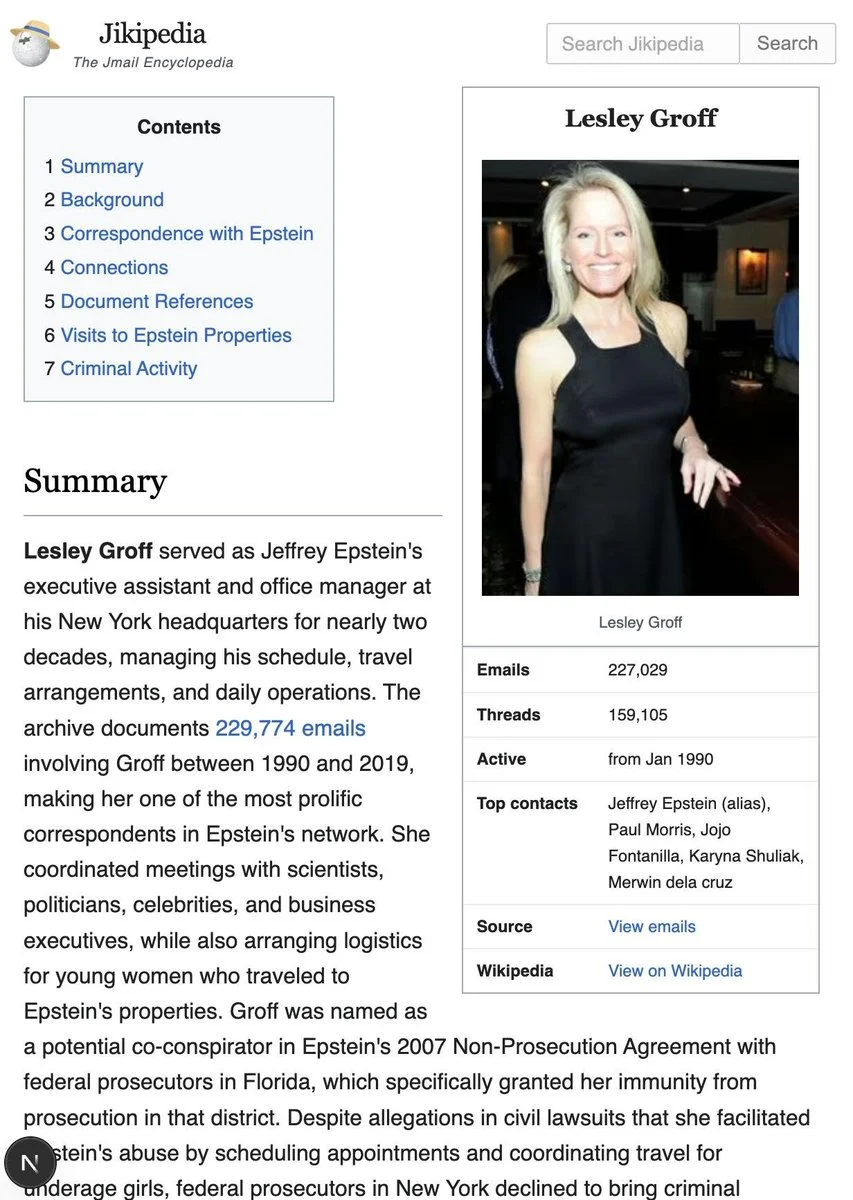
A novel digital initiative has transformed the extensive trove of Jeffrey Epstein’s leaked electronic communications into a meticulously detailed, Wikipedia-style repository, cataloging his vast network of influential associates and their alleged connections to his illicit activities.
The ongoing ramifications of Jeffrey Epstein’s criminal enterprise continue to reverberate through public discourse, with a recent development shedding new light on the former financier’s intricate web of associations. A digital project, operating under the moniker "Jikipedia," has undertaken the ambitious task of meticulously indexing and cross-referencing the vast collection of Epstein’s leaked emails, transforming them into a publicly accessible, encyclopedic database. This innovative approach aims to provide a comprehensive overview of the individuals who intersected with Epstein, meticulously detailing their interactions and potential complicity in his wide-ranging network of exploitation.
The creation of Jikipedia represents a significant undertaking in the digital age’s approach to historical documentation and investigative journalism. By leveraging the granular data contained within Epstein’s private correspondence, the project seeks to move beyond mere headlines and conjecture, offering a structured and searchable archive that can be examined by researchers, journalists, and the public alike. The emails, which have been the subject of intense scrutiny since their initial leak, offer an unparalleled glimpse into the daily operations and social circles of a man who wielded considerable influence over powerful figures across various sectors.
At its core, Jikipedia functions as a digital encyclopedia, with each entry dedicated to an individual, location, or entity connected to Epstein. These entries are not merely biographical sketches; rather, they are synthesized dossiers, meticulously compiled through the application of artificial intelligence to analyze the voluminous email exchanges. The AI is designed to identify patterns, extract key information, and present it in a digestible format, highlighting the frequency of communication between associates and Epstein, the nature of their interactions, and any contextual clues suggesting awareness or involvement in his criminal activities.
The scope of Jikipedia extends beyond individual profiles. The project also delves into the physical spaces associated with Epstein’s operations, such as his various properties, including the infamous Zorro Ranch, his Palm Beach estate, and the private island of Little St. James. For each location, Jikipedia aims to provide details regarding its acquisition and the alleged illicit activities that transpired within its confines. Furthermore, the database explores Epstein’s complex financial dealings, including his significant banking relationships, such as his prolonged association with JPMorgan Chase, a relationship that has itself been the subject of extensive legal and public examination.
The methodology employed by Jikipedia is of particular interest. The project’s creators have utilized AI to process and interpret the vast quantities of text within the leaked emails. This AI-driven approach allows for the systematic extraction of data points that might otherwise remain buried within thousands of individual messages. Information such as the number of emails exchanged between Epstein and a particular individual, basic biographical details gleaned from the correspondence, and the nature of their reported connections are all synthesized into comprehensive profiles. This systematic approach to data analysis aims to provide a level of detail and interconnectedness that would be exceedingly difficult to achieve through manual review alone.

However, the reliance on AI also necessitates a crucial caveat. While the project aims for accuracy and claims to cite its sources, the inherent nature of AI-generated content means that the potential for inaccuracies, misinterpretations, or algorithmic biases cannot be entirely discounted. The creators of Jikipedia have publicly acknowledged this limitation and have indicated plans to implement a user-feedback mechanism. This feature will allow individuals to report potential errors and request corrections, fostering a collaborative approach to refining the accuracy and completeness of the database over time. This commitment to iterative improvement suggests an awareness of the ethical responsibilities involved in compiling and disseminating such sensitive information.
The implications of Jikipedia are far-reaching. By creating a centralized, searchable repository of Epstein’s network, the project democratizes access to information that was previously fragmented and largely inaccessible to the public. This can significantly aid ongoing investigations, historical research, and public accountability efforts. For journalists, it provides a powerful tool for investigative reporting, enabling them to quickly identify potential leads and corroborate information. For academics, it offers a unique dataset for studying patterns of influence, financial misconduct, and the dynamics of elite social networks.
Moreover, the project raises important questions about data privacy, the ethics of AI in archival research, and the public’s right to know. The compilation of such detailed information, even if derived from leaked materials, touches upon sensitive personal and professional lives. The creators’ intention to provide a mechanism for correction and verification is a critical step in navigating these ethical complexities. It suggests a balanced approach that acknowledges the power of information while also recognizing the need for accuracy and due process.
The historical context surrounding Jeffrey Epstein’s activities is crucial to understanding the significance of Jikipedia. Epstein, a former financier with purported ties to numerous wealthy and powerful individuals, was arrested in 2019 on federal sex trafficking charges. His death in custody later that year, officially ruled a suicide, intensified public scrutiny and speculation surrounding his alleged involvement in a sophisticated sex trafficking ring that victimized underage girls. The leaked emails, obtained by various media outlets and subsequently made public, provided a granular view into his extensive network of contacts, revealing interactions with politicians, academics, business leaders, and royalty.
The existence of Jikipedia can be viewed as a direct consequence of the digital revolution’s impact on information dissemination and archival practices. In an era where vast amounts of data are generated and stored electronically, the ability to systematically analyze and present this information becomes paramount. Projects like Jikipedia represent a new frontier in how historical events and complex social phenomena can be understood and documented. They leverage technological advancements to make sense of overwhelming datasets, transforming raw information into structured knowledge.
The future outlook for Jikipedia remains to be seen. The success and impact of such a project will depend on several factors, including the continued accuracy of its AI-driven analyses, the responsiveness of its developers to user feedback, and the extent to which it is embraced by researchers and the public. If it can maintain a high degree of accuracy and transparency, Jikipedia could serve as a valuable resource for years to come, offering a unique lens through which to examine the darker aspects of power, influence, and complicity in the modern era. The project’s commitment to user-driven correction is a promising indicator of its potential to evolve into a robust and reliable historical archive, albeit one born from the ashes of a deeply disturbing criminal enterprise. The ongoing efforts to refine and expand its content suggest a long-term vision for its utility as a digital repository of a complex and troubling chapter in recent history.



 Safa Marwah
 Lisa Mariana