Ayu Aulia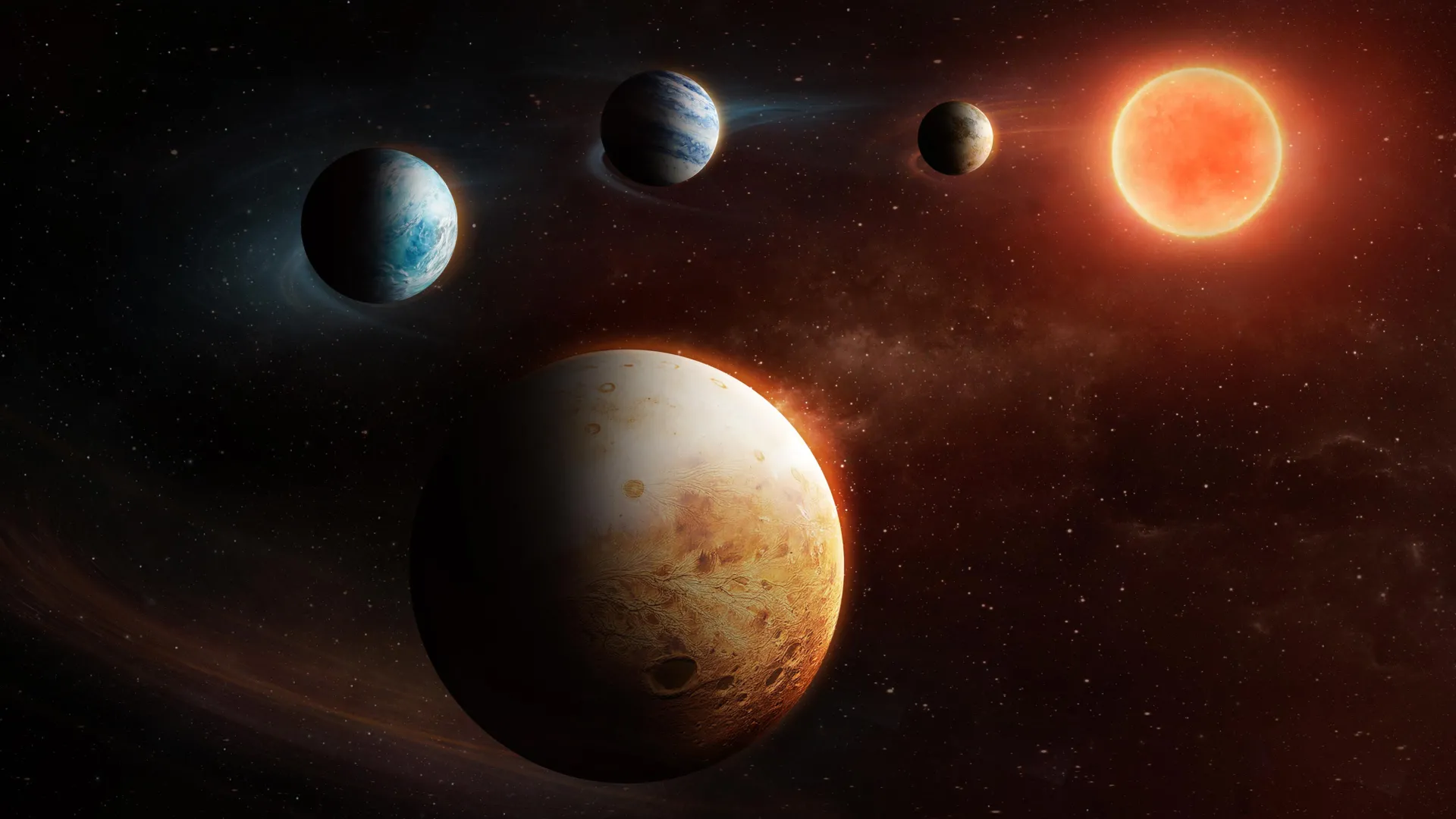
Astronomers have identified a novel exoplanetary architecture orbiting a distant star, presenting a profound challenge to long-held theoretical frameworks governing the formation and evolution of planetary systems across the cosmos. This groundbreaking discovery centers on a rocky planet detected in an unusually distant orbit from its host star, a configuration that directly contradicts the widely accepted paradigm dictating the distribution of planetary compositions within stellar neighborhoods. The finding compels a significant re-evaluation of the dynamic processes shaping celestial bodies, suggesting a greater complexity and diversity in planetary genesis than previously theorized.
For decades, the dominant scientific consensus on planet formation has been underpinned by a clear and consistent model. This framework posits that planetary systems typically exhibit a specific organizational pattern: smaller, dense, rocky worlds coalesce in the warmer, inner regions closer to their parent star, while massive, gaseous giants accumulate in the cooler, outer expanses. This arrangement is not merely coincidental; it is a direct consequence of the physical conditions present within a nascent protoplanetary disk—the swirling cloud of gas and dust from which planets are born. Our own Solar System serves as a quintessential example, with the terrestrial planets (Mercury, Venus, Earth, Mars) occupying the inner orbits, composed predominantly of silicates and metals, and the gas and ice giants (Jupiter, Saturn, Uranus, Neptune) residing in the outer reaches, characterized by vast envelopes of hydrogen, helium, and heavier volatile compounds.
The prevailing theory elucidates this compositional gradient through the interplay of stellar radiation and temperature. In the immediate vicinity of a young, luminous star, intense radiation and stellar winds exert a powerful influence, effectively stripping away lighter, more volatile gases from the atmospheres of developing protoplanets. This process leaves behind the denser, refractory materials to form solid, rocky cores and ultimately, the terrestrial planets we observe. Conversely, farther from the star, temperatures are significantly lower, allowing planets to retain substantial amounts of hydrogen, helium, and other volatiles. These cooler conditions facilitate the accretion of vast gaseous envelopes around growing cores, leading to the formation of gas giants. The "snow line" or "frost line" within the protoplanetary disk, where volatile compounds like water, methane, and ammonia condense into solid ice, is a critical boundary in this model, often delineating the transition zone between rocky and gaseous planet formation.
However, the recently identified system orbiting LHS 1903, a diminutive and relatively cool red dwarf star, deviates strikingly from this established script. Red dwarfs, being smaller and less massive than our Sun, represent the most common type of star in the Milky Way and are increasingly becoming targets for exoplanet searches due to their prolonged stability and the relative ease of detecting transiting planets. The initial observations of the LHS 1903 system, conducted by an international team of researchers utilizing a combination of ground-based and space-borne observatories, including the European Space Agency’s CHEOPS satellite, revealed a seemingly conventional architecture. Three inner planets were identified: an innermost rocky world, followed by two gas-rich planets akin to smaller versions of Neptune. This initial configuration largely aligned with the standard expectations for planet formation around such a star.
Yet, a sustained program of additional observations and meticulous data analysis yielded an unforeseen revelation. Further measurements from the CHEOPS mission confirmed the existence of a fourth planet, designated LHS 1903 e, occupying the outermost orbit of the system currently known. To the profound surprise of the scientific community, this most distant world exhibited characteristics consistent with a rocky composition, defying the expectation that planets formed at such a significant distance from their star would inevitably be gas-dominated. This anomalous placement of a rocky world in an outer orbit represents a direct challenge to the fundamental tenets of the standard planet formation model, which predicts a clear inverse relationship between orbital distance and a planet’s gaseous content.
Professor Ryan Cloutier of McMaster University and Professor Thomas Wilson of the University of Warwick, who spearheaded the research, articulated the profound implications of this discovery. As Professor Cloutier noted, the consistent pattern of "rocky inside, gaseous outside" has been observed across hundreds of exoplanetary systems. The detection of a rocky planet in the outer reaches of a system, therefore, necessitates a comprehensive re-evaluation of the temporal dynamics and environmental prerequisites for the genesis of terrestrial worlds. This unexpected finding underscores the limitations of current theoretical frameworks when confronted with empirical evidence from the burgeoning field of exoplanetary science.
The research team embarked on a rigorous investigation to ascertain the origins of LHS 1903 e’s unusual composition and orbital placement. They meticulously explored several alternative scenarios that might account for such an anomaly. One prominent hypothesis considered was that the planet initially formed as a gas giant but subsequently experienced a catastrophic event, such as a massive impact with another celestial body, which stripped away its thick atmosphere, leaving behind a denuded rocky core. Another scenario involved planetary migration, where planets form in one region of the disk and then gravitationally interact, shifting their orbital positions over millions of years. This process is known to occur in other systems, giving rise to phenomena like "hot Jupiters" that orbit extremely close to their stars.
However, detailed computer simulations and exhaustive studies of the planets’ precise orbital parameters within the LHS 1903 system systematically ruled out both impact-stripping and significant planetary migration as plausible explanations. The absence of discernible debris fields, the stability of the system’s orbits, and the specific dynamics observed did not support these violent or extensive repositioning events. The rigorous exclusion of these alternative hypotheses lent significant credence to the idea that the observed architecture of LHS 1903 is an intrinsic feature of its formation process rather than a result of subsequent chaotic events.
Instead, the compelling evidence accumulated by the researchers points towards a more radical and less conventional explanation: the planets in this system may not have formed concurrently within a uniform environment. Rather, their development could have occurred sequentially, one after another, as the conditions within the protoplanetary disk around LHS 1903 underwent significant transformations over time. This "inside-out" or "sequential accretion" model contrasts sharply with the standard "core accretion" model, which often implies a more synchronous formation of multiple planetary embryos within the disk.
The standard core accretion model proposes that planetary embryos coalesce almost simultaneously within a protoplanetary disk, drawing material from their immediate surroundings. Over millions of years, these growing bodies accrete more gas and dust, eventually evolving into fully formed planets with a diverse range of sizes and compositions determined by their location within the disk. The inside-out planet formation framework, however, posits a different developmental pathway. In this scenario, planets take shape in a more staggered fashion, responding to the dynamic and shifting environmental conditions within the disk. The local conditions at the precise moment each planet reaches its final mass and composition—specifically, the availability of gaseous material—are the primary determinants of whether it becomes a gas-rich world or remains a rocky core.
This sequential formation mechanism offers a compelling explanation for the enigmatic nature of LHS 1903 e. According to this revised understanding, by the time the outermost rocky planet began its assembly process, a substantial portion of the primordial gas in the surrounding protoplanetary disk may have already dissipated or been depleted. This depletion of volatile material would have left insufficient quantities of gas for LHS 1903 e to accrete a thick atmosphere, thereby sealing its fate as a rocky world despite its distant orbital position. Such a scenario fundamentally challenges the notion of a static, uniform environment for planet formation and highlights the critical role of the disk’s evolutionary timeline.
Professor Cloutier further emphasized the profound implications, stating, "It’s remarkable to see a rocky world forming in an environment that shouldn’t favour that outcome. It challenges the assumptions built into our current models." This discovery not only compels a re-evaluation of the timing and mechanisms of planetary accretion but also raises broader questions regarding the statistical prevalence of such systems. Is LHS 1903 an exceedingly rare anomaly, a unique outlier in the galactic census of exoplanets, or is it merely an early example of a previously unrecognized pattern of planetary system architecture that scientists are only now beginning to uncover?
The continuous advancements in observational technologies and detection methodologies are strengthening humanity’s capacity to identify exoplanetary systems that diverge significantly from the familiar architecture of our own Solar System and challenge long-standing theoretical constructs. The European Space Agency’s CHEOPS mission, specifically designed to perform high-precision characterization of exoplanets, has been instrumental in this regard, providing the crucial photometric data necessary to discern the subtle nuances of planetary transits and refine our understanding of their properties. Future missions, such as the James Webb Space Telescope and forthcoming extremely large ground-based telescopes, promise even greater precision and the ability to probe exoplanet atmospheres directly, offering unprecedented insights into their compositions and origins.
Each new exoplanetary system discovered, particularly those exhibiting unexpected characteristics, contributes another vital data point to a rapidly expanding and increasingly complex picture of planetary diversity across the galaxy. This growing body of empirical evidence necessitates a continuous refinement and, in some cases, a radical overhaul of the theoretical models that seek to explain how worlds are sculpted from the primordial dust and gas around stars. The anomalous nature of LHS 1903 e underscores that our understanding of cosmic processes is still evolving and that the universe holds many more surprises, continually pushing the boundaries of astrophysical inquiry and inspiring new generations of scientists to unravel its profound mysteries. The implications extend beyond theoretical astrophysics, potentially influencing our strategies for identifying potentially habitable worlds and understanding the prevalence of life elsewhere in the cosmos.



 Lisa Mariana
 Aura Kasih
 Safa Marwah