Ayu Aulia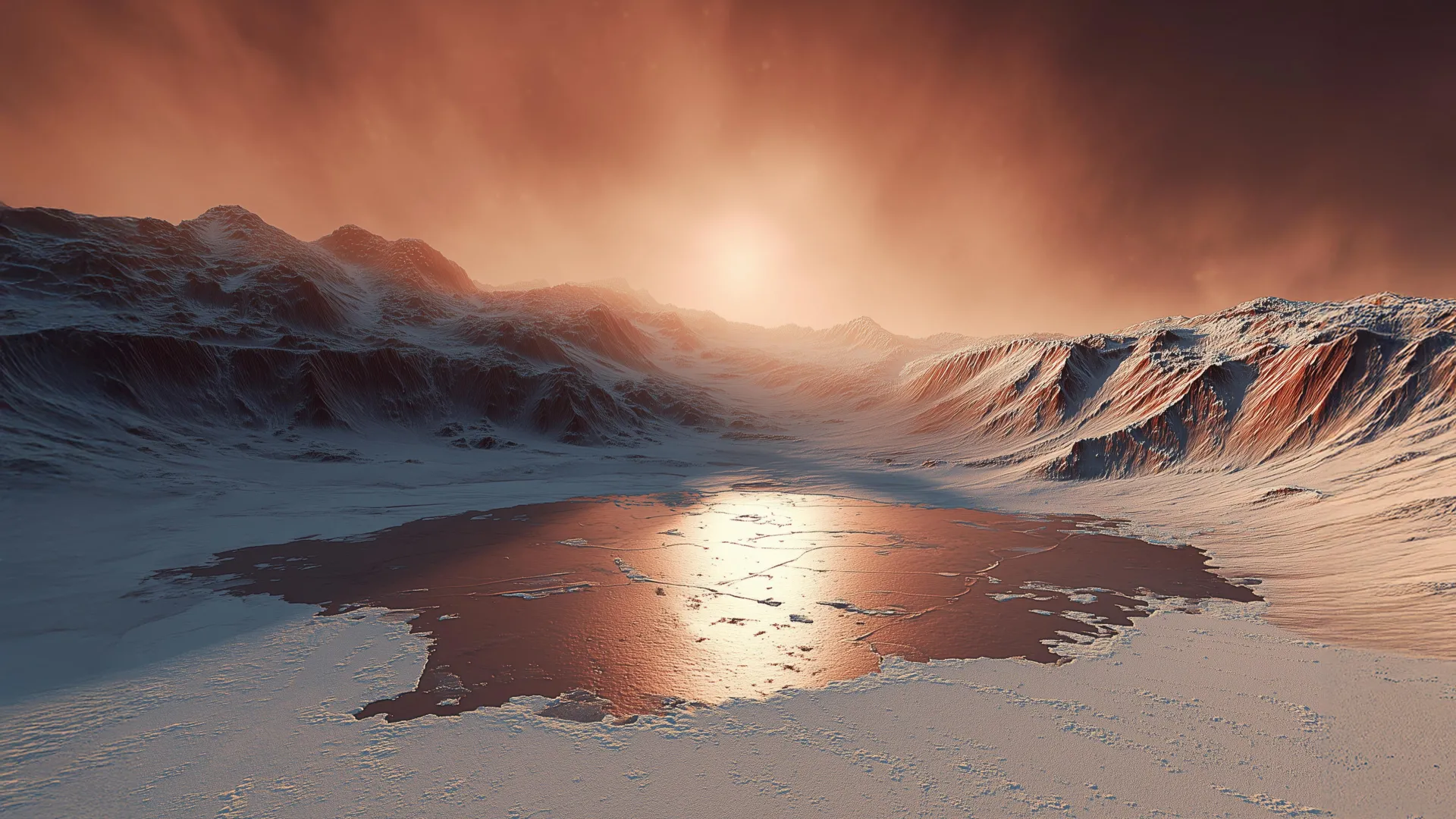
For eons, the enigma of liquid water on early Mars has perplexed planetary scientists. Despite compelling geological evidence of ancient rivers, deltas, and expansive lakebeds etching the Martian surface, prevailing climate models have consistently suggested an early Red Planet too frigid to sustain such features for prolonged periods. Now, groundbreaking research proposes a compelling resolution: small, ancient Martian lakes may have persisted for decades, even centuries, through a simple yet profound mechanism – the insulating power of thin, seasonal ice. This innovative perspective challenges the long-held assumption that a consistently warm early Martian climate was a prerequisite for long-lasting surface water, offering a more nuanced understanding of the planet’s hydrological past and its potential for ancient habitability.
The profound discrepancy between the geological record and atmospheric simulations has long been dubbed the "Mars water paradox." Orbiters and rovers, notably NASA’s Curiosity and Perseverance, have meticulously documented a wealth of features unmistakably shaped by flowing or standing water, including sedimentary rocks, hydrated minerals, and distinct shorelines within vast craters. Gale Crater, the landing site of the Curiosity rover, serves as a prime example, revealing extensive layered sediments indicative of a sustained lacustrine environment. Yet, standard climate models, accounting for the fainter young Sun and the planet’s distance, have struggled to produce conditions warm enough to prevent widespread freezing for more than fleeting periods. This paradox has spurred various hypotheses, from transient episodes of intense volcanism releasing greenhouse gases to a much denser carbon dioxide atmosphere, none of which have fully reconciled all observations. The new study offers a refreshingly elegant solution, suggesting that the very cold conditions often assumed for early Mars might not have precluded stable liquid water.
To navigate this complex problem, a team of scientists embarked on an ambitious modeling endeavor. They ingeniously adapted a sophisticated climate modeling framework, initially developed for Earth, to simulate the specific conditions of ancient Mars approximately 3.6 billion years ago. This framework, known as Proxy System Modeling, is typically employed to reconstruct Earth’s past climates using indirect environmental indicators such as tree rings or ice cores. On Mars, however, such terrestrial proxies are absent. Instead, the researchers leveraged data meticulously collected by robotic missions, particularly the geological and mineralogical findings from NASA’s Curiosity rover within Gale Crater. Rock formations and specific mineral deposits served as crucial "stand-ins" for a climate record, allowing the team to infer and input past environmental conditions into their adapted model.
The modification process was a meticulous multi-year undertaking, requiring significant adjustments to account for the unique planetary physics and atmospheric chemistry of ancient Mars. Key factors integrated into the model included the weaker solar luminosity impacting the young Sun, the prevalence of a carbon dioxide-rich atmosphere, and the distinct seasonal variations inherent to the Red Planet’s axial tilt and orbital eccentricity. Crucially, the team also had to recalibrate fundamental physical constants, such as gravity, to accurately reflect the Martian environment. This bespoke simulation tool, christened Lake Modeling on Mars with Atmospheric Reconstructions and Simulations (LakeM2ARS), represented a significant leap forward in understanding Martian paleohydrology.
Using LakeM2ARS, the research team executed 64 distinct test scenarios, each informed by existing Martian climate simulations and direct measurements from Curiosity in Gale Crater. Each scenario envisioned a hypothetical lake within the crater and tracked its evolution over a simulated period of 30 Martian years, equivalent to approximately 56 Earth years. This extensive set of simulations enabled a robust exploration of how Martian lakes might respond to varying atmospheric pressures, temperatures, and solar radiation, providing a comprehensive understanding of their potential for long-term stability under different environmental conditions. The flexibility and responsiveness of the model to these specific Martian parameters underscore the power of adapting Earth-centric scientific tools with creative ingenuity.
The simulations yielded a spectrum of outcomes, but a consistent and profoundly significant pattern emerged: in numerous scenarios, lakes, rather than freezing solid during colder seasons, maintained a liquid state beneath a remarkably thin, seasonal ice cover. This thin ice layer proved to be the linchpin of the entire mechanism. It functioned as a natural insulating lid, significantly curtailing evaporation and preventing the rapid loss of water to the tenuous Martian atmosphere. Concurrently, during the warmer periods of the Martian year, this ephemeral ice cover was thin enough to allow solar radiation to penetrate and warm the underlying liquid water, facilitating a seasonal melt-freeze cycle.
This dynamic interplay between seasonal ice formation and melting allowed some modeled lakes to maintain a remarkably stable depth over decades. The ice acted as a protective barrier in winter, preserving the liquid water, and then receded in summer, allowing for partial replenishment or sustained liquid conditions. This finding suggests that even when average ambient air temperatures plummeted far below freezing, the internal dynamics of these ice-covered lakes could support continuous liquid water. The temporary nature of this ice cover also offers an elegant explanation for why direct geological evidence of thick, perennial ice sheets or glaciers has not been extensively discovered in association with ancient Martian lakebeds. Such a thin, seasonally appearing and disappearing ice layer would leave minimal lasting geological signatures, resolving another long-standing observational puzzle.
The implications of this research are far-reaching, fundamentally challenging earlier assumptions about the conditions necessary for surface water on early Mars. If ancient lakes were indeed protected by dynamic, seasonal ice rather than requiring consistently warm, greenhouse-gas-rich periods or being buried under permanent glacial ice, many perplexing geological features on Mars become significantly easier to interpret. The well-preserved shorelines, the finely layered sediments indicative of gradual deposition, and the specific mineral deposits found in these ancient lakebeds are all consistent with stable, long-lasting lacustrine environments that endured despite an overall cold climate. This paradigm shift suggests that the Red Planet’s past may have been more amenable to liquid water, and thus potentially life, than previously considered.
Looking ahead, the researchers plan to expand the application of their LakeM2ARS model beyond Gale Crater, applying it to other prominent Martian basins known to host evidence of ancient paleolakes. This broader investigation will ascertain whether similar ice-insulated lakes could have been a widespread phenomenon across the planet. Furthermore, future iterations of the model will explore how variations in ancient atmospheric composition, such as different concentrations of carbon dioxide or methane, and the potential influence of groundwater flow, might have further impacted lake stability and longevity over geological timescales.
Should these patterns of ice-insulated liquid water prove to be pervasive across early Mars, the findings would significantly bolster the hypothesis that a cold early Mars could still have sustained year-round liquid water. Liquid water is universally recognized as a fundamental ingredient for the emergence and sustenance of life as we know it. This research therefore has profound implications for the field of astrobiology, potentially expanding the range of conditions under which habitable environments could arise on other planets and moons beyond Earth. By offering a physically plausible mechanism for enduring liquid water under cold conditions, this study opens new avenues for understanding the Red Planet’s environmental history and its potential to have harbored ancient microbial life, guiding future missions in their quest for biosignatures. This pioneering work, supported by the Rice Faculty Initiative Fund and the Canadian Space Agency, involved collaborative efforts from scientists at Rice University, the Jet Propulsion Laboratory at the California Institute of Technology, Brown University, and York University.



 Lisa Mariana
 Aura Kasih
 Safa Marwah