Ayu Aulia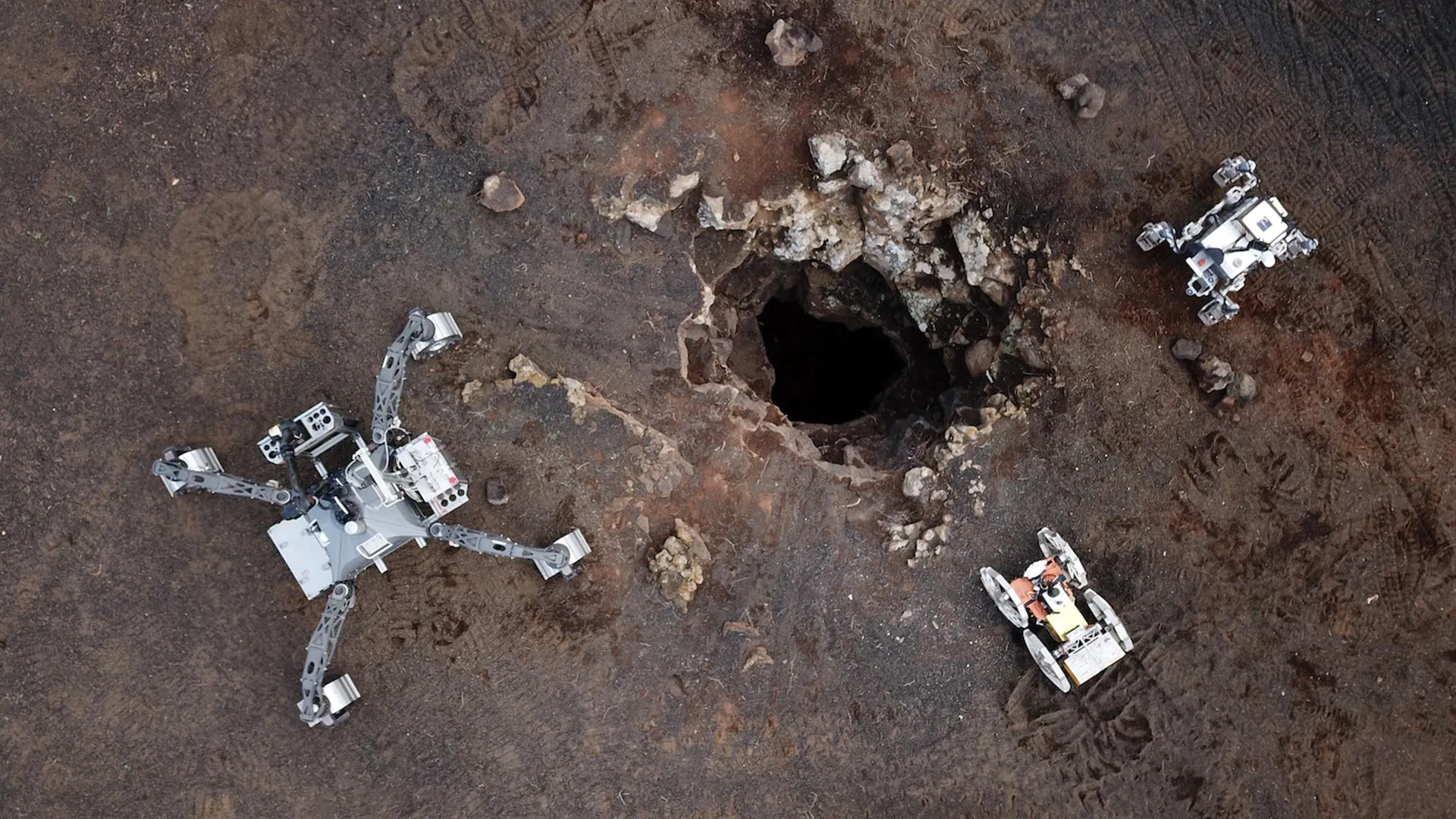
The quest for permanent human outposts beyond Earth increasingly focuses on the Moon and Mars, with natural subsurface formations emerging as prime candidates for future settlements. These extensive underground caverns, primarily volcanic lava tubes, offer invaluable protection against the severe environmental hazards prevalent on airless celestial bodies, including lethal cosmic radiation and incessant micrometeoroid bombardment. However, the inherent complexities of these subterranean realms—characterized by treacherous topography, restricted access points, and perilous conditions—pose formidable challenges to exploration and detailed analysis, necessitating innovative technological solutions.
To surmount these formidable obstacles and unlock the potential of extraterrestrial lava tubes, a collaborative European research consortium, prominently featuring the Space Robotics Laboratory at the University of Malaga, has engineered a groundbreaking mission architecture centered on autonomous robotic exploration. This sophisticated framework, recently detailed in the esteemed journal Science Robotics, deploys a synergistic fleet of three distinct robotic entities, designed to operate in concert without direct human supervision, meticulously surveying and generating high-fidelity three-dimensional maps of these challenging subterranean landscapes. Initial field trials are presently underway within analogous volcanic caves on Lanzarote, Spain, with the ultimate objective of deploying this advanced robotic system on lunar missions.
The Strategic Imperative of Subsurface Habitats
The rationale behind targeting lunar and Martian lava tubes for future human settlements is multifaceted and compelling. Surface environments on both the Moon and Mars are relentlessly exposed to a barrage of cosmic rays, high-energy solar particle events, and a continuous shower of micrometeorites. These threats pose significant health risks to astronauts, including increased cancer rates, neurological damage, and acute radiation sickness, while simultaneously degrading sensitive equipment and physical structures. Lava tubes, formed by ancient volcanic activity, provide a natural shield of overhead rock, capable of attenuating these hazardous phenomena significantly. Estimates suggest that even a few meters of regolith or basaltic rock can reduce radiation exposure to levels comparable to Earth’s surface, a critical factor for long-duration missions.
Beyond radiation and impact protection, these subterranean environments offer other crucial advantages. The extreme diurnal temperature swings on the Moon, for instance, can range from over 100°C in sunlight to below -170°C in shadow, imposing immense thermal stress on any surface infrastructure. Within lava tubes, temperatures are expected to remain remarkably stable, mitigating the need for energy-intensive heating and cooling systems for habitats. Furthermore, these geological features may harbor reservoirs of water ice, particularly in permanently shadowed regions or cold traps, which is indispensable for life support, propellant production, and scientific research. The scientific yield from exploring these pristine environments is also immense, potentially revealing insights into planetary geology, volcanic processes, and even the possibility of preserved biosignatures in the case of Mars.
Navigating the Unseen: Challenges of Subsurface Exploration
Despite their immense promise, the exploration of lunar and Martian lava tubes presents an array of unprecedented technical and operational hurdles. The rough, unpredictable terrain within these caverns—characterized by steep inclines, loose regolith, sharp volcanic rock, and potentially significant drops—is exceptionally difficult for conventional rovers to traverse. Entry points, often discovered as "skylights" or collapsed sections of the tube roof, can be narrow, unstable, and pose significant descent challenges. Moreover, the absolute darkness prevalent within these environments deprives robots of solar power and complicates visual navigation, demanding advanced artificial intelligence for autonomous operation.
Communication is another critical barrier. Radio signals struggle to penetrate solid rock, meaning traditional direct-to-Earth communication links would be unreliable or impossible deep within a tube. This necessitates the development of sophisticated relay networks, potentially involving multiple robots, to maintain contact with mission control. The time delay for communication with Earth (light-speed lag) also makes real-time teleoperation impractical, underscoring the indispensable requirement for highly autonomous systems capable of independent decision-making and error recovery. Any robotic system designed for this environment must be exceptionally robust, energy-efficient, and capable of operating for extended periods without human intervention.
A Multi-Robot Paradigm for Autonomous Subsurface Reconnaissance
The European consortium’s innovative mission concept directly addresses these challenges through a synergistic deployment of heterogeneous robotic agents. This paradigm recognizes that no single robot type can optimally perform all required tasks in such a complex environment. Instead, by leveraging specialized capabilities, a team of robots can collectively achieve objectives far beyond the scope of individual units. The core of this strategy lies in distributed intelligence and collaborative autonomy, allowing the robots to share sensor data, coordinate actions, and adapt to unforeseen circumstances as a cohesive unit.
The three distinct types of robots envisioned for this mission likely include:
- Surface Reconnaissance Rovers/Drones: Operating above ground, these units would map the exterior terrain, identify potential entry points (skylights), establish initial communication relays, and provide a global context for the subsurface mission.
- Deployment/Descent Units: Specialized for navigating the challenging entry points, these robots would be equipped for controlled rappelling or lowering of equipment into the tube.
- Subsurface Explorer Rovers: Designed for navigating the dark, confined, and rough terrain within the lava tube, these would be the primary data gatherers, equipped with advanced mapping and scientific instrumentation.
This collaborative approach enhances mission robustness through redundancy and task distribution, while maximizing scientific return by enabling specialized data collection.
The Four-Phase Exploration Protocol
The proposed mission unfolds in a meticulously structured four-phase sequence, each building upon the successful completion of the preceding stage, designed to progressively reduce risk and maximize exploratory efficiency:
-
Phase 1: Perimeter Mapping and Entrance Characterization. The mission commences with a thorough reconnaissance of the area immediately surrounding the lava tube entrance. Surface-based robots, potentially complemented by aerial drones for overhead perspective, cooperatively survey the exterior terrain, identifying the most stable and accessible entry points. This initial mapping effort is critical for assessing environmental hazards, establishing primary communication links, and creating a foundational spatial understanding of the mission zone. Advanced sensors, including LiDAR, stereoscopic cameras, and possibly ground-penetrating radar, are employed to generate high-resolution topographical maps and characterize the geological stability of the access points. This phase directly informs the subsequent safe deployment strategies.
-
Phase 2: Initial Subsurface Environmental Probing. Once an optimal entry point is identified, a specialized, sensor-laden payload cube is precisely deployed into the lava tube. This passive drop, often through a skylight, is designed to gather crucial initial environmental data without risking a mobile robotic asset. The cube’s instrumentation typically includes sensors for measuring ambient temperature, radiation levels, atmospheric composition (if any), and seismic activity. This preliminary data is invaluable for validating environmental models, assessing immediate hazards, and informing critical go/no-go decisions for subsequent, more complex robotic descents. It provides a first glimpse into the tube’s interior conditions, establishing a baseline for scientific investigation.
-
Phase 3: Controlled Descent and Interior Access. Following the successful acquisition of preliminary data, a dedicated scout rover undertakes the perilous descent into the lava tube. This phase often involves a controlled rappelling mechanism, allowing the rover to navigate steep inclines or vertical drops safely while simultaneously surveying the walls of the entry shaft. This specialized rover is engineered for extreme robustness and agile maneuverability in confined spaces. Its sensors continue to refine the environmental profile, while its navigation systems begin to map the immediate interior of the tube, ensuring a secure foothold for deeper exploration. The ability to control descent velocity and direction is paramount for preventing damage and maintaining stable communication.
-
Phase 4: Deep Exploration and Comprehensive 3D Mapping. With the scout rover established within the tube, the robotic team—potentially augmented by additional smaller, more specialized explorers or even micro-drones deployed from the scout—commences the in-depth exploration of the lava tube’s interior. This phase is dedicated to systematically traversing the subterranean environment, collecting extensive scientific data, and constructing highly detailed three-dimensional topographical maps. Techniques such as Simultaneous Localization and Mapping (SLAM) utilizing LiDAR and photogrammetry are critical for creating accurate models of the tube’s geometry, which are essential for future habitat planning, resource identification, and scientific analysis. Communication challenges deep underground are addressed through an adaptive mesh network established by the robots themselves, allowing data to be relayed efficiently back to the surface and ultimately to Earth.
Validation in Terrestrial Analogs: The Lanzarote Field Test
The technical viability and operational efficacy of this multi-robot mission concept were rigorously demonstrated during a comprehensive field test conducted in February 2023 within the volcanic caves of Lanzarote, Spain. The choice of Lanzarote was deliberate, as its unique geological formations provide an exceptional terrestrial analog for the lunar and Martian volcanic terrains, offering realistic conditions for testing the system’s capabilities.
The trial successfully validated several critical aspects of the mission architecture, including the autonomous navigation capabilities of the robots in complex, unstructured subterranean environments, the robustness of inter-robot communication protocols, the precision of sensor data fusion for mapping, and the operational integrity of deployment mechanisms. This real-world validation underscored the collective expertise of the European consortium, which is spearheaded by the German Research Center for Artificial Intelligence (DFKI), a global leader in AI and robotics, with significant contributions from the Space Robotics Laboratory at the University of Malaga and the Spanish aerospace company GMV, renowned for its work in mission planning and ground segment systems. The success of these trials marked a pivotal milestone, confirming the technical feasibility of the approach and laying a robust foundation for future extraterrestrial deployments.
Broader Implications for Planetary Exploration and Human Expansion
The successful demonstration of this mission concept extends far beyond the immediate goal of exploring lava tubes; it represents a profound validation of collaborative autonomous robotic systems as a transformative paradigm for future planetary exploration. The ability of diverse robots to work in concert, perceive their environment, make independent decisions, and execute complex tasks without continuous human oversight dramatically expands the scope and safety of missions to the Moon, Mars, and potentially beyond.
Such systems are instrumental in paving the way for human settlement by performing critical precursor tasks: identifying and characterizing safe landing zones, surveying potential habitat sites, prospecting for vital resources like water ice, and even constructing initial infrastructure elements before human arrival. By mitigating the inherent risks and increasing the efficiency of exploration, these robotic pioneers accelerate the timeline for sustainable human presence off-world. Moreover, the technologies developed for this mission—advanced autonomy algorithms, robust communication networks, precision navigation in GPS-denied environments, and highly specialized robotic mobility platforms—have broad applicability. They could be adapted for terrestrial uses such as hazardous environment inspection, disaster response, subterranean mining, and infrastructure monitoring, demonstrating the powerful spin-off potential of space research. Continued investment in such advanced robotic technologies is therefore not merely an investment in space exploration but also in future technological capabilities on Earth.
The Space Robotics Laboratory at UMA: A Nexus of Innovation and Education
The Space Robotics Laboratory at the University of Malaga (UMA) plays a pivotal role in this international endeavor, serving as a vital hub for the advancement of space robotics autonomy. The laboratory’s core mission is to innovate new methodologies and technologies that empower space robots—whether destined for planetary surfaces or orbital operations—to operate with unprecedented levels of independence. This includes the development of sophisticated algorithms for path planning, obstacle avoidance, precise localization, environmental perception, and intelligent task allocation, all critical components for autonomous mission success in unpredictable space environments.
In recent years, the UMA laboratory has forged a close partnership with the European Space Agency (ESA), contributing significantly to the development of next-generation guidance, navigation, and control systems for planetary exploration vehicles. Their work has focused on enabling rovers to chart optimal routes and execute complex maneuvers with minimal human intervention, thereby enhancing mission efficiency and robustness against communication delays or unforeseen challenges.
Beyond its cutting-edge research, the Space Robotics Laboratory at UMA is deeply committed to nurturing the next generation of space robotics engineers. Students from the School of Industrial Engineering at UMA are actively engaged in this pioneering work through internships, thesis projects, and direct participation in research initiatives. This hands-on experience provides invaluable practical training, bridging academic theory with real-world engineering challenges. The collaborative nature of the laboratory’s work is further emphasized by its extensive network of national and international partnerships, fostering joint research efforts and facilitating technology transfer agreements with leading aerospace companies and research organizations, thereby ensuring that the innovations developed at UMA contribute directly to the global advancement of space exploration. The synergy between research, education, and international collaboration positions UMA as a key contributor to the future of autonomous space missions.



 Lisa Mariana
 Aura Kasih
 Safa Marwah