Ayu Aulia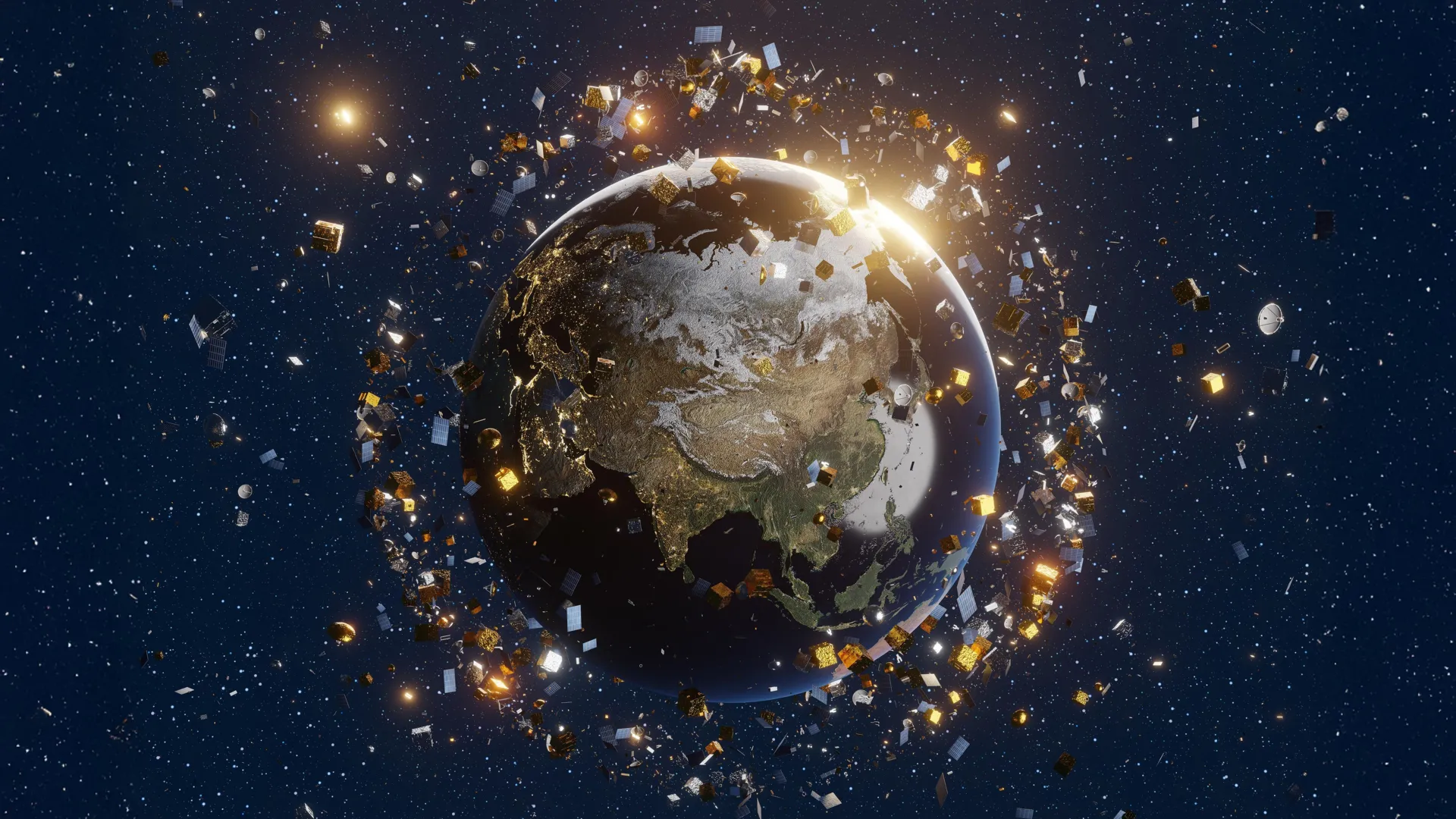
The burgeoning proliferation of satellite mega-constellations in Low Earth Orbit (LEO) has introduced an unprecedented level of connectivity and data transfer, yet recent analytical findings suggest this increasingly crowded domain exists in a state of precarious equilibrium, susceptible to rapid destabilization from solar phenomena, potentially leading to catastrophic orbital debris generation within a matter of days.
Humanity’s reliance on space-based infrastructure has grown exponentially over the past decade. From global internet provision and precision navigation to weather forecasting and national security, an intricate web of satellites underpins critical terrestrial functions. The advent of mega-constellations, comprising thousands of interconnected spacecraft, has democratized access to satellite services and spurred technological innovation. However, this rapid expansion has also transformed LEO into a congested environment, presenting novel challenges for orbital management and long-term sustainability. The density of operational satellites has reached a point where the margin for error has significantly diminished, creating a system where routine operations require continuous, sophisticated intervention to prevent widespread collision.
Statistical analyses underscore the inherent fragility of this crowded orbital domain. Across the entirety of LEO mega-constellations, instances of objects passing within one kilometer of each other are alarmingly frequent, occurring approximately every 22 seconds. Within the largest of these networks, such proximity events are registered roughly every 11 minutes. To maintain operational integrity and mitigate collision risks, individual satellites within these constellations are compelled to execute an average of over forty orbital adjustments annually. While these maneuvers currently avert disaster, their sheer frequency signals a system operating under constant stress, where automated collision avoidance systems are perpetually engaged in a complex, high-stakes ballet. This constant state of preventative action, while demonstrating the current system’s capacity to react, also highlights the narrow tolerances within which these vast networks must operate.
The Peril of Anomalous Conditions
While the robust performance of collision avoidance systems under typical operating conditions offers a measure of reassurance, engineering principles dictate that systemic vulnerabilities often manifest not during routine operations, but when confronted with anomalous or extreme scenarios. These "edge cases" test the limits of design and expose unforeseen weaknesses. In the context of LEO mega-constellations, solar events represent a particularly potent and unpredictable edge case, capable of disrupting the delicate balance that maintains orbital stability.
Solar storms, powerful eruptions of energy and matter from the sun, primarily impact satellites through two distinct but compounding mechanisms. The first involves significant alterations to Earth’s upper atmosphere, while the second directly compromises satellite operational integrity.
Atmospheric Perturbations and Enhanced Drag
When a solar storm’s energetic particles and radiation interact with Earth’s magnetosphere, they deposit energy into the upper atmosphere. This deposition causes the atmosphere to heat and expand, increasing its density at orbital altitudes. Consequently, satellites experience significantly enhanced atmospheric drag. This increased resistance forces spacecraft to consume more propellant to maintain their designated orbits, accelerating fuel depletion and shortening operational lifespans. More critically, the dynamic and unpredictable nature of this atmospheric expansion introduces substantial uncertainty into precise orbital predictions. Satellites, already navigating a congested environment, become harder to track accurately, necessitating an even greater frequency of avoidance maneuvers. A notable solar event in May 2024, for instance, compelled more than half of all LEO satellites to expend valuable fuel reserves on such adjustments, illustrating the pervasive impact of even moderate space weather. The cumulative effect of these atmospheric perturbations is a heightened risk of uncontrolled drift and an elevated probability of unintentional proximity events, even for well-managed constellations.
Compromised Control and Communication
Beyond atmospheric heating, solar storms pose a direct threat to the electronic systems aboard satellites. The intense radiation and electromagnetic disturbances generated during these events can interfere with, degrade, or even completely disable critical satellite navigation, communication, and command systems. If a satellite’s ability to receive ground commands or transmit its own status is compromised, it becomes effectively blind and unresponsive. When this loss of control occurs concurrently with increased atmospheric drag and heightened orbital uncertainty, the potential for a catastrophic incident escalates dramatically. A non-responsive satellite, drifting unpredictably within a crowded orbital plane, becomes an uncontrollable hazard, a rogue element capable of initiating a destructive chain reaction.
Quantifying the Imminence of Disaster
The most dire long-term consequence of widespread orbital collisions is the hypothetical Kessler Syndrome, a scenario where accumulating debris renders LEO unusable for generations. While Kessler Syndrome describes a process unfolding over decades, researchers have developed a novel metric, termed the Collision Realization and Significant Harm (CRASH) Clock, to quantify the much shorter timescale over which a crisis could rapidly manifest. This metric provides a stark assessment of the immediate danger posed by a systemic failure in collision avoidance.
According to this analysis, as of mid-2025, a complete and sustained loss of command and control over satellite avoidance maneuvers would precipitate a major, cascading collision event within approximately 2.8 days. This figure stands in stark contrast to the pre-mega-constellation era of 2018, when similar conditions would have allowed for an estimated 121 days before such an incident. The acceleration of risk is profound. Furthermore, the analysis reveals that even a temporary loss of control, lasting a mere 24 hours, carries a 30% probability of initiating a significant collision capable of triggering the destructive feedback loop that characterizes Kessler Syndrome. These figures underscore the extreme time sensitivity of maintaining active control in today’s LEO environment.
Limited Foresight, Critical Window
A significant challenge in mitigating the risks posed by solar storms is the inherently limited predictability of these events. Current space weather forecasting capabilities often provide only a day or two of advance warning, at best. This narrow window offers operators minimal time to implement protective measures beyond attempting to safeguard vulnerable systems. The dynamic and rapidly evolving atmospheric conditions during a severe solar storm necessitate continuous, real-time monitoring and control of satellite constellations. Should this real-time command capability be lost, the research indicates an extremely narrow window—potentially just a few days—to restore it before the entire system risks irreparable damage through cascading collisions.
This concern is not merely theoretical. While a prominent solar event in 2024 was among the strongest in recent memory, it pales in comparison to the Carrington Event of 1859, the most powerful solar storm in recorded history. If an event of similar magnitude were to occur today, it could disrupt satellite control and communication for a duration far exceeding the critical three-day threshold identified by the CRASH Clock. A single, historically plausible event of this scale could inflict severe, long-lasting damage to global satellite infrastructure, potentially restricting humanity’s access to space for decades or even centuries.
Navigating the Future of Space Utilization
The benefits derived from satellite mega-constellations—global connectivity, enhanced data collection, and expanded access to space-based services—are undeniable and transformative. However, these technological advancements have introduced a new class of systemic risk, one that challenges the long-term viability of orbital operations. A comprehensive and realistic understanding of these inherent dangers is paramount for responsible space governance and sustainable utilization.
The potential outcome of widespread orbital collapse—the loss of access to space for future generations due to a single, extreme solar event—demands urgent attention and informed decision-making. This analytical work provides critical insights into the fragility of current LEO architectures, highlighting the accelerated timeline of potential disaster and the profound implications of systemic failure. As humanity’s presence in space continues to expand, proactive strategies encompassing enhanced space weather forecasting, robust satellite design, resilient command and control systems, and internationally coordinated traffic management are no longer merely desirable but essential for safeguarding the orbital commons and ensuring continued access to the benefits derived from space. The risks are substantial and can no longer be overlooked in the calculus of space exploration and utilization.



 Lisa Mariana
 Aura Kasih
 Safa Marwah