Safa Marwah
A meticulously orchestrated cyber espionage operation, attributed to a sophisticated China-aligned threat collective, has been observed actively exploiting a severe vulnerability within Tencent’s widely adopted Sogou Input Method for Windows. This critical security lapse, identified as CVE-2026-51990, allowed attackers to execute remote code with a single user interaction, facilitating the deployment of a potent backdoor known as GrayRabbit. The campaign underscores the persistent threat posed by nation-state actors targeting popular consumer software for strategic objectives, highlighting significant supply chain risks and the imperative for robust security postures in software development.
Exploiting a Pervasive Platform: The Sogou Input Method Vulnerability
Tencent’s Sogou Input Method is a dominant application in China, boasting hundreds of millions of installations. Its primary function is to enable users to input Chinese characters using standard keyboards, but its architecture includes a custom link handler and an integrated web browser component. Cybersecurity researchers recently uncovered a critical flaw within this application, categorizing it as a one-click remote code execution (RCE) vulnerability. This classification signifies the extreme ease with which an attacker can compromise a system; a user merely needs to click a specially crafted link to initiate the attack sequence, granting the attacker arbitrary code execution capabilities on the victim’s machine.
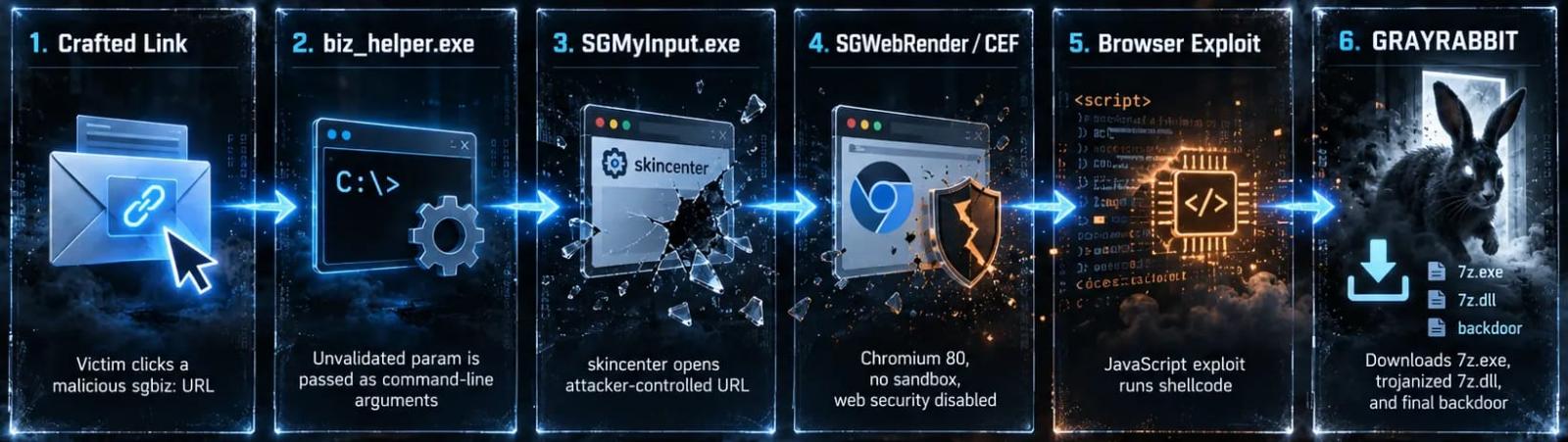
The investigation revealed that the threat group, designated UNC3569, meticulously crafted a multi-stage attack chain to exploit this vulnerability. The initial vector leveraged the application’s custom URI scheme, sgbiz:. When a victim clicks a malicious link embedded with this custom URI, the Windows operating system invokes Sogou’s biz_helper.exe protocol handler. Crucially, this handler was found to pass attacker-controlled command-line arguments directly to the legitimate SGMyInput.exe executable without proper validation. This lack of input sanitization is a fundamental security flaw, allowing an attacker to dictate the subsequent actions of the application.
In the second phase of the attack, the maliciously injected arguments directed SGMyInput.exe to open Sogou’s skincenter component. This component, in turn, utilizes an embedded Chromium webview to load content. The critical oversight here was that Sogou did not impose any restrictions on the URL scheme or destination for this embedded browser. This allowed UNC3569 to instruct the skincenter to load an arbitrary, attacker-controlled URL, effectively redirecting the user’s application to a malicious web page.
The final and most critical stage of the attack chain exploited a known vulnerability within the outdated Chromium 80 engine embedded within Sogou’s skincenter. The use of an antiquated browser engine is a significant security lapse, as older versions are often rife with publicly documented vulnerabilities that have long since been patched in more current iterations. Compounding this issue, the embedded browser was observed running without a sandboxing mechanism and with crucial web-security protections disabled. Sandboxing is a fundamental security isolation technique that prevents malicious code executed within a browser from affecting the rest of the operating system. Its absence, combined with disabled security features, created an environment ripe for exploitation. Consequently, the malicious web page loaded in the skincenter could easily leverage a known Chromium 80 exploit to achieve full code execution on the victim’s system, paving the way for the installation of the GrayRabbit backdoor.
GrayRabbit: A Modular and Evolving Espionage Tool
The payload delivered through this sophisticated attack chain is the GrayRabbit backdoor, a modular malware family previously documented by cybersecurity researchers. Early analyses in 2024 had already linked GrayRabbit to UNC3569, characterizing it as a versatile tool employed by a China-based threat actor known to operate across both cybercrime and state-sponsored espionage ecosystems. This dual operational capability suggests a highly resourced and adaptable adversary, capable of leveraging tactics and infrastructure from both spheres.

The specific GrayRabbit sample analyzed in the context of the Sogou Input Method exploitation exhibited enhanced sophistication. It was identified as a more mature 64-bit variant, indicating ongoing development and refinement by its creators. This version incorporated an expanded command set, providing attackers with a broader array of functionalities to exert control over compromised systems. Furthermore, its command-and-control (C2) configuration was found to be encrypted using the RC4 algorithm, a common technique employed by threat actors to obscure communication with their infrastructure and evade detection.
The capabilities embedded within the GrayRabbit backdoor are extensive and indicative of a tool designed for long-term espionage and persistent access. These capabilities include:
- Process Execution: The ability to launch arbitrary processes on the compromised system, allowing for the deployment of additional tools or execution of specific commands.
- Interactive Reverse Shells: Establishing a direct, interactive command-line interface from the victim’s machine back to the attacker’s server, granting real-time control.
- File Manipulation: Comprehensive functions for uploading and downloading files, enabling exfiltration of sensitive data and introduction of further malicious payloads.
- System and User Information Collection: Harvesting extensive details about the compromised system’s configuration, installed software, network settings, and user data.
- Reflective Plugin Loading: The capacity to load additional malicious modules or plugins directly into the host’s memory without writing them to disk, a stealthy technique designed to evade traditional endpoint detection mechanisms.
The breadth of these functionalities confirms GrayRabbit as a highly capable espionage tool, designed to establish persistent access, gather intelligence, and facilitate lateral movement within compromised networks.
The Threat Actor: UNC3569’s Strategic Objectives
UNC3569, the threat group behind this campaign, is a significant entity within the landscape of state-sponsored cyber operations. Their classification as a China-aligned espionage group strongly suggests that their objectives are aligned with national intelligence priorities, potentially involving intellectual property theft, political intelligence gathering, or surveillance of specific individuals or organizations. The targeting of Sogou Input Method, with its enormous user base predominantly within China, raises several strategic possibilities. It could be used for internal surveillance against specific dissidents, journalists, or government officials, or to target foreign entities and individuals who utilize the software for engagement with Chinese counterparts. The group’s reported presence in both cybercrime and "cyber contractor-for-hire" ecosystems further complicates attribution and motivations, suggesting a flexible operational model that can adapt to various mission requirements. This flexibility allows them to leverage a wider range of resources and tactics, making them a formidable adversary.
Broader Implications and Systemic Security Concerns
This incident serves as a stark reminder of the pervasive risks associated with vulnerabilities in widely adopted software, particularly those developed by major technology companies. The exploitation of Sogou Input Method by UNC3569 highlights several systemic security concerns:
- Supply Chain Vulnerability: Applications like Sogou Input Method, embedded deep within the digital infrastructure of millions, represent critical points of failure in the software supply chain. A vulnerability in such a foundational piece of software can lead to widespread compromise, affecting individuals and organizations globally.
- Outdated Components: The reliance on an outdated Chromium 80 engine, which has known vulnerabilities, is a severe security misstep. Software developers, especially those responsible for applications with vast user bases, have a responsibility to keep third-party components updated and patched. Neglecting this leads to a build-up of technical debt and a growing attack surface.
- Compromised Security Features: The decision to run the embedded browser without a sandbox and with critical web security protections disabled is particularly egregious. These features are fundamental safeguards designed to prevent the exact type of RCE exploit witnessed in this campaign. Their deactivation indicates either a profound lack of security awareness or a deliberate choice that prioritized functionality or performance over security.
- Geopolitical Context: The involvement of a China-aligned group targeting a Chinese application adds a layer of geopolitical complexity. While the immediate victims might be individual users, the ultimate targets could be specific entities, intellectual property, or broader intelligence objectives. This underscores the need for users, particularly those engaged in sensitive work or residing in targeted regions, to be acutely aware of the software they use.
Vendor Response and Lingering Risks
Upon receiving the detailed findings from cybersecurity researchers on April 9, Tencent initiated an investigation and subsequently released a patch. The updated Sogou Input Method version 16.3.0.3498, deployed on April 21, addressed key aspects of the vulnerability. The patch implemented validation for URL arguments accepted through the protocol handler, enforcing strict HTTPS requirements and restricting navigation to a whitelist of approved domains associated with Sogou and Tencent. These measures are critical in preventing the initial stages of the attack chain by limiting the ability of attackers to inject arbitrary URLs.
However, researchers issued a significant caveat: while the immediate exploitation vector was mitigated, the underlying architectural weaknesses persist. The embedded Chromium browser remains outdated and continues to operate without a sandbox, with many essential web security protections still disabled. This means that while the specific attack chain identified by UNC3569 has been disrupted, the fundamental vulnerabilities that made it possible—the outdated browser engine and the disabled security features—remain unaddressed. This creates a lingering attack surface that sophisticated threat actors could potentially exploit through different means in the future. Without a comprehensive overhaul of this component, users of Sogou Input Method will continue to face elevated risks from novel attack techniques that bypass the current patch.
Future Outlook and Mitigation Strategies
The incident with Sogou Input Method and GrayRabbit serves as a critical case study for cybersecurity resilience. For individuals, the immediate recommendation is to ensure that Sogou Input Method is updated to version 16.3.0.3498 or later. Beyond this specific patch, users must maintain general cybersecurity hygiene, including exercising extreme caution when clicking unfamiliar links, especially those using custom URI schemes. Regular software updates for all applications, operating systems, and browsers are paramount.
For software developers, this event underscores the vital importance of secure development lifecycle practices. This includes:
- Proactive Vulnerability Management: Regularly auditing code, especially third-party components, for known vulnerabilities and promptly applying patches or updating to newer, more secure versions.
- Principle of Least Privilege: Designing applications to run with the minimum necessary privileges and ensuring that embedded components operate within secure, sandboxed environments.
- Input Validation: Implementing robust input validation mechanisms for all user-supplied or externally sourced data, including command-line arguments and URI schemes.
- Security by Design: Integrating security considerations from the initial design phase of software development, rather than attempting to bolt them on as an afterthought.
For organizations, a multi-layered defense strategy is essential. This includes comprehensive asset management to identify all deployed software, rigorous vulnerability management programs to track and remediate weaknesses, and robust endpoint detection and response (EDR) solutions to identify and neutralize sophisticated threats like GrayRabbit. Employee training on phishing and social engineering tactics remains a critical component of defense.
The continuous evolution of sophisticated threat actors like UNC3569, coupled with the inherent complexities of modern software development, guarantees that such exploitation campaigns will persist. The Sogou Input Method incident serves as a stark reminder that vigilance, proactive security measures, and a commitment to addressing fundamental architectural weaknesses are non-negotiable requirements in the ongoing battle against cyber espionage. The long-term security of users hinges on software vendors fully addressing underlying vulnerabilities, not just patching immediate exploitation vectors.




 Aura Kasih
 Ayu Aulia