 Aura Kasih
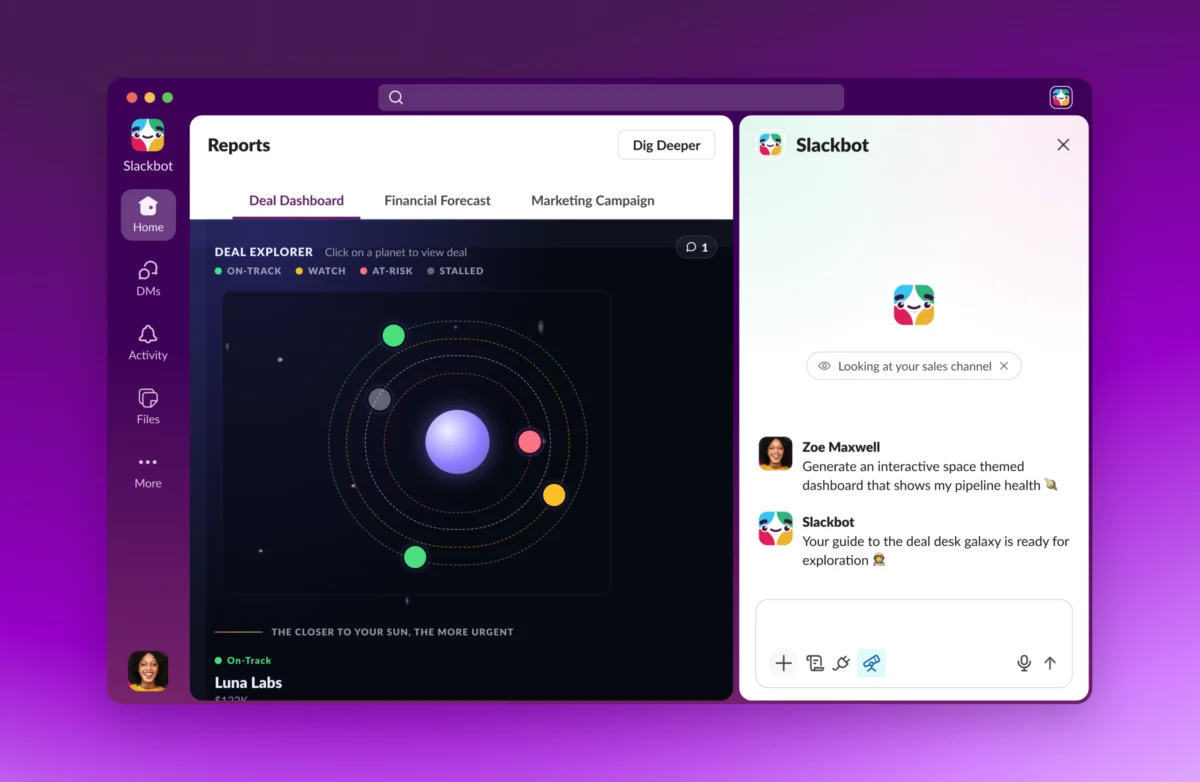
Slack is ushering in a new era of collaborative data interaction with the introduction of "Slackforce Surfaces," a groundbreaking feature designed to embed dynamic reports, polls, dashboards, presentations, and even microsites directly within chat conversations. This innovative tool empowers users to leverage AI to transform raw data into actionable insights, all without leaving the familiar Slack interface.
This significant development marks a pivotal moment in how teams manage and interpret information, moving beyond static documents and siloed applications. Slackforce Surfaces aims to democratize data access and analysis, making it an integral part of daily workflows. The core of this functionality lies in the enhanced capabilities of Slackbot, which now acts as an intelligent engine for data synthesis and presentation. Users can simply articulate their data needs to Slackbot, specifying the desired output and the context. The AI then intelligently scours relevant conversations and integrated applications – such as Google Drive, Salesforce, or other enterprise software – to gather the necessary information.
The result is a "Surface," a live, interactive digital asset that can be shared seamlessly with colleagues. These Surfaces can be pinned to specific channels, ensuring that relevant team members have immediate access to critical data. The interactive nature of these Surfaces is a key differentiator. Unlike static screenshots or exported files, colleagues can directly engage with the presented information, drill down into specific data points, and even leave comments and annotations, fostering a truly collaborative analytical environment.
Imagine a sales team needing to track real-time performance against quarterly targets. Instead of manually compiling spreadsheets and sending them via email, a team member could instruct Slackbot to create a live sales dashboard. This dashboard, powered by data pulled from their CRM and communication channels, could visualize key metrics like deal closures, pipeline value, and individual rep performance. Colleagues could then interact with the dashboard, filtering by region, product, or time period, and leave feedback directly on specific deals or trends.
Ryan Gavin, Slack’s Chief Marketing Officer, articulated the strategic intent behind this advancement, stating, "You’re not exporting your data to some other tool to make sense of it; you’re asking Slackbot to build the dashboard, the deck, the report right where the conversation already is, and your whole team can act on it together." This sentiment underscores Slack’s commitment to keeping information and action within the context of where work happens. By eliminating the need to switch between multiple applications, Slackforce Surfaces aims to reduce friction, enhance productivity, and accelerate decision-making cycles.
This launch follows a series of strategic enhancements to Slackbot’s AI capabilities. Just months prior, Slack underwent a significant overhaul of its native bot, transforming it into a more robust AI assistant. This previous iteration empowered Slackbot to perform tasks such as summarizing lengthy conversation threads, efficiently sorting through messages, and even assisting with meeting scheduling. The introduction of collaborative "vibe coding" channels last month further signals Slack’s intent to weave more sophisticated, AI-driven functionalities into the fabric of its platform. The integration of Surfaces builds directly upon this foundation, evolving Slackbot from an assistant into a powerful data creation and visualization tool.
The potential applications for Slackforce Surfaces extend far beyond sales reporting. Consider a customer support team managing a high volume of inquiries. A live dashboard could be generated, displaying real-time ticket volumes, resolution times, customer satisfaction scores, and agent availability. This would provide supervisors and team members with an immediate, comprehensive overview of the support queue, enabling proactive resource allocation and identification of potential bottlenecks.
Another compelling use case could be in financial forecasting. A weather-themed financial forecast, for instance, could dynamically pull data from various connected financial applications, economic indicators, and even relevant news feeds. This would allow for a more engaging and contextualized understanding of market trends and their potential impact. Slack emphasizes that the AI’s data retrieval will strictly adhere to user-defined permissions, ensuring that sensitive information remains protected and only accessible where explicit consent has been granted.
Slackforce Surfaces is designed for broad accessibility, being available to all Slack customers, including those utilizing the free tier, provided Slackbot is enabled within their workspace. The real-time data integration aspect of this feature is slated for activation starting in October, indicating a phased rollout of its full capabilities. This inclusive approach suggests a strategic effort to embed these powerful new data tools across a wide spectrum of businesses and organizations, regardless of their subscription level.
The implications of this feature are profound for the modern workplace. In an era where data proliferation is a constant challenge, the ability to distill complex information into easily digestible and interactive formats directly within communication channels offers a significant competitive advantage. Organizations can foster a more data-informed culture by making insights readily available and actionable for all team members.
From a strategic perspective, this move positions Slack as a more central hub for enterprise operations, moving beyond its initial role as a communication tool. By integrating data visualization and reporting directly into its ecosystem, Slack is challenging traditional business intelligence platforms and analytical tools. This could lead to a more consolidated and streamlined technology stack for many companies, reducing reliance on third-party applications and the associated costs and complexities.
The AI-driven nature of Surfaces is particularly noteworthy. It lowers the barrier to entry for data analysis, empowering individuals who may not have specialized data science skills to generate meaningful insights. This democratization of data analysis can unlock new perspectives and drive innovation from all levels of an organization. The ability for Slackbot to learn from conversations and context further refines its data gathering and presentation capabilities over time, promising an increasingly intelligent and personalized experience for users.
Looking ahead, the continued evolution of Slackforce Surfaces could see even more sophisticated AI integrations. We might anticipate predictive analytics capabilities, automated anomaly detection, and the generation of prescriptive recommendations based on the analyzed data. The potential for integrating with an even wider array of enterprise applications, from HR systems to project management tools, could create a truly comprehensive digital workspace where data informs every aspect of collaboration and decision-making.
The success of Slackforce Surfaces will likely depend on several factors, including the accuracy and reliability of its AI in interpreting user requests and retrieving data, the intuitiveness of the user interface for interacting with the generated Surfaces, and the seamlessness of its integration with existing enterprise software ecosystems. However, the underlying promise of transforming how teams access, understand, and act upon information within their daily workflows is a compelling one, positioning Slack at the forefront of a new wave of intelligent, collaborative work environments. This development represents a significant step towards a future where data is not just analyzed, but is an active, dynamic participant in the conversation.


 Safa Marwah

 Lisa Mariana